
Table of Contents
- Immediate Actions: What to Do After a Car Accident
- Car Accident Checklist: Essential Information to Gather
- Car Accident Injuries: When to Seek Medical Evaluation
- Insurance Claim After Car Accident: Notification and Documentation
- Car Accident Legal Advice: Protecting Your Rights
- Digital Evidence Preservation and Photo Documentation
- Common Mistakes to Avoid and What Not to Say
- Getting Professional Assistance: When to Call a Towing Service
- Frequently Asked Questions
What to Do After a Car Accident: Step-by-Step Guide
Last Updated: July 28, 2026
When you’re involved in a car accident, the first few minutes matter enormously. Knowing what to do can mean the difference between protecting yourself legally and financially or facing serious consequences. At Fast Towing San Diego, we’ve responded to thousands of accident scenes and seen firsthand how proper immediate actions protect drivers. This guide walks you through every critical step, from impact through insurance claims and recovery.
Immediate Actions: What to Do After a Car Accident
Your first priority after any collision is safety. Before exchanging information or taking photos, assess the situation and move to safety if possible.
Check for injuries and move to safety
Check yourself and any passengers for injuries immediately. Ask passengers directly: “Are you hurt?” Some injuries like whiplash or internal bleeding aren’t immediately obvious.
If the accident was minor and your vehicle is drivable, move it out of traffic. Turn on hazard lights and steer to the shoulder or nearby parking lot. If your car won’t move or the accident was severe, stay inside with your seatbelt on.
If anyone is injured or the accident involved a large vehicle, stay put and call 911. Do not attempt to move an injured person unless there’s immediate fire or safety hazard.
Never exit your vehicle into oncoming traffic. More accidents happen at accident scenes than at the original collision. Stay visible and safe.
Call 911 if necessary
Call 911 if anyone is injured, there’s significant property damage, a vehicle is disabled in traffic, you suspect impairment, the other driver is aggressive, or it’s a hit and run.
For minor accidents with both vehicles drivable and no injuries, you can exchange information without police. However, calling creates an official record valuable if the other driver later disputes what happened or injuries emerge days later.
Car Accident Checklist: Essential Information to Gather
Once everyone’s safety is confirmed, document everything. The information you collect becomes evidence for your insurance claim and any potential legal action.
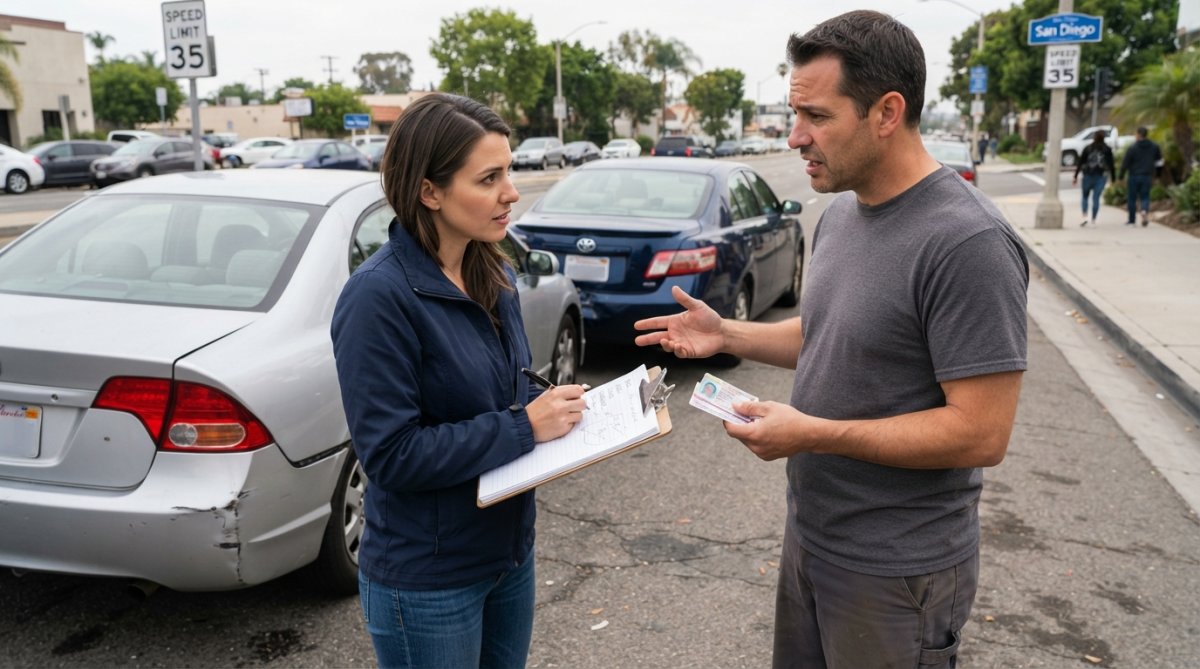
Exchange information with other drivers
Get from every driver involved:
- Full name and phone number
- Address
- Driver’s license number and state
- Vehicle make, model, year, and color
- License plate number
- Insurance company name and policy number
- Vehicle identification number (VIN)
Write this down or photograph their documents. Also ask if they were on the clock (for commercial vehicles) and whether they have a dashcam.
If the other driver refuses to provide information or becomes aggressive, return to your vehicle, lock the doors, and wait for police.
Photograph the other driver’s insurance card and license directly. Photos capture exact policy numbers and expiration dates better than handwritten notes.
Collect witness statements
Get contact information from anyone who witnessed the accident. Ask what they saw, whether they watched the moment of impact, which driver had the green light, and if anyone was speeding. Get their full name, phone number, and email. Request written statements via email when possible.
Document the accident scene
Take photos and video of:
- Overall accident scene (wide shot showing both vehicles)
- Each vehicle’s damage (multiple angles, close-ups)
- Accident location (intersection, street name, traffic signals, road conditions)
- Weather and road conditions
- Traffic signals and road markings
- Skid marks or debris
- Vehicle positions after collision
Take at least 20-30 photos from multiple angles and distances. Document the time, date, and location in your phone’s notes immediately.
Car Accident Injuries: When to Seek Medical Evaluation
Not all injuries are obvious at the scene. Some serious injuries emerge hours or days later. Many accident victims skip medical evaluation and regret it when symptoms develop.
Visible vs. delayed injury symptoms
Whiplash, concussions, and internal injuries often don’t show symptoms for 24-48 hours. You might feel fine at the scene and wake up with severe neck pain, headaches, or dizziness.
Watch for:
- Headaches or dizziness
- Neck or back pain
- Stiffness or reduced range of motion
- Numbness or tingling
- Nausea or vision changes
- Difficulty concentrating
- Sleep disturbances
- Mood changes or anxiety
If you experience any of these, seek medical evaluation even if you felt fine at the scene. Document when symptoms started. Get a medical report stating symptoms are consistent with accident-related injury. Medical bills are covered by the at-fault driver’s liability insurance or your own coverage.
Mental health and emotional recovery
Car accidents are traumatic. Many victims experience anxiety, PTSD, depression, or driving phobia afterward. If you find yourself anxious about driving, having nightmares, or avoiding roads where the accident occurred, consider speaking with a therapist. Document these experiences in writing, they strengthen pain and suffering claims.
Insurance Claim After Car Accident: Notification and Documentation
Your insurance company needs to know about the accident quickly. Delays can give insurers grounds to deny claims.
Timing your insurance notification
Call your insurance agent or claims line within 24 hours. Most policies require prompt notification. Have ready: your policy number, the other driver’s information, accident date/time/location, a brief description, the police report number, and photos.
Do not speculate or admit fault. Stick to facts: “I was traveling northbound on Main Street. The other vehicle pulled out from a side street. We collided at the intersection.” Let the insurance company investigate and determine fault.
What to tell your insurance agent
INCLUDE:
- Objective facts (time, location, road conditions, weather)
- What you observed (other vehicle’s position, traffic signals)
- Injuries you experienced (describe symptoms, not severity)
- Damage to your vehicle (general description; photos provide detail)
AVOID:
- Admissions of fault (“I think I might have been going fast”)
- Uncertainty (“I’m not sure who had the right of way”)
- Opinions (“The other driver seemed distracted”)
- Detailed medical descriptions (let medical records speak)
- Anything you’re unsure about
Insurance adjusters identify inconsistencies. Stick to what you directly observed. If unsure, say so.
Preventing claim denial
Insurance companies deny claims for specific reasons:
- Late notification: Report within 24 hours
- Inconsistent statements: Stick to the same facts with police and insurance
- Failure to cooperate: Provide photos, medical records, and repair estimates promptly
- Excluded drivers: Ensure all regular drivers are listed on your policy
- Policy lapse: Check your policy status immediately
- Misrepresentation: Be honest on policy applications
- Unrelated damage: Only claim damage from this accident
Thorough documentation, photos, witness statements, medical records, and police reports, makes it harder for insurers to deny legitimate claims.
Car Accident Legal Advice: Protecting Your Rights
Most minor accidents are resolved through insurance without legal involvement. But some situations require legal counsel.
When to contact legal counsel
Consult an attorney if:
- You’re seriously injured (medical bills exceed $10,000 or permanent injury)
- The other driver is uninsured or underinsured
- You’re blamed for an accident you didn’t cause
- The insurance company is unreasonably delaying or denying your claim
- You’re contacted by the other driver’s attorney
- The accident involved a commercial vehicle
- You’re facing criminal charges
Many accident attorneys work on contingency. Do not sign anything the other driver or their insurance company sends without reviewing it with an attorney first.
Statute of limitations for claims
You have 2-4 years for property damage and 2-3 years for personal injury in most states. However, insurance claims have shorter deadlines, typically 30-90 days. Missing this deadline can result in claim denial.
Digital Evidence Preservation and Photo Documentation
Dashcams, smartphone photos, and security footage can be decisive in determining fault.
Dashcam and smartphone photos
If you have a dashcam, preserve the footage immediately. Download it to your computer and back it up to cloud storage. Take smartphone photos at the scene and continue documenting as the accident unfolds, the tow truck arriving, damage close-ups.
Check for security footage from nearby businesses, traffic cameras, or other vehicles’ dashcams. Provide your insurance company with the location and business name so their investigator can request footage.
Storing and backing up accident evidence
Back up everything to cloud storage immediately. Email yourself copies of important documents and photos. Organize your accident file with photos, insurance information, medical records, police report, witness statements, repair estimates, and insurance correspondence. Keep this file for 3-5 years.
Common Mistakes to Avoid and What Not to Say
The words you speak after an accident can be used against you.
Avoid saying:
- “I’m sorry” or “It was my fault” (admissions of fault)
- “I wasn’t paying attention” (admission of inattention)
- “I didn’t see the other vehicle” (suggests you weren’t looking)
- Speculating about injuries
- Detailed medical information to strangers
- Admitting to traffic violations
- Posting about the accident on social media
Don’t:
- Accept a quick settlement (injuries may emerge later)
Provide factual information to police and your insurance company, and let your attorney handle all other communication.
Getting Professional Assistance: When to Call a Towing Service
If your vehicle is damaged significantly, disabled in traffic, or unsafe to drive, you need a tow truck. Attempting to drive a damaged vehicle can cause further damage and create safety hazards.
Fast Towing San Diego provides 24/7 towing and roadside assistance across San Diego. Our professionally trained drivers respond quickly, many customers report arrival within 30 minutes. We can tow cars, motorcycles, exotic vehicles, and boats. We also connect you with trusted repair shops and offer mobile mechanic services for quick assessments.
When you call a towing service, ask: How quickly can you arrive? What is your service area? Do you accept insurance direct billing? Can you recommend repair shops? Are you available 24/7?
Fast Towing San Diego answers yes to all of these.
| Step | Timeline | What to Do |
|---|---|---|
| Immediate | 0-5 minutes | Check for injuries, move to safety, call 911 if needed |
| Scene Documentation | 5-30 minutes | Exchange information, collect witness statements, take photos |
| Medical Evaluation | Within 24 hours | Seek medical attention if injured or unsure |
| Insurance Notification | Within 24 hours | Call insurance company with accident details |
| Towing and Transport | Within hours | Arrange professional towing to repair facility |
| Claim Process | Days to weeks | Provide documentation, cooperate with adjuster, track repairs |
| Recovery | Weeks to months | Follow medical treatment, monitor claim status, pursue legal action if needed |
Car accidents are stressful, but knowing what to do gives you control over the outcome. The actions you take in the first hours, documenting evidence, seeking medical evaluation, notifying your insurance company, and arranging professional assistance, determine whether your claim proceeds smoothly or gets delayed and disputed.
Fast Towing San Diego has guided thousands of drivers through this process with fast response times, affordable pricing, and connections to trusted repair shops. When your accident happens at 2 AM on a weekend, you need a towing service that answers the phone and shows up. Get started with Fast Towing San Diego and turn a stressful situation into a managed recovery.
Frequently Asked Questions
What is the first thing you should do after a car accident?
First, check yourself and passengers for injuries. If anyone is hurt, call 911 immediately. If it’s safe, move vehicles out of traffic to prevent further accidents and traffic obstruction. Turn on hazard lights and set up warning triangles if available. Only after ensuring safety should you exchange information with other drivers and document the accident scene.
What information should I exchange after a car accident?
Collect the other driver’s name, phone number, address, driver’s license number, vehicle make and model, license plate, and insurance company details. Also note the police officer’s name and report number if law enforcement responds. Get contact information from any witnesses. Document the accident scene with photos showing vehicle damage, road conditions, traffic signals, and the overall incident location.
When should I notify my insurance company after a car accident?
Contact your insurance agent or claims department as soon as reasonably possible, ideally within 24 hours. Prompt notification helps prevent claim denial and ensures your claim adjuster can properly investigate while evidence is fresh. Provide factual details about what happened, but avoid admitting fault or speculating about liability. Your insurance company will guide you through the claims process and explain your coverage options.
Should I go to the doctor after a car accident if I feel fine?
Yes. Some car accident injuries, particularly whiplash and internal injuries, may not show symptoms immediately. Getting a medical evaluation creates documentation of any injuries, which is critical for your insurance claim and personal injury protection. Even minor accidents can cause delayed pain or complications. A medical professional can identify injuries you might not feel right away and recommend appropriate treatment.
What should I avoid saying after a car accident?
Never admit fault or apologize for the accident, as this can be used against you in liability claims. Avoid discussing settlement amounts or making promises about payment. Don’t sign documents other than the police report without legal review. Limit communication with the other driver and their insurance company, direct all communication through your insurance agent. Stick to factual statements about what happened without speculation.
What happens after I call a towing service for accident recovery?
A professional towing service will safely transport your vehicle to a repair shop or storage facility. Many towing companies, like Fast Towing San Diego, can also help connect you with trusted repair shops and provide guidance on next steps. The towing service handles vehicle transport safely, allowing you to focus on medical care and insurance claims. You’ll receive documentation of where your vehicle is stored for your insurance company.
How long do I have to file an insurance claim or lawsuit after a car accident?
The statute of limitations varies by state, typically ranging from 2 to 6 years for property damage claims and personal injury claims. However, filing promptly, within days or weeks, is crucial for preserving evidence and witness statements. Contact your insurance agent immediately and consult legal counsel if there are significant injuries or liability disputes. Don’t delay, as waiting reduces the strength of your claim and evidence.