
Table of Contents
- Why Towing Services for Fleet Managers Matter
- 24/7 Emergency Roadside Assistance and Priority Dispatch
- Choosing a Towing Partner for Fleets: Vetting Criteria That Matter
- Commercial Fleet Roadside Assistance: Beyond Basic Towing
- Fleet Vehicle Breakdown Management and Operational Efficiency
- Fleet Management Software Towing Integration and Telematics
- Sustainability and EV Towing: Future-Proofing Your Fleet
- Making the Right Choice for Your Towing Services
- Frequently Asked Questions
Towing Services for Fleet Managers: Complete 2026 Guide
Last Updated: August 1, 2026
Why Towing Services for Fleet Managers Matter
A fleet breakdown costs far more than the tow itself. You lose driver hours, miss deliveries, and disappoint clients. Towing services for fleet managers are critical infrastructure, not an afterthought. At Fast Towing San Diego, we’ve worked with government agencies, municipal fleets, and commercial operators who’ve learned this lesson the hard way.
The real problem isn’t finding a towing service. It’s finding one that understands your fleet’s specific needs: priority dispatch, volume pricing, system integration, and the ability to handle everything from light-duty vehicles to specialized equipment. Most towing companies treat fleet managers like individual consumers. They don’t.
Below, we’ll show you exactly how to evaluate towing partners, structure service agreements, and build a roadside assistance program that actually reduces downtime.
24/7 Emergency Roadside Assistance and Priority Dispatch
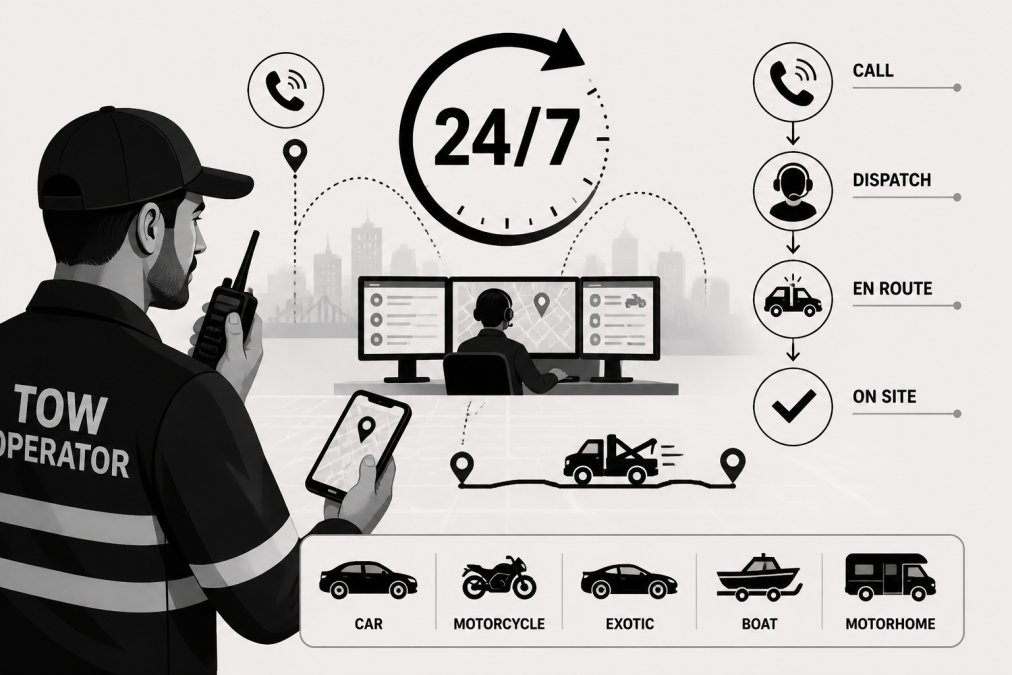
Round-the-clock availability is a baseline requirement for fleet operations. A vehicle breakdown at 2 AM on a Sunday affects your Monday schedule just as much as a weekday incident.
Priority dispatch is where most generic roadside assistance programs fail fleet managers. When you have 50 vehicles on the road and three break down simultaneously, the third vehicle shouldn’t wait because a solo dispatcher is overwhelmed. A fleet-grade towing service maintains dedicated dispatch capacity for account holders, ensuring your vehicles get routed to available resources without delay.
Response Time Standards and ETA Accuracy
Response times matter only if they’re realistic and consistently met. When evaluating a towing partner, ask for their average response time broken down by geography and time of day. A partner serving your fleet should provide:
- Published response time targets for each zone you operate in
- Historical performance data (not just promises)
- Escalation procedures if a vehicle exceeds the target window
- Real-time ETA updates sent directly to your drivers
According to National Highway Traffic Safety Administration guidance on fleet safety, visibility into response times reduces driver anxiety and improves incident reporting accuracy.
Real-Time Tracking and Visibility
You need to see what’s happening. A towing service that provides real-time tracking, showing your dispatch team the exact location of the tow truck, its current status, and ETA to your disabled vehicle, transforms a stressful situation into a managed event. This visibility also prevents duplicate calls and false alarms.
The best fleet towing services integrate tracking data into your existing fleet management software or provide a dedicated portal where your team can monitor active incidents.
Request a demo of the towing partner’s tracking system before signing a contract. Real-time means updates every 30-60 seconds, not every 5 minutes.
Choosing a Towing Partner for Fleets: Vetting Criteria That Matter
Not all towing services are equipped to handle fleet accounts. A company with five trucks might be excellent for individual consumers but completely unprepared for a fleet that needs multiple simultaneous tows and professional vendor management.
Start by evaluating these specific criteria:
- Fleet experience: How many commercial fleet accounts do they currently serve? Ask for references from similar-sized operations.
- Equipment diversity: Can they handle your exact vehicle types?
- Dispatch infrastructure: Do they have a 24/7 command center or rely on part-time dispatchers?
- Integration capability: Can they connect to your telematics system or fleet management software?
- Insurance and licensing: Are drivers CDL-certified where required? Is their liability coverage adequate for your operation?
CDL-Licensed Drivers and Equipment Capabilities
A Commercial Driver’s License (CDL) is required by the Federal Motor Carrier Safety Administration for operators towing vehicles over 10,000 pounds gross vehicle weight rating (GVWR). If your fleet includes heavy-duty trucks or loaded trailers, your towing partner’s drivers must be CDL-certified.
Beyond licensing, verify specific endorsements. A CDL with hazmat endorsement is essential if you transport hazardous materials. Equipment matters equally. A tow truck rated for 25-ton recovery is different from one rated for 50-ton recovery. Confirm the towing partner has the exact equipment in their fleet, not just “access to” it through subcontractors.
Heavy-Duty Towing and Specialized Recovery
Some situations demand more than a standard flatbed. Accidents, off-road recoveries, and specialized vehicle transport require equipment and expertise that general-purpose towing services don’t maintain.
The best partners maintain their own heavy-duty fleet in-house. This means faster response, consistent quality, and no markup from subcontractors. Ask specifically: “Do you own and operate the heavy-duty rotator trucks, or do you call another company when a job requires them?”
Fast Towing San Diego maintains professionally trained drivers backed by over 100 years of combined experience, capable of handling diverse vehicle types including boats, trailers, and exotic cars.
A towing partner that outsources heavy-duty recovery is adding delay and cost to your operation. Insist on in-house capability for any service level that matters to your operation.
Commercial Fleet Roadside Assistance: Beyond Basic Towing
Towing is just the beginning. A comprehensive commercial fleet roadside assistance program includes services that prevent tows from happening in the first place and reduce the total cost of a breakdown incident.
Incident and Accident Management Services
When a vehicle is involved in an accident, the towing company is often the first professional on scene. A fleet-grade service doesn’t just haul the vehicle away, they document the incident, coordinate with law enforcement, communicate with your insurance carrier, and ensure the vehicle is secured properly pending investigation.
This incident management capability saves time and reduces liability exposure. A towing service trained in incident management can walk drivers through the process: securing the vehicle, documenting the scene, contacting authorities, and ensuring evidence preservation.
On-Site Repair and Breakdown Support
Not every breakdown requires a tow. A battery jump, tire change, or fuel delivery can get a vehicle back on the road in 15 minutes. A comprehensive roadside assistance program includes these services as part of the base offering, not as expensive add-ons.
If your service agreement includes jump starts, tire changes, and lockout service at no additional charge, your drivers will call for help instead of attempting risky DIY repairs on the shoulder of a busy highway.
Fleet Vehicle Breakdown Management and Operational Efficiency
The cost of a vehicle breakdown extends far beyond the towing fee. When a delivery vehicle goes down, you lose the driver’s productivity, miss customer commitments, and potentially incur late fees or penalties.
Minimizing Downtime and Logistics Costs
Every hour a vehicle is out of service costs money. The towing company’s role is to minimize that window. This means:
- Prioritizing your fleet’s calls over individual consumers
- Routing vehicles to repair shops that can start work immediately
- Coordinating with your preferred repair vendors to ensure your vehicles are priority jobs
- Providing loaner vehicles or transportation alternatives so drivers can continue their routes
A Fleet Management Association best practices guide emphasizes that downtime reduction is the single largest opportunity for cost savings in fleet operations. Every hour of downtime prevented saves between $150 and $400 depending on the vehicle type and operation.
Preventative Maintenance and Asset Recovery
A towing service focused only on emergency response misses an opportunity to improve fleet health. The best partners provide data on breakdown patterns. Which vehicles are breaking down most frequently? What are the common failure modes? This intelligence helps you identify vehicles that need preventative maintenance before they fail on the road.
If your towing partner doesn’t provide breakdown analytics or preventative maintenance insights, you’re missing data that could prevent future incidents. Request a quarterly report showing breakdown frequency by vehicle, location, and failure type.
Fleet Management Software Towing Integration and Telematics
The most sophisticated fleet operations integrate towing services directly into their fleet management software. When a vehicle sends a breakdown alert through your telematics system, the alert automatically triggers a tow request with the towing partner. Your dispatch team sees the vehicle location, the tow truck location, and the ETA in a single interface.
This integration eliminates manual phone calls and reduces the window between breakdown and assistance dispatch.
Service Level Agreements (SLAs) and Contractual Standards
A Service Level Agreement (SLA) is a binding contract that specifies exactly what the towing partner will deliver. An SLA includes specific, measurable commitments:
- Average response time by geography (e.g., 20 minutes in urban areas, 45 minutes in rural zones)
- Escalation procedures if response time is exceeded
- Uptime guarantees for dispatch systems
- Incident documentation and reporting requirements
- Penalty clauses if service levels are missed consistently
The SLA also specifies what’s covered and what costs extra. Is a 50-mile tow included in the base rate, or does it trigger additional charges? These details must be crystal clear before you sign.
Transparent Quotes and Volume Pricing Models
Fleet accounts receive volume discounts. Request a detailed quote that breaks down pricing by service type:
- Local tow (under 10 miles)
- Regional tow (10-50 miles)
- Long-distance tow (50+ miles)
- Jump start/roadside assist
- Heavy-duty recovery
- Specialty services (hazmat, oversized loads)
Compare quotes across multiple partners on an apples-to-apples basis. A transparent partner provides a comprehensive quote with no hidden fees.
| Service Type | Typical Coverage | Fleet Advantage |
|---|---|---|
| Local tow (under 10 miles) | Included in base agreement | Unlimited calls, no per-incident fees |
| Regional tow (10-50 miles) | Included or tiered pricing | Volume discount on mileage overage |
| Jump start/tire change | Usually included | No separate service call charges |
| Heavy-duty recovery | Often additional | Negotiated rate for fleet volume |
| Incident management | Included with premium plans | Coordination and documentation included |
Fleets with 25+ vehicles operating in defined geographic regions. Volume discounts become meaningful at this scale, and the operational complexity justifies investment in a dedicated towing partner.
Sustainability and EV Towing: Future-Proofing Your Fleet
Electric vehicles require different towing approaches than traditional combustion engines. Improper towing of an EV can damage the battery pack, invalidate warranties, and create safety hazards.
An EV-capable towing partner understands battery pack location and weight distribution, charging system vulnerabilities during transport, proper securing techniques, and regulatory requirements around EV incident response.
If your fleet includes or plans to include electric vehicles, specifically ask about EV towing experience and certifications. According to Society of Automotive Engineers EV towing guidelines, improper EV towing is a leading cause of post-incident damage claims.
Making the Right Choice for Your Towing Services
The towing partner you choose becomes part of your fleet’s operational backbone. A good partner reduces downtime, improves safety, and provides peace of mind.
Evaluate potential partners on these final criteria:
References from similar operations. Call three fleet managers currently using the service. Ask about response times, professionalism, and how well the partner handles volume surges.
Trial period. Request a 30-day trial with a small subset of your fleet. This reveals any integration issues, dispatch problems, or service inconsistencies before you commit your entire operation.
Financial stability. Verify the towing company is financially stable and has been in business for at least 5 years.
Technology roadmap. Ask about their plans for telematics integration, mobile app development, and incident analytics. A partner investing in technology will serve you better long-term.
The decision ultimately comes down to which partner understands your specific operation and commits to minimizing your downtime. The cheapest option rarely is the best option.
Fleet breakdowns are inevitable. How you respond determines whether they’re minor inconveniences or operational disasters. Fast Towing San Diego brings over 100 years of combined professional experience to fleet management, offering 24/7 priority dispatch, comprehensive incident management, and partnerships with trusted repair shops. With specially negotiated fleet accounts and mobile mechanic services, you get the support your operation needs without the guesswork. Contact Fast Towing San Diego to discuss how a dedicated towing partnership can reduce your fleet’s downtime and operational costs.
Frequently Asked Questions
What is commercial fleet roadside assistance and how does it differ from standard roadside help?
Commercial fleet roadside assistance is a specialized service designed for businesses managing multiple vehicles. Unlike standard roadside assistance for individual drivers, fleet programs offer volume pricing, priority dispatch networks, real-time tracking, and customized service level agreements. They include incident management, on-site repair capabilities, preventative maintenance support, and vendor management, all critical for minimizing downtime and controlling logistics costs across your entire commercial transport operation.
How do fleet managers choose a reliable towing partner for their vehicles?
Evaluate potential partners using these key criteria: CDL-licensed drivers with proper training, heavy-duty towing capabilities matching your vehicle classes, 24/7 availability with documented response times, transparent pricing models with volume discounts, and integration with your fleet management software. Request references from similar-sized fleets, review their service level agreements carefully, verify their dispatch network coverage in your operating areas, and confirm they handle accident recovery and asset recovery efficiently.
What should a service level agreement (SLA) with a towing company include?
A comprehensive SLA should specify: guaranteed response times (e.g., 30-minute average), coverage areas and blackout zones, types of incidents covered (breakdowns, accidents, recoveries), equipment capabilities (heavy-duty wreckers, rotator service), driver qualifications (CDL requirements), pricing structure and volume discounts, real-time tracking and reporting access, incident escalation procedures, and performance penalties for missed commitments. Clear SLAs protect your fleet by establishing accountability and preventing surprise costs.
How does fleet management software integration improve towing service coordination?
Integration with telematics and fleet management platforms enables automated dispatch when vehicles experience breakdowns, provides real-time ETA accuracy to drivers, centralizes incident reporting and documentation, tracks fuel consumption patterns to predict maintenance needs, and consolidates billing across all services. This reduces manual coordination, accelerates response times, improves operational efficiency, and gives fleet managers complete visibility into costs and service quality, ultimately reducing downtime and logistics expenses.