
Table of Contents
- Understanding Common Hidden Towing Fees
- State Laws on Towing Storage Fees and Rate Limits
- How to Request an Itemized Receipt and Verify Charges
- Average Cost of a Tow Truck and What You Should Expect
- Creating a Towing Fee Dispute Letter Template
- How to Report Predatory Towing and File a Complaint
- Steps to Take at the Impound Lot and Recover Your Vehicle
- Frequently Asked Questions
Last Updated: August 6, 2026
Understanding Common Hidden Towing Fees
Hidden towing fees are charges that appear on your final bill without clear explanation or prior disclosure. These costs can transform a straightforward tow into an unexpectedly expensive experience. Common hidden fees include notification fees, administrative charges, daily storage fees at the impound lot, and equipment surcharges for specialized vehicles. Some operators add “gate fees,” “lot fees,” or “dispatch charges” never mentioned upfront.
What separates legitimate operators from predatory ones is transparency. A reputable towing company discloses all potential charges before hooking up your vehicle and provides an itemized receipt showing exactly what you’re paying for. Most states have regulations governing what towing companies can legally charge. The difference between a $150 tow and a $400 tow often comes down to hidden fees rather than actual distance or service.
State Laws on Towing Storage Fees and Rate Limits
California law sets specific limits on what towing companies can charge. Under California Vehicle Code Section 22658, private property towing is heavily regulated. Storage fees cannot exceed a set daily rate, and operators must provide written notice of these fees. Despite these requirements, many towing operators charge fees that skirt legal edges or exploit loopholes.
The key insight: state laws on towing storage fees apply even when you didn’t authorize the tow. If your vehicle was towed from private property, the property owner’s towing contractor must still follow California’s rate limits. Many people assume they have no recourse if they parked illegally, but the law still protects you from excessive charges.
Before you need a tow, search for “[your county] towing regulations” or “[your city] towing ordinances” and write down the legal storage fee limits. When dealing with an impound lot, you’ll have concrete numbers to reference when challenging inflated charges.
How to Request an Itemized Receipt and Verify Charges
Requesting an itemized receipt is your strongest tool for identifying hidden fees and catching illegal charges. Ask for a detailed breakdown of every charge, don’t accept a single-line receipt that just says “Towing and Storage: $450.”
A legitimate itemized receipt should show:
- Towing charge (base rate plus any distance surcharge)
- Storage fee (daily rate multiplied by number of days)
- Administrative or processing fee (if applicable)
- Any specialized equipment charges
- Notification or dispatch fees
- The exact dates and times storage began and ended
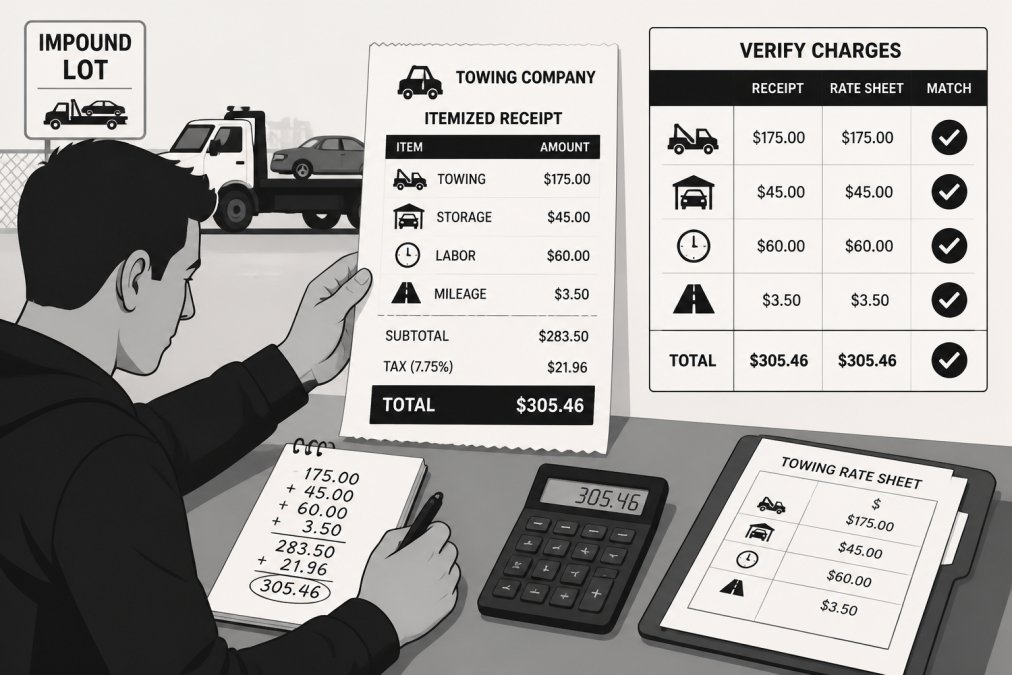
Once you have the itemized receipt, compare each line item against California’s legal rate limits and the towing company’s posted rate schedule. Common red flags include vague descriptions (“miscellaneous fee,” “facility charge”), undisclosed fees, storage charges extending beyond actual holding days, or equipment surcharges for standard vehicles. Ask for the itemized receipt before you pay, you have the legal right to see what you’re paying for before handing over money.
Average Cost of a Tow Truck and What You Should Expect
Understanding typical towing costs helps you spot genuinely excessive charges. A local tow within 5-10 miles generally costs less than a long-distance tow. Specialty vehicles like motorcycles or exotic cars may require different equipment and higher rates. Emergency tows during late-night or weekend hours sometimes carry premium charges.
What you should expect in a transparent towing transaction:
- Clear disclosure of the base towing rate before the tow begins
- Explanation of any distance surcharges or mileage rates
- Separate itemization of storage fees
- Written confirmation of all charges before authorization
- No surprise fees on your final bill
Many towing companies advertise low base rates but profit through hidden fees. A company quoting $75 for a tow but charging $50 per day for storage and $35 in “administrative fees” is effectively more expensive than one quoting $120 with transparent pricing.
Before you need emergency towing, call a few reputable operators and ask for their rate structure. Write down the base tow rate, storage rate, and any other standard fees.
Creating a Towing Fee Dispute Letter Template
If you’ve been charged unfair fees, a formal written dispute is often more effective than a phone call. A well-crafted dispute letter creates a paper trail and signals you’re serious about challenging charges.
[Your Name]
[Your Address]
[City, State, ZIP]
[Your Email]
[Your Phone Number]
[Date]
[Towing Company Name]
[Towing Company Address]
[City, State, ZIP]
RE: Dispute of Towing and Storage Charges – Vehicle [Make/Model/Year] – License Plate [ABC123]
Dear [Manager/Claims Department]:
I am writing to dispute charges on the towing and storage bill for my vehicle, which was towed on [date]. The total amount charged was $[amount], and I believe several charges violate California Vehicle Code Section 22658 and exceed the legal rate limits for [County] County.
Specific charges in dispute:
-
Storage Fee: Charged at $[amount] per day for [number] days. According to [County] towing regulations, the legal limit is $[legal limit] per day. I was not provided advance notice of storage rates before the tow occurred.
-
Administrative Fee: Charged $[amount]. This fee was not disclosed upfront and is not listed on the towing company’s posted rate schedule.
-
[Other disputed charge]: [Explain why this charge is excessive or unauthorized.]
Supporting documentation:
- Itemized receipt dated [date] (attached)
- Photographs of posted rate schedule at impound lot (attached)
- Copy of [County] towing rate regulations (attached)
I request that you provide written justification for each charge or reduce the bill to reflect only legally compliant fees. If I do not receive a response within 14 days, I will pursue this matter through small claims court and file a complaint with the [County/City] consumer protection agency.
Please contact me at [phone number] or [email] to discuss this matter.
Sincerely,
[Your Signature]
[Your Typed Name]
Send this letter via certified mail with return receipt requested. Keep copies of everything.
How to Report Predatory Towing and File a Complaint
Predatory towing practices should be reported to protect other vehicle owners. California has multiple agencies that investigate towing complaints.
California Department of Consumer Affairs handles complaints about towing operators who violate state law. File a complaint online or by mail with your itemized receipt, photographs of posted rates, and copies of your dispute letter.
Your City or County Consumer Protection Office handles local violations. Contact your city attorney’s office or county consumer affairs department.
The Better Business Bureau maintains complaint records visible to consumers researching towing companies.
California Attorney General’s Office handles large-scale consumer fraud.
When filing any complaint, include your full name, contact information, vehicle details, date of tow, itemized receipt, copies of posted rate schedules, documentation of disputes, specific violations of state law, and photographs of evidence.
Steps to Take at the Impound Lot and Recover Your Vehicle
Storage fees accumulate daily, so your goal is to recover your vehicle quickly while documenting everything.
Step 1: Locate your vehicle and verify its condition. Request access to inspect your vehicle before paying charges. Photograph the condition from multiple angles to document any existing damage.
Step 2: Request the rate schedule and all applicable fees. Ask for the posted rate schedule and photograph it. Ask the impound lot to explain every charge that will appear on your bill.
Step 3: Ask about the storage period. Confirm exactly when storage charges began and when they will end.
Step 4: Dispute charges before paying if they seem excessive. If any charge exceeds the legal limit or wasn’t disclosed upfront, challenge it before you pay. Reference the posted rate schedule and state law.
Step 5: Request the itemized receipt. Before you pay, insist on a detailed, itemized receipt showing every charge. Photograph it with your phone.
Step 6: Pay only what’s legally required. If the lot demands charges exceeding legal limits, you have the right to refuse and dispute them later. Generally, you must pay the legally compliant portion to recover your vehicle. Pay by credit card if possible for a payment record.
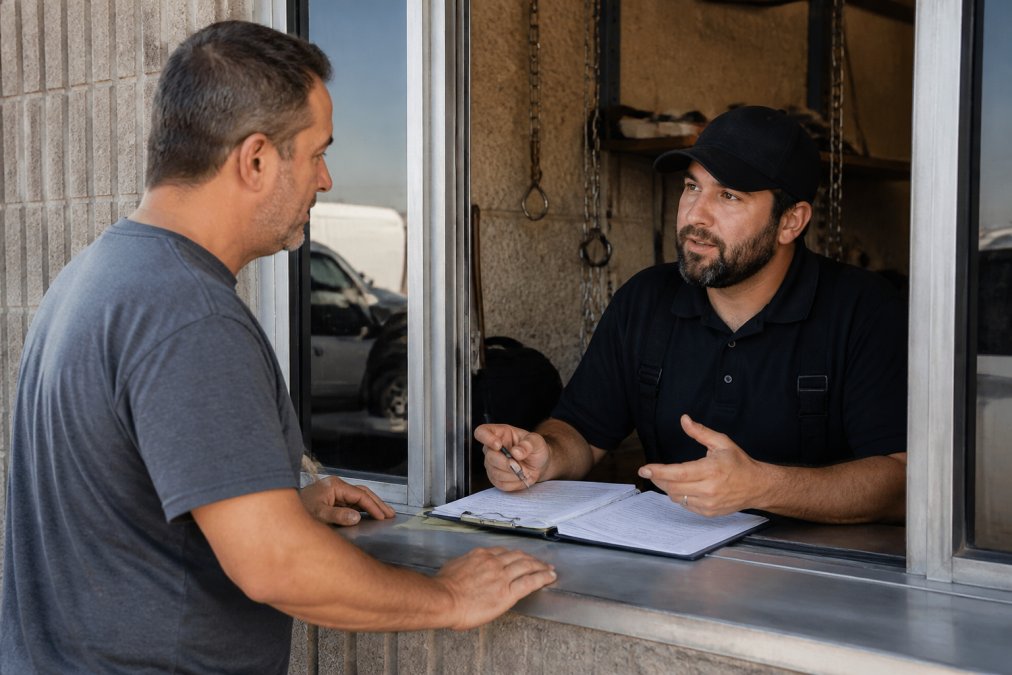
Step 7: Document the release process. Keep the release paperwork, itemized receipt, and any written communications from the impound lot.
Avoiding hidden towing fees starts with knowledge and preparation. Understand your state’s towing regulations, request itemized receipts, and don’t hesitate to dispute excessive or unexplained charges. When you need reliable, honest towing service in San Diego, Fast Towing San Diego delivers fast response times and upfront pricing with no surprise charges or hidden fees. Get started today by calling for a transparent quote or visiting our website to learn more about our services and commitment to customer protection.
Frequently Asked Questions
What is the most common way towing companies hide fees?
The most frequent hidden charges include administrative fees, notification fees, and storage fees that aren’t disclosed upfront. Many companies quote only the base towing rate, then add facility charges, gate fees, and daily storage costs once your vehicle arrives at the impound lot. Always ask for a complete, itemized quote before authorizing a tow, and request written confirmation of all charges in writing.
Can I dispute towing charges after the fact?
Yes. If you believe charges are unfair or unauthorized, you can dispute them through a credit card chargeback, small claims court, or by filing a complaint with your state’s consumer protection agency. Keep all documentation including photos of your vehicle before towing, the tow ticket, and any receipts. Many states have statutory limits on what towing companies can legally charge, making it possible to recover overages.
What should I do if a towing company refuses to release my vehicle without payment?
Request an itemized breakdown of all charges immediately. Verify each fee against your state’s towing regulations and the original service agreement. If charges exceed statutory limits or were never disclosed, contact your state’s attorney general or consumer protection office. Document everything in writing and consider filing in small claims court if the company continues to refuse release or demands payment for illegal fees.
Does insurance cover hidden or disputed towing fees?
Standard auto insurance policies typically cover the basic towing service, but coverage for storage fees, administrative charges, and other add-ons varies by policy. Review your insurance documentation or contact your insurer to understand what’s included. If a towing company charges fees that exceed your insurance coverage limit, you may be responsible for the difference, making it critical to understand your policy before authorizing a tow.