
Table of Contents
- Why Standard Towing Fails Specialized Vehicles
- Flatbed Transport: The Gold Standard for Low-Clearance Towing
- Tow Dolly Systems: Moving Non-Functional Vehicles Safely
- Enclosed Auto Transport Services for Exotic and Vintage Cars
- How to Transport a Non-Functional Classic Car Without Damage
- Cost of Enclosed Car Transport vs. Open Alternatives
- DIY vs. Professional Towing: Safety and Insurance Considerations
- Specialized Equipment for EV and Hybrid Towing
- Frequently Asked Questions
Last Updated: August 9, 2026
Why Standard Towing Fails Specialized Vehicles
Standard towing equipment wasn’t designed for low-clearance sports cars, classics with fragile suspension, or electric vehicles with regenerative braking systems. The approach angle of a standard flatbed might drag the front bumper. Wheel-lift methods can damage EV drivetrains. Dollies miss the specific tie-down points that protect high-value cars.
Fast Towing San Diego has spent over 100 years combined experience handling vehicles that most towing services turn away: exotic cars, vintage motorcycles, and non-functional classics requiring precision transport. A flatbed approach that works for a pickup truck will destroy a Porsche 911. A dolly system perfect for a disabled sedan won’t safely transport a non-functional classic across state lines. Choosing the right alternative for your specific vehicle separates a successful transport from a costly mistake.
Flatbed Transport: The Gold Standard for Low-Clearance Towing
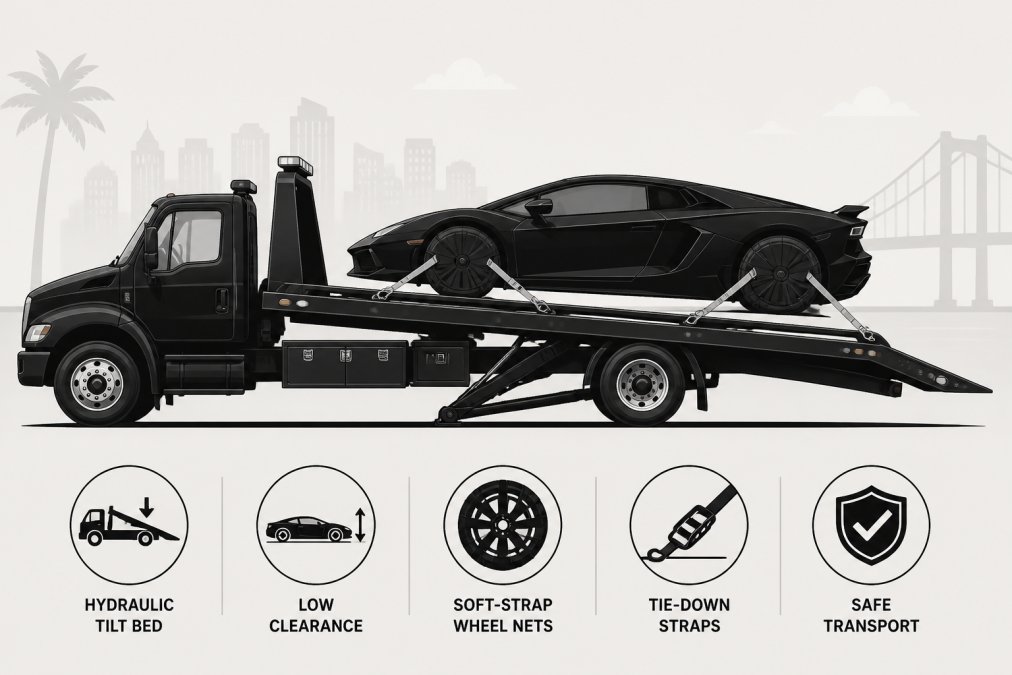
Flatbed towing is the safest method for vehicles with low ground clearance, custom suspension, or components extending beyond standard bumper heights. Unlike wheel-lift or dolly systems, flatbed carriers position your entire vehicle horizontally on a flat deck, eliminating approach angle damage and protecting undercarriage components. Soft-strap wheel nets secure wheels without pressuring suspension. Tie-down points attach to the frame or designated recovery points, not bumpers or body panels.
How Flatbed Towing Protects Your Vehicle
Flatbed transport eliminates two major risks: approach angle damage and drivetrain damage. When vehicles roll onto wheel-lift carriers, the front wheels leave the ground first, creating a pivot point that can drag the front end against the carrier frame. Flatbed systems keep all four wheels off the ground simultaneously, avoiding this entirely.
For electric vehicles, flatbed towing prevents wheel rotation during transport. When EV wheels turn, the regenerative braking system generates electrical current, potentially damaging the motor controller or battery management system. A flatbed keeps wheels stationary, eliminating this risk. Weight distribution also matters, flatbed transport spreads the vehicle’s weight across the entire deck, reducing stress on suspension components and preventing chassis flexing during long-distance hauling.
When Flatbed Transport Is Your Best Option
Choose flatbed transport if your vehicle has ground clearance under 5 inches, a custom body kit, an all-wheel-drive system, or is a low-slung sports car. Flatbed is standard for non-functional vehicles being transported long distances. For vintage car preservation, flatbed is non-negotiable, older vehicles often have suspension geometry that differs from modern designs, and wheel-lift towing can bend frame components. Over 500+ miles, flatbed eliminates cumulative stress on suspension bushings and frame welds.
Tow Dolly Systems: Moving Non-Functional Vehicles Safely
A tow dolly is a two-wheeled trailer that lifts the front wheels of a disabled vehicle off the ground, allowing the rear wheels to roll freely. The vehicle is secured with soft straps, and the dolly is towed behind a standard vehicle. This cost-effective method works well for front-wheel-drive vehicles over short distances. DJS Universal Dollies and CHAMP Mighty Mover Car Dollies are purpose-built systems for vehicles up to 4,000-4,200 pounds, with hub and pinch weld adapters for various vehicle types.
How Dollies Work for Disabled Vehicles
A dolly supports the front end weight while allowing rear wheels to roll. The vehicle is positioned so front wheels rest on the dolly’s deck, secured with straps to prevent movement. For electric vehicles, dollies prevent wheel-rotation problems entirely, front wheels are lifted and stationary, so no regenerative braking occurs. This makes dollies ideal for moving vehicles from accident scenes to repair shops without requiring working brakes, steering, or engine.
Dolly Limitations and When to Choose Something Else
Tow dollies have significant limitations. They don’t work safely for all-wheel-drive vehicles, stationary front wheels and rolling rear wheels create different rotational speeds, damaging the center differential. Dollies aren’t designed for long-distance hauling; over 100+ miles, the vehicle’s rear suspension flexing can cause frame damage or suspension failure. Trailer sway becomes a concern on highways. Additionally, dolly transport requires a separate tow vehicle with adequate towing capacity, and low-clearance vehicles may experience approach angle problems during loading.
| Transport Method | Best For | Distance Limit | Cost Approach | Vehicle Type Fit |
|---|---|---|---|---|
| Flatbed Transport | Low-clearance, exotic, non-functional vehicles | 500+ miles | Professional service | All types |
| Tow Dolly | Front-wheel-drive disabled vehicles, shop movement | Under 100 miles | Rental or owned equipment | FWD, RWD only |
| Enclosed Auto Transport | Vintage, collector, luxury vehicles | 500+ miles | Professional service | All types |
| Recovery Services | Stuck, accident, emergency situations | Varies | Professional service | All types |
Enclosed Auto Transport Services for Exotic and Vintage Cars
Enclosed auto transport is the premium option for vehicles where damage prevention is the highest priority. Unlike open trailers exposing vehicles to weather, road debris, and theft, enclosed carriers are fully enclosed with climate control and security features. Shaughnessy Overland Express and similar white-glove services specialize in transporting exotic, luxury, and collector vehicles with personalized handling.
An enclosed carrier typically holds 1-2 vehicles compared to 8-10 on open trailers, allowing more personalized attention to tie-down points and vehicle positioning. Professional drivers trained in exotic vehicle handling know specific vulnerabilities, tie-down point locations, fragile suspension components, and proper positioning to avoid damage.
For vintage cars, enclosed transport is often the only acceptable option. Original paint, chrome, and interior materials are irreplaceable. Exposure to weather causes rust, paint damage, and interior deterioration. Climate-controlled enclosed carriers maintain stable temperature and humidity, protecting the vehicle’s condition. For vehicles worth $50,000 or more, enclosed transport’s insurance value justifies the expense, a single stone chip on a vintage Porsche can cost thousands to repair.
How to Transport a Non-Functional Classic Car Without Damage
Transporting a non-functional classic car requires a systematic approach starting before loading and continuing through every mile of transport, preventing secondary damage that occurs during the towing process itself.
Pre-Transport Inspection Checklist
Document the vehicle’s current condition with photographs and notes, creating a baseline protecting both you and the towing service. Verify the vehicle’s tie-down points, reinforced frame attachment points designed to safely support the vehicle’s weight. Never allow straps to attach to bumpers, body panels, or suspension components, which will bend or break under load.
Confirm the transmission is in neutral and the parking brake is disengaged. Check for custom suspension modifications, lowered ride height, or extended body kits that might create clearance issues. Communicate these details to the towing service before arrival. Verify doors and windows are secure and remove loose interior items.
- Photograph vehicle from all angles before towing
- Locate and verify all tie-down points on frame
- Confirm transmission is in neutral and parking brake is off
- Check for custom suspension or body modifications
- Document any existing damage or fluid leaks
- Secure or remove loose interior and exterior items
- Verify towing service has appropriate equipment for vehicle type
- Confirm insurance coverage and liability limits with towing service
Equipment and Tie-Down Points
Soft-strap wheel nets protect wheels and tires without marking or scratching them. For classic cars, frame-mounted tie-down points are the only acceptable attachment method, typically located at the four corners near the wheels. Never allow straps to attach to bumpers or suspension components.
Tie-down angle matters, straps should approach at 15-30 degrees to horizontal, creating downward force that keeps the vehicle stable during transport. Improper angles cause the vehicle to shift during turns or braking. For low-clearance vehicles, hydraulic lift carriers with adjustable ride height are essential, lowering to ground level for loading and raising once secured.
Cost of Enclosed Car Transport vs. Open Alternatives
Open transport, where vehicles load onto exposed trailers alongside others, is most economical, typically costing 30-40% less than enclosed alternatives. Enclosed transport costs more due to specialized equipment, reduced capacity per trip, and higher insurance requirements. However, for vehicles worth $50,000 or more, enclosed transport’s cost is a small percentage of total vehicle value and justified by protection provided.
For short-distance moves under 50 miles, renting a tow dolly or car trailer can range from approximately $45 to $80 per day for a tow dolly, and around $70 per day for a trailer. However, rental equipment is general-purpose gear not specialized for exotic or classic vehicles. You’re personally liable for damage, responsible for arranging help if breakdown occurs, and pressured to return equipment promptly.
Professional towing services like Fast Towing San Diego eliminate these concerns. They carry liability insurance covering damage during transport, have specialized equipment matched to your vehicle type, and provide 24/7 support. For non-functional vehicles, professional services often include recovery as part of standard offering, making total cost comparable to renting equipment plus separate recovery help.
DIY vs. Professional Towing: Safety and Insurance Considerations
DIY towing means you’re personally responsible for equipment selection, vehicle securing, route planning, and emergency response. If the vehicle is damaged, you’re liable for repair costs. If an accident occurs, your personal liability insurance may not cover it because towing activities often fall outside standard homeowner or auto policies.
Professional towing services carry commercial liability insurance covering damage to transported vehicles and third-party liability if accidents occur. They also carry workers’ compensation insurance protecting their drivers, essential protection DIY towing doesn’t provide.
Insurance Liability for DIY Towing Attempts
Personal auto insurance typically covers liability while driving, but towing creates different scenarios. Most personal policies exclude coverage for commercial activities. If you cause an accident while towing and injure someone, your personal liability insurance might deny the claim. You’d then be personally liable for medical bills, property damage, and legal costs, potentially tens of thousands of dollars.
If the vehicle you’re towing is damaged, your homeowner’s insurance won’t cover it, and your auto insurance might deny coverage because you operated outside the policy’s intended use. This leaves you personally responsible for repair costs, which for exotic or vintage vehicles can be $10,000-50,000 or more.
DIY towing without proper insurance creates personal liability exposure. If you damage the vehicle you’re towing or cause an accident, your personal insurance may deny coverage, leaving you responsible for all costs. For vehicles worth more than $5,000, professional services are safer than self-towing.
Why Professional Recovery Services Protect Your Investment
Professional towing services provide protection DIY methods can’t match. They carry comprehensive liability insurance covering repair costs if they damage your vehicle and third-party claims if accidents occur. You’re protected from personal liability. Professional services have specialized equipment and training, knowing how to position vehicles safely and respond to problems during transport. They provide accountability, documented contracts, insurance information, and clear recovery paths if damage occurs.
For non-functional vehicles, professional services are especially important. A disabled vehicle can’t respond to emergencies during transport. If a tire blows or the vehicle shifts, a professional driver knows how to respond safely.
Fast Towing San Diego’s 100+ years of combined experience means their team has encountered virtually every specialized vehicle scenario. They know classic car vulnerabilities, electrical concerns with electric vehicles, and suspension sensitivities of exotic imports. This expertise translates to safer transport and lower damage risk.
Specialized Equipment for EV and Hybrid Towing
Electric vehicles and hybrids require towing methods that standard equipment doesn’t accommodate. The primary concern is preventing wheel rotation, which on an EV triggers the regenerative braking system and can damage the motor controller or battery management system.
For EVs, flatbed transport is the safest option, wheels remain stationary and off the ground, eliminating unintended wheel rotation risk. Soft-strap wheel nets secure wheels without allowing movement. Leave the transmission in neutral, not park, which engages the parking brake.
Tow dollies can work for EVs only if front wheels are completely lifted off the ground. If any part touches the road surface, wheel rotation can occur and cause damage. This requires precise positioning, a small error results in thousands of dollars in damage. Standard wheel-lift towing is not recommended for EVs, as it relies on lifting front wheels while rear wheels roll, creating the exact wheel-rotation scenario that damages EV drivetrains.
For hybrids, wheel rotation can trigger the regenerative braking system and potentially damage the hybrid battery or motor controller. Flatbed transport is safest, though tow dollies work if front wheels are completely lifted. Battery-electric vehicles are especially vulnerable, a single improper tow attempt can result in $5,000-15,000 in repairs to the battery management system or motor controller.
Choosing the right towing method for a specialized vehicle protects your investment. Standard towing equipment fails because it wasn’t designed for low-clearance vehicles, exotic cars, classics, or electric powertrains. Flatbed transport eliminates approach angle damage. Enclosed auto transport protects vintage vehicles from weather and debris. Professional recovery services provide insurance coverage and expertise DIY methods can’t match.
Fast Towing San Diego specializes in these scenarios. With over 100 years of combined experience, professionally trained drivers, and specialized equipment for exotic cars to electric vehicles, they understand the specific protection each vehicle type requires. Whether you need immediate roadside assistance or long-distance specialized transport, their 24/7 availability and commitment to affordable, reliable service means your vehicle reaches its destination intact. Contact Fast Towing San Diego today for a consultation on the right transport method for your vehicle.
Frequently Asked Questions
What is the safest way to tow a low-clearance specialized vehicle?
Flatbed transport is the safest method for low-clearance vehicles because it eliminates drivetrain damage and protects the vehicle’s undercarriage. Unlike wheel-lift or tow dolly methods, flatbed towing keeps all wheels off the ground, preventing suspension stress and transmission damage. For exotic cars, vintage motorcycles, and vehicles with air suspension systems, flatbed eliminates approach angle concerns entirely. Professional towing services like Fast Towing San Diego use hydraulic lifts and soft-strap wheel nets to secure your vehicle without scratching or denting it.
How much does enclosed auto transport services cost compared to open towing?
Enclosed auto transport services cost more than open alternatives because they provide weather protection and reduce exposure to road debris. Pricing depends on distance, vehicle type, and current market demand. For a non-functional classic car requiring enclosed transport, costs vary significantly based on pickup and delivery locations. Rather than guessing, contact Fast Towing San Diego for a quote that reflects your specific transport needs and vehicle specifications. Professional enclosed transport protects high-value vehicles from damage that could exceed the transport cost.
Can I tow a non-functional exotic car myself, or do I need professional help?
DIY towing of exotic cars carries significant risks and liability concerns. Your personal auto insurance may not cover damage caused during towing, and improper tie-down techniques can damage the vehicle’s frame or suspension. Professional recovery services use specialized equipment like soft-strap wheel nets and proper load distribution to prevent drivetrain damage and transmission damage. Fast Towing San Diego’s professionally trained drivers have over 100 years of combined experience handling exotic and specialized vehicles safely, protecting both your car and your liability exposure.
Are hybrid and electric vehicles safe to tow using standard methods?
Hybrid and electric vehicles require specialized towing equipment because standard wheel-lift methods can damage the drivetrain or generate electricity that stresses the battery system. DJS Universal Dollies, approved by Tesla and BMW, prevent wheel rotation during transport, protecting the vehicle’s electrical systems. Flatbed transport is the safest option for EVs and hybrids, eliminating any risk of unintended wheel movement or transmission engagement. Always use a towing service experienced with EV and hybrid specifications to avoid costly repairs.