
Table of Contents
- What to Do When You’re Stranded: Immediate Steps
- Build Your Emergency Kit Before You Need It
- Finding Emergency Towing Services Near Me
- How to Choose a Roadside Assistance Plan
- Common Roadside Emergencies and Solutions
- Roadside Assistance Etiquette and Tipping
- Special Considerations for Electric Vehicles and Specialty Vehicles
- Staying Safe While You Wait for Help
- Frequently Asked Questions
Last Updated: August 20, 2026
What to Do When You’re Stranded: Immediate Steps
When your vehicle breaks down, your priority shifts from driving to safety. Every decision in the first few minutes affects your safety and recovery speed.
Activate Your Hazard Lights and Move to Safety
Turn on your hazard lights immediately. If your car is still running, drive slowly to the nearest safe location, an exit ramp, wide shoulder, or parking lot. If your vehicle won’t start, stay inside with your seatbelt on until traffic passes, then exit on the passenger side, away from traffic. Never stand between your car and oncoming vehicles.
Once safe, turn on your interior dome light if it’s dark and put on a safety vest or reflective clothing. These steps take less than a minute and dramatically improve visibility to other drivers and emergency responders.
Gather Your Vehicle Information
Before calling for roadside assistance, collect:
- Your vehicle’s year, make, model, and color
- Your license plate number
- Your current location (intersection, mile marker, or address)
- A brief description of what happened
- Whether your vehicle is still running or completely disabled
This information speeds up dispatch. Many roadside assistance apps populate these details automatically from your vehicle registration.
Build Your Emergency Kit Before You Need It
An emergency kit determines what you can fix yourself versus what requires professional help.
Essential Items Every Driver Should Carry
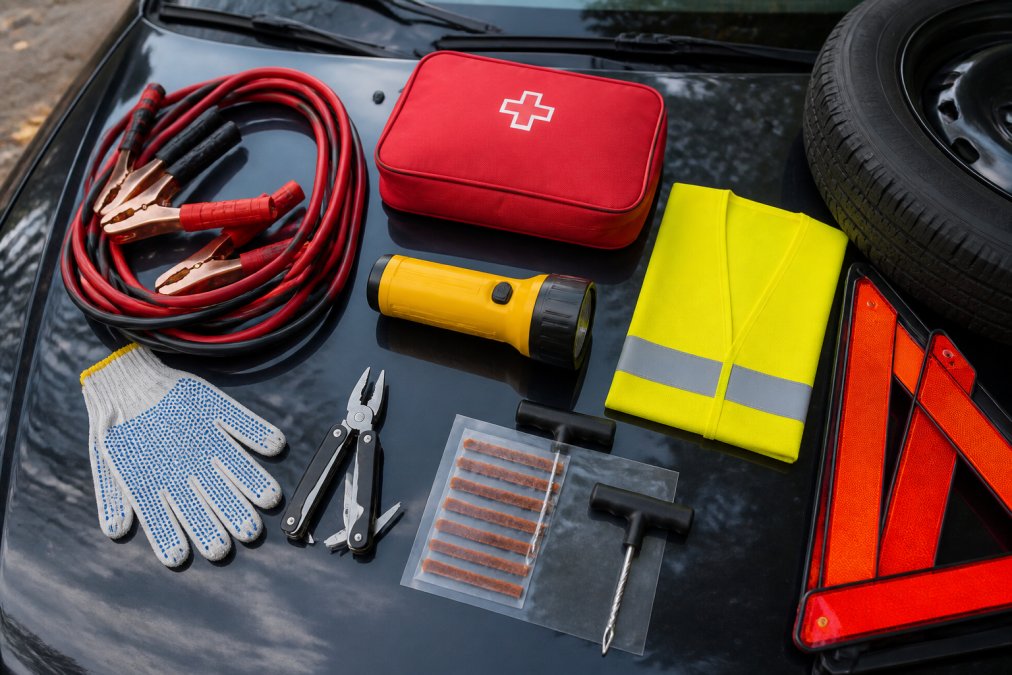
Start with jumper cables or a portable jump starter. A dead battery is the most common reason drivers need roadside assistance. A portable jump starter costs under $50 and eliminates the need to find another car.
Add a basic tool kit: a multi-tool, adjustable wrench, screwdrivers (Phillips and flathead), and pliers. Include a flashlight with extra batteries or a headlamp.
Tire-related items are essential: a spare tire (check monthly that it’s properly inflated), a tire jack, a tire iron, and a tire repair kit with patches and portable air compressor. Add safety equipment: reflective triangles or flares, a safety vest, and a first aid kit. Keep a phone charger in your vehicle, a car charger, portable power bank, or both.
Seasonal Additions for Winter and Summer
Winter driving demands extra preparation. Add blankets or an emergency bivy, hand warmers, and extra snacks. Keep a small shovel or ice scraper to clear snow around your wheels if you need traction. Add winter windshield washer fluid rated for your climate, regular fluid freezes in winter.
Summer heat is its own danger. Keep extra water in your vehicle, a gallon or more. Add sunscreen and a wide-brimmed hat. Keep a small bag of sand or kitty litter for traction if stuck in loose gravel or sand.
Finding Emergency Towing Services Near Me
When your vehicle breaks down, you need help now. Knowing how to find and call for roadside assistance ensures you get professional support quickly.
Calling for Help: What Information to Have Ready
When you call a towing service, have your location pinpointed. If you’re on a highway, know your mile marker or nearest exit. GPS coordinates from your phone work perfectly.
Describe your situation clearly. “My engine won’t start” is clearer than “something’s wrong.” State your vehicle type, a sedan tows differently than a motorcycle, SUV, or luxury car. Professional towing services like Fast Towing San Diego can manage specialty transports without risk of damage.
Ask about response time and confirm pricing expectations before the technician arrives. Knowing what to expect prevents surprise bills later.
Response Time Expectations and Tracking
Response time varies based on your location and time of day. Urban breakdowns during business hours typically get faster response than rural breakdowns at 2 AM. However, professional roadside assistance services operate 24/7.
Many services now offer real-time tracking. Once you call, you can see your technician’s location and estimated arrival time on your phone. Fast Towing San Diego maintains multiple vehicles and technicians across the service area specifically to keep response times short, even during peak hours or late-night emergencies.
How to Choose a Roadside Assistance Plan
You have multiple options for getting help when you break down.
Membership Plans vs. Insurance Coverage vs. On-Demand Apps
A membership plan is a subscription service dedicated to roadside assistance. You pay an annual or monthly fee, and when you need help, you call your membership service. The advantage is predictability; the disadvantage is paying whether you use the service or not.
Insurance-based roadside assistance is often bundled with your auto insurance policy. The advantage is simplicity; the disadvantage is that coverage limits may be low, and using the service might affect your claims history.
On-demand apps connect you with available tow trucks in real time. You pay per service, not a subscription. The advantage is flexibility and transparency; the disadvantage is that availability varies by location and time.
The best choice depends on how often you drive, how far you travel, and whether you value predictability or flexibility.
Coverage Limits and Service Area Boundaries
Every roadside assistance plan has limits. Towing distance is the most important. Some plans cover only 10 miles of towing; others cover 100 miles or more. If you break down 50 miles from home and your plan covers only 10 miles, you’re paying out of pocket for the remaining 40 miles.
Service area boundaries matter too. A national membership plan covers you everywhere in the country. A regional service might cover only a specific area. Read the fine print on what’s actually covered. Some plans exclude certain vehicle types like motorcycles, commercial vehicles, or specialty vehicles.
Common Roadside Emergencies and Solutions
Most breakdowns fall into a few categories. Understanding what causes them helps you manage the situation while waiting for professional help.
Battery Jump Starts and Electrical Issues
A dead battery is the most common roadside emergency. If you have jumper cables and another vehicle nearby, you can attempt a jump start yourself. Connect the red cable to the positive terminal of the dead battery, then to the positive terminal of the good battery. Connect the black cable to the negative terminal of the good battery, then to an unpainted metal surface on your vehicle. Start the other vehicle, wait a minute, then try starting yours.
If a jump start doesn’t work or you don’t have cables, you need professional help. A technician can diagnose whether it’s the battery, alternator, or another electrical component.
Flat Tire Changes and Spare Tire Maintenance
A flat tire is manageable if you have a spare and the tools to change it. Loosen the lug nuts slightly while the vehicle is still on the ground. Raise the vehicle with the jack, remove the lug nuts completely, and pull the flat tire toward you. Mount the spare, hand-tighten the lug nuts, lower the vehicle, then tighten the lug nuts fully in a star pattern.
However, if your spare is flat, damaged, or missing, you can’t change the tire yourself. If you have only a temporary spare, drive carefully to a repair shop, temporary spares are rated for 50 miles at 50 mph maximum.
Lockout Service and Fuel Delivery
You locked your keys in your car. Don’t break a window or attempt to pry the door open. Call for professional lockout service. A technician can open your door without damage in minutes.
Fuel delivery is straightforward. A technician brings fuel to your vehicle and adds it to your tank. This is why keeping your tank above a quarter-full is good practice.
Overheating, Belts, and Hose Failures
If your engine temperature gauge is in the red zone or you see steam from under the hood, stop driving immediately. Pull over safely, turn off the engine, and wait for it to cool. Once cool, check your coolant level. If the vehicle overheats again shortly after, you have a leak requiring professional diagnosis.
Serpentine belt and hose failures can disable your vehicle. If you see a belt hanging loose or a hose spraying coolant, you need professional help.
Roadside Assistance Etiquette and Tipping
When a technician arrives to help, treat them professionally and fairly.
When and How Much to Tip Your Tow Truck Driver
Tipping isn’t mandatory, but it’s customary when a technician goes above and beyond. For simple services like a jump start or fuel delivery, $5 to $10 is standard. For more involved work like a tire change or long tow, $15 to $20 is appropriate. Cash is best because it goes directly to the technician.
Professional Courtesy During the Service Call
Stay out of the technician’s way while they work. Be honest about what happened, this context helps them diagnose the problem faster. Provide them with access to your vehicle keys and any information they need. In difficult conditions, offer basic courtesy like a bottle of water on a hot day.
Special Considerations for Electric Vehicles and Specialty Vehicles
Electric vehicles and specialty vehicles require different handling than standard gasoline cars.
EVs don’t have traditional engines, so jump starts work differently. You can’t use traditional jumper cables on most EVs. When calling for roadside assistance, specify that you have an EV. Services like Fast Towing San Diego understand EV-specific requirements and have the right equipment.
Towing an EV requires care. Many EVs can’t be towed with their drive wheels on the ground because the regenerative braking system can be damaged. Professional tow operators use flatbed towing for EVs.
Motorcycles, exotic cars, boats, and trailers require specialty towing. Improper towing can cause thousands of dollars in damage. If you own a specialty vehicle, confirm before an emergency that your roadside assistance service can handle it.
Staying Safe While You Wait for Help
The time between your breakdown and the technician’s arrival is when you’re most vulnerable.

Stay inside your vehicle with the doors locked unless you’re in immediate danger. Your car is a protective shell. If you must exit, wear your safety vest and stay away from traffic. Stand on the passenger side of your vehicle, away from the roadway.
Keep your phone charged and accessible. Don’t accept help from strangers. In extreme heat, crack your windows for ventilation but keep doors locked. In extreme cold, keep the engine running for heat, but ensure your exhaust isn’t blocked by snow.
If you’re waiting more than 30 minutes beyond the estimated arrival time, call the service back and ask for an updated ETA.
Being stranded is stressful, but preparation and knowledge reduce that stress significantly. An emergency kit in your vehicle, understanding your roadside assistance options, and knowing how to handle common breakdowns puts you in control. When you do need help, professional services like Fast Towing San Diego provide 24/7 support with experienced technicians who handle everything from simple jump starts to complex specialty vehicle transports. The key is having a plan before you need it.
Frequently Asked Questions
What should I do immediately when my vehicle breaks down on the road?
First, activate your hazard lights and safely move your vehicle out of traffic if possible. Turn off the engine and turn on interior lights if it’s dark. Stay inside your vehicle with the doors locked and windows up unless it’s unsafe to do so. Call for roadside assistance right away. Have your location, vehicle details, and description of the problem ready when you call. If you’re on a busy freeway, move as far away from traffic as safely possible and wait for professional help to arrive.
How much should you tip roadside assistance and tow truck drivers?
Tipping for roadside assistance is customary but not required. A standard tip ranges from $5 to $20, depending on the complexity of the service and your satisfaction. For basic services like jump starts or lockouts, $5 to $10 is appropriate. For more involved work like tire changes or towing, consider $15 to $20. If the driver goes above and beyond, such as helping in bad weather or taking extra time, a larger tip is appreciated. Always tip in cash if possible, as it ensures the driver receives it directly.
What’s the difference between membership roadside assistance plans and insurance coverage?
Membership plans are standalone subscriptions you purchase directly from a roadside assistance provider, offering predictable annual costs and specific coverage limits. Insurance-based roadside assistance is typically included or available as an add-on through your auto insurance policy. On-demand apps let you pay per service when needed. Membership plans often provide better response times and wider service areas, while insurance coverage integrates with your policy but may have limits. Choose based on how frequently you think you’ll need help and your budget preferences.
What items should I keep in my vehicle emergency kit?
Essential items include jumper cables, a flashlight with extra batteries, a first aid kit, a spare tire (properly inflated), a tire jack and lug wrench, safety cones or flares, a reflective safety vest, basic hand tools (screwdrivers, pliers, adjustable wrench), motor oil, coolant, windshield washer fluid, jumper cables, blanket, and a phone charger. In winter, add ice scraper, sand or kitty litter for traction, and extra blankets. In summer, carry extra water for both you and your radiator. Keep a flashlight, jumper cables, and your roadside assistance phone number easily accessible at all times.