
Table of Contents
- Car Service Emergency: Your First 5 Moves on the Highway
- What Is Included in Roadside Assistance?
- Emergency Towing Services Near Me: How to Choose Fast
- 24/7 Roadside Assistance Cost: What to Expect
- DIY vs. Professional: When to Call a Tow Truck
- Does Your Insurance Cover Emergency Roadside Help?
- Build Your Emergency Kit Before You Need It
- Get Back on the Road With a Team You Can Trust
- Frequently Asked Questions
Last Updated: September 4, 2026
Car Service Emergency: Your First 5 Moves on the Highway
A car service emergency is any sudden mechanical failure, accident, or safety issue that leaves you stranded. The first 60 seconds decide whether this becomes a minor inconvenience or a dangerous situation. The team at Fast Towing San Diego has responded to thousands of these calls, and the drivers who handle it best follow the same five moves every time.
Move 1: Control the Vehicle, Not the Panic. Your first instinct may be to slam the brakes. Resist it. Ease off the accelerator, grip the wheel firmly, and activate your hazard lights immediately. If you have a tire blowout, steer straight and let the vehicle decelerate naturally before gently guiding it toward the shoulder. Signal and cross lanes only when it is safe. Your goal is to reach the farthest point on the shoulder or the nearest exit ramp.
Move 2: Get to the Safest Possible Position. Once on the shoulder, turn your wheels away from traffic, put the vehicle in park, and set the parking brake. If you cannot reach a shoulder and are stopped in a travel lane, stay in your vehicle with your seatbelt on and hazard lights flashing. Call 911 immediately to alert authorities to your location so they can manage traffic.
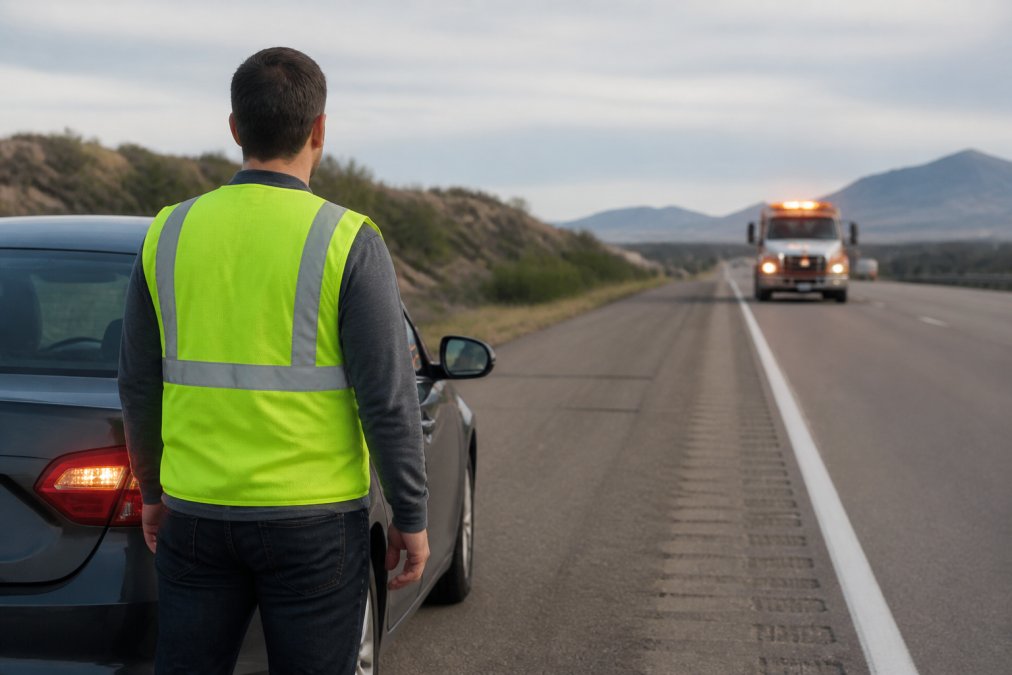
Move 3: Exit the Vehicle with a Protocol. If you are on a highway shoulder, exit through the passenger-side door, away from traffic, a critical step many drivers overlook. Once outside, put on a reflective safety vest if you have one, and move behind the guardrail or at least 50 feet from your vehicle, uphill and upstream of traffic if possible. Never stand behind your vehicle or between your car and the travel lane.
Move 4: Assess the Situation from a Distance. From your safe position, visually inspect the vehicle for obvious signs like a flat tire, steam from the engine bay, or fluid leaking. Do not open the hood if you see smoke or smell burning, this could indicate a fire risk. If the issue is a flat tire on a quiet road and you have a spare, you may choose to change it yourself (see the DIY vs. Professional section below). If the problem is mechanical, electrical, or involves any fluid other than washer fluid, do not attempt a repair. Your assessment is for relaying information to the dispatcher.
Move 5: Call for Help with the Right Information. Call your roadside assistance provider or a verified local towing company. Provide your exact location (use the nearest mile marker or exit number), your vehicle’s make and model, and a description of the problem, a dead battery requires a different truck than a blown engine. Stay on the line until the dispatcher confirms the truck is dispatched and gives you an estimated arrival time. Then, return to your safe waiting position.
Never accept help from an unmarked vehicle or a driver who approaches you on the shoulder before you have called a verified dispatch center. Scam towing operations target stranded motorists, and accepting help from an unverified driver can lead to inflated charges or unsafe towing.
What Is Included in Roadside Assistance?
Roadside assistance is a service that brings professional help to your location when your vehicle breaks down, covering a defined set of common emergencies. Standard coverage typically includes battery jump-starts, flat tire changes, vehicle lockout assistance, and fuel delivery. Many providers also include towing services, which transport your vehicle to a repair shop if it cannot be fixed on site.
What most guides miss is that the scope varies significantly between providers. A basic plan might cover a jump-start but charge extra for a tow beyond a short distance. Membership-based programs like AAA offer tiered levels, with AAA’s membership benefits including mileage limits that increase at higher tiers. Insurance add-ons, such as those from Geico Emergency Road Service, typically bundle towing and labor into your existing policy for a small premium per vehicle.
When you call a professional service for a car service emergency, confirm what is included before the truck rolls. Ask about towing distance limits, whether the technician carries a spare tire, and if there are extra fees for after-hours dispatch.
Emergency Towing Services Near Me: How to Choose Fast
When you search for emergency towing services near me, you need a company that answers instantly and arrives quickly, not one that keeps you waiting on hold. Speed and reliability matter most when you are stranded on a freeway shoulder at night. A provider with local dispatchers and nearby service vehicles will always beat a national call center routing jobs from across the country.
When evaluating a towing company during an emergency, confirm they operate 24/7, including holidays, and ask for an estimated arrival time before you commit. Check that their trucks can handle your specific vehicle type, whether that is a standard sedan, a motorcycle, or a heavy truck. Ask about flat-rate pricing so you are not surprised by the final bill.
Never accept help from an unmarked vehicle or a driver who approaches you on the shoulder before you have called a verified dispatch center. Scam towing operations target stranded motorists, and accepting help from an unverified driver can lead to inflated charges or unsafe towing.
24/7 Roadside Assistance Cost: What to Expect
The 24/7 roadside assistance cost depends entirely on how you access the service, and the range is wider than most drivers expect. For insurance-linked plans, the cost is often minimal. For example, Erie Insurance offers roadside assistance as an add-on for around $5 per vehicle per year, while Allstate provides roadside assistance for roughly $78 annually or on a pay-per-use basis. Membership programs like AAA start near $54 per year for basic coverage.
For on-demand calls without a membership or insurance add-on, expect a per-incident fee that varies by distance and time of day. Ask for a flat-rate quote before the truck is dispatched; a reputable company will quote the tow based on distance and vehicle type over the phone. For specific pricing in your area, contact Fast Towing San Diego directly for a transparent quote.
DIY vs. Professional: When to Call a Tow Truck
A few roadside fixes are safe to handle yourself, but most car service emergency situations call for a professional. Changing a flat tire on a quiet side street with a spare in good condition is a reasonable DIY task. Jump-starting a dead battery with portable jumper cables is another. Beyond those two scenarios, the risk of injury or further vehicle damage climbs fast.
Call a tow truck when the problem involves the engine, brakes, steering, or transmission, or when you are stopped on a highway shoulder where passing traffic creates danger. Attempting a repair on a busy road to save money puts you at risk of being struck by another vehicle. Professional drivers are trained to work safely in traffic and carry the equipment to handle vehicles that cannot roll.
If your car is disabled in a travel lane or on a narrow shoulder, do not attempt any DIY fix. Get yourself behind the guardrail and call a professional. The cost of a tow is far lower than the cost of an accident.
Does Your Insurance Cover Emergency Roadside Help?
Many drivers have roadside assistance coverage already included in their auto policy and do not realize it. Before you pay a $100+ per-incident fee for a tow, spend 10 minutes checking the three most common places this coverage hides: your auto insurance policy, your credit card benefits, and your vehicle’s warranty.
1. Check Your Auto Insurance Policy. Insurance companies frequently offer emergency roadside service as an add-on endorsement, covering towing, jump-starts, and lockout assistance for a small annual premium. For example, Geico Emergency Road Service is a common add-on that covers towing up to a certain mileage limit, typically around $10-$20 per six-month policy period. Allstate provides roadside assistance as a pay-per-use option or an annual bundle. To check your coverage, look for terms like “Roadside Assistance,” “Emergency Road Service,” or “Towing and Labor” in your declarations page. If you don’t see it, call your agent and ask directly: “Do I have roadside assistance, and what are the per-incident limits?”
2. Check Your Credit Card Benefits. Many premium credit cards, such as the Chase Sapphire Preferred or the American Express Platinum, include roadside assistance as a cardholder benefit. The mechanics vary: some cards offer a pay-per-use service where you call the card’s benefits administrator, they dispatch a local provider, and the charge appears on your statement (often at a discounted rate). Others reimburse you for a tow you arrange yourself, up to a set dollar amount per incident. Call the number on the back of your card and ask about “roadside assistance benefits” before you call a tow truck. Be aware that these benefits often have specific terms, like a maximum of four service calls per year or a $50 reimbursement cap, so ask for the full details.
3. Check Your Vehicle Warranty or Manufacturer Program. If your car is relatively new, your manufacturer’s warranty may include roadside assistance. Most new vehicles from major manufacturers come with 3 years/36,000 miles of 24/7 roadside assistance, including towing to the nearest dealership. This benefit expires, so check your owner’s manual or the manufacturer’s website to see if you are still within the coverage window. If you are, the service is typically free and includes jump-starts, flat tire changes, and lockout help.
4. Understand Your Coverage Limits. If you have coverage, understand the limits. Most insurance-linked roadside plans cap towing at a specific distance per incident, often 5 to 15 miles, and some exclude certain vehicle types like RVs or motorcycles. When your coverage runs out, you pay the difference, so ask the towing company for a quote that separates the insured portion from any overage. For example, if your insurance covers a 5-mile tow and you are 12 miles from the shop, you are responsible for the remaining 7 miles. A reputable provider will quote that overage transparently.
Before you call for help, have your policy number or credit card benefits document ready. When you call the towing company, tell the dispatcher: “I have roadside coverage through [provider]. Please bill them first and quote me the overage separately.” This simple sentence can save you from paying the full per-incident rate out of pocket.
If you discover you have no coverage, you have two options: pay the per-incident rate for this emergency, or sign up for a membership program on the spot. Many providers, including AAA, allow you to join and use the service immediately, though there may be a waiting period for certain benefits. For a one-time emergency, a pay-per-incident call is often cheaper than an annual membership. The key is to check your existing benefits first, most drivers are surprised to find they already have coverage they never used.
Build Your Emergency Kit Before You Need It
Preparation turns a potential disaster into a manageable delay, and a well-stocked emergency kit is the cheapest insurance you will ever buy for your vehicle. At minimum, your kit should include jumper cables or a portable jump starter, a flashlight with extra batteries, a reflective safety vest, and warning triangles. Add a basic first aid kit, bottled water, and a phone charger that works without the engine running.
A portable lithium jump starter is a worthwhile investment for drivers who want to be self-sufficient. The Noco Boost Plus GB40 delivers 1,000 amps of peak current and includes spark-proof technology, letting you restart a dead battery without a second vehicle. For a pre-assembled option, the AAA Excursion Roadside Emergency Kit bundles jumper cables, a flashlight, and a reflective triangle into one organized bag.
Store the kit in your trunk where you can reach it without unloading cargo. Check it twice a year, and replace any expired items or discharged batteries before they are needed.
Get Back on the Road With a Team You Can Trust
A car service emergency is stressful, but the right response plan removes most of the danger and uncertainty. You now know the first five moves, what roadside assistance should include, how to choose a towing provider fast, and what a fair price looks like. The missing piece is having a reliable team on call before you need them.
Fast Towing San Diego brings over 100 years of combined experience to every call, with professionally trained drivers available 24/7/365. We handle everything from jump-starts and tire changes to accident towing and transport for boats, trailers, and exotic vehicles. After an accident, we connect you with trusted repair shops so you are not left figuring out the next step alone. First responders, military personnel, and fleet accounts receive special discounts. Save our number now, and get back on the road with a team that answers when it matters.
Frequently Asked Questions
How do I know you’ll actually show up fast, or am I going to be sitting on the side of the freeway for an hour?
Response times depend on your location, traffic, and current demand. Professional providers like Fast Towing San Diego prioritize freeway calls because stranded drivers face the highest risk there. Ask for an estimated arrival time when you call, and confirm the dispatcher knows your exact mile marker. A company with professionally trained drivers and a local dispatch center will get to you faster than one routing trucks from across town.
What’s this going to cost me? I don’t want to call for help and then get hit with a surprise bill.
24/7 roadside assistance cost varies by service type, distance, time of day, and vehicle. A basic jump-start costs less than a long-distance tow, and exotic or specialty vehicles may require different equipment. Always ask for a flat-rate quote before the truck rolls. Reputable providers give transparent pricing upfront, and if you have roadside coverage through insurance or a membership, your out-of-pocket cost could be minimal.
Can I get emergency towing if I’m not a member of a roadside assistance program?
Yes. You do not need a membership to call for emergency towing services near me. Many providers, including Fast Towing San Diego, offer on-demand help to anyone, 24/7. You pay per incident rather than an annual fee. This suits drivers who rarely break down but want professional help available when they do. Just confirm pricing before dispatch, since pay-per-use rates are higher than membership-based plans.
After you pick up my car, what happens next? Do I have to figure out the repair shop myself?
A full-service towing company handles more than the transport. After an accident or breakdown, the driver can tow your vehicle to a shop you choose, or recommend a trusted repair partner they work with regularly. Ask your provider about mobile mechanic services that can diagnose and fix issues on-site, saving you a tow altogether. This support matters most during a car service emergency when you are stressed and unfamiliar with local shops.
A breakdown can happen at any hour, and waiting on the shoulder is never the time to research your options. Fast Towing San Diego offers fast response times, affordable flat-rate pricing, and comprehensive roadside help including jump starts and tire changes. Get started with Fast Towing San Diego and keep a trusted partner ready for your next emergency.