
Table of Contents
- What Counts as Emergency Towing?
- Emergency Towing 24/7: How Fast Is Fast?
- Roadside Assistance vs Emergency Towing: Know the Difference
- Average Cost of Emergency Towing and How Billing Works
- How to Choose a 24/7 Tow Truck Company
- Step-by-Step Safety Guide for Stranded Motorists
- Insurance and Reimbursement Documentation for Towing
- Common Roadside Breakdown Scenarios and the Right Call
- Frequently Asked Questions
Last Updated: September 9, 2026
What Counts as Emergency Towing?
Emergency towing is the immediate dispatch of a tow truck for situations where a vehicle cannot be safely driven and poses a risk to the driver, passengers, or other road users. This typically covers breakdowns, accidents, and mechanical failures that leave you stranded and unable to reach a repair facility under your own power.
The most common triggers include a dead battery that jump-start service cannot revive, a blown tire with no usable spare, engine failure on a busy freeway, or being involved in a collision that leaves the car inoperable. What separates emergency towing from a standard transport booking is the urgency and the location: you are usually on the roadside, not in a driveway, and you need help now, not later today.
Knowing the difference between a true emergency and a situation that can wait until business hours helps you make the right call and avoid unnecessary charges.
Do not attempt to drive a vehicle with visible fluid leaks, a smoking engine, or steering that feels unresponsive. Continuing to drive can turn a minor mechanical issue into major engine damage and create a serious hazard for other motorists.
Emergency Towing 24/7: How Fast Is Fast?
When you search for emergency towing 24 7 availability, you are really asking one question: how long will I be waiting on the side of the road? The honest answer depends on where you are, the time of day, and how busy the dispatch center is at that moment.
A well-run company keeps a fleet positioned across its service radius so that response times stay consistent. In urban areas, a realistic window is often 30 to 45 minutes (nhtsa.gov). In rural zones or during severe weather, that window can stretch, and any dispatcher who promises a fixed minute count regardless of conditions is not being straight with you.
What Delays a Tow Truck?
Several factors slow down a response even when a company has trucks available:
- Traffic and road conditions: A jackknifed semi on the freeway delays every truck behind it.
- Distance from the nearest truck: If you are at the edge of the coverage area, the drive takes longer.
- High call volume: A major storm or multi-car accident can overwhelm even the best dispatch centers.
- Complex recoveries: A vehicle in a ditch or needing winch-out service takes longer to secure than a simple roadside pickup.
What you can control is your own preparation. Knowing your exact location, having your vehicle identification and insurance information ready, and describing the situation accurately to the dispatcher all speed up the process.
When you call, ask for the truck’s estimated arrival time and its vehicle number. A professional dispatcher will provide both without hesitation. This gives you a concrete reference point and confirms you are dealing with an organized operation, not a solo operator juggling calls.
Roadside Assistance vs Emergency Towing: Know the Difference
The terms are often used interchangeably, but roadside assistance and emergency towing are distinct services, and knowing which one you need saves you time and money.
Roadside assistance covers minor issues that can be resolved on-site where the vehicle is parked. This includes jump-start service, tire change, lockout assistance, and fuel delivery. The technician arrives, fixes the problem, and you drive away. No tow truck is required.
Emergency towing is the transport of a vehicle that cannot be made roadworthy at the scene. This includes accident recovery, major mechanical failures, and vehicles that have left the roadway. The tow truck arrives, secures the vehicle, and transports it to a repair facility or your chosen destination.
| Service | What It Fixes | How It Ends | Typical Response |
|---|---|---|---|
| Roadside Assistance | Dead battery, flat tire, lockout, empty tank | You drive away | 30-45 minutes |
| Emergency Towing | Accident damage, engine failure, off-road recovery | Vehicle is transported | 30-45 minutes, varies by distance |
| Winch-Out Service | Vehicle stuck in ditch, mud, or snow | Vehicle is pulled to drivable surface | Depends on terrain |
The practical takeaway: if the technician can fix it on the spot, you pay for a service call. If the vehicle needs to move, you are paying for a tow. Calling for the wrong one means a second dispatch and a second bill.
Average Cost of Emergency Towing and How Billing Works
Pricing for emergency towing varies widely depending on distance, vehicle type, and the time of call. No company publishes a single flat rate because the variables are too numerous: a motorcycle tow is not priced like a motorhome recovery, and a 2 AM accident call carries different costs than a scheduled daytime transport.
Most companies structure billing around a base hook-up fee plus a per-mile rate. The base fee covers the truck reaching you and securing the vehicle, and the per-mile rate covers the distance to the destination. Additional charges apply for after-hours calls, oversized vehicles, or difficult recoveries requiring a flatbed or winch.
The average cost of emergency towing in the United States typically falls into a broad range, but your actual quote depends on your specific situation. Always ask for a total estimate before the truck is dispatched, and confirm whether that estimate includes mileage to your chosen repair shop or only to the nearest facility.
Before you agree to a tow, ask three questions: What is the hook-up fee? What is the per-mile rate? And is there an additional charge for nights, weekends, or holidays?
For current pricing specific to your location and vehicle type, check the Fast Towing San Diego website or call for a direct quote.
How to Choose a 24/7 Tow Truck Company
Choosing a 24/7 tow truck company while you are stranded is the worst time to make that decision. The research should happen now, before you need it. When you evaluate a provider, look beyond the phone number and consider what actually determines whether you get good service.
First, confirm the company is genuinely available around the clock, 365 days a year. Ask directly about night and holiday coverage.
Second, verify the fleet can handle your specific vehicle. A company that only runs standard wheel-lift tow trucks cannot safely transport a vintage motorcycle or a low-clearance exotic car. You need a provider with flatbed towing capability and operators who understand how to secure different vehicle types.
Third, check credentials. Fast Towing San Diego, for example, brings over 100 years of combined experience and drivers who handle everything from city fleet vehicles to boats and trailers.
Step-by-Step Safety Guide for Stranded Motorists
Your safety comes before your vehicle, every single time. A car can be replaced. You cannot. If you break down, the first priority is getting yourself out of the path of traffic, and the second is making your vehicle visible to other drivers.
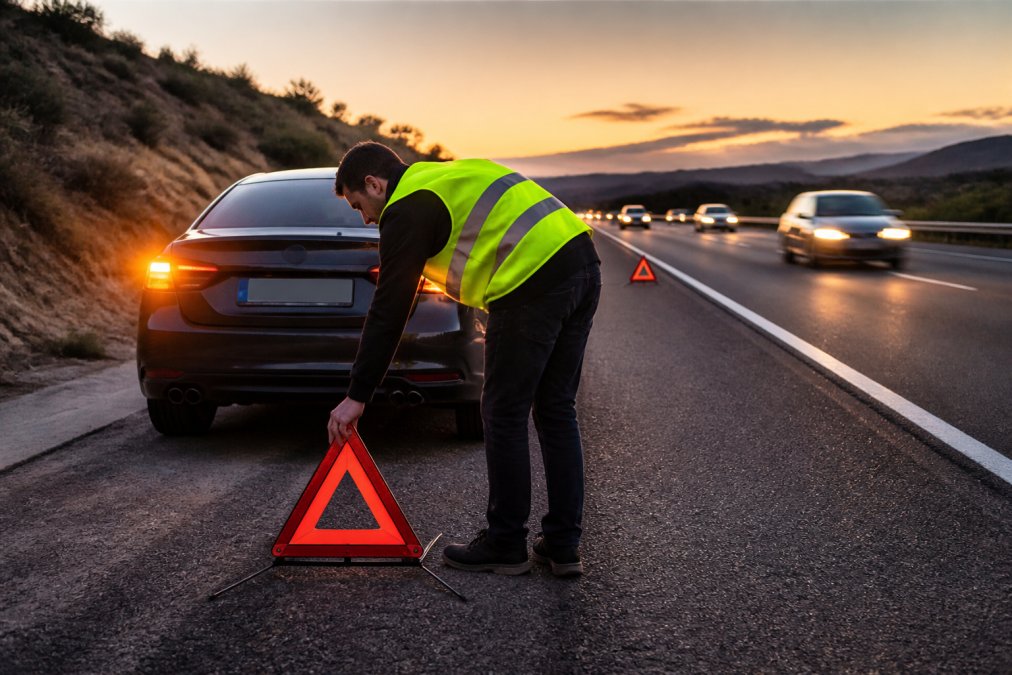
Step 1: Move to safety. If the vehicle is still drivable, pull as far onto the shoulder or median as possible. Turn on your hazard lights immediately. If you cannot move the vehicle, stay inside with your seatbelt fastened until help arrives.
Step 2: Exit carefully. Only exit the vehicle on the side away from traffic. If you are on a busy freeway, exiting at all can be dangerous. Assess the situation before opening any door.
Step 3: Set up warning devices. Place emergency triangles behind your vehicle. A general guideline is one triangle immediately behind the vehicle and another further back to give approaching drivers advance warning. On a highway, the distance should be greater than on a city street.
Step 4: Call for help. Call your emergency towing provider, give them your exact location, and describe the situation. Stay on the line until the dispatcher confirms they have all the information needed.
Step 5: Stay visible and wait. Return to your vehicle and keep your seatbelt on. If you must be outside the vehicle, wear a reflective vest and stay well behind the guardrail, away from traffic lanes.
Never stand behind your vehicle or between your vehicle and the traffic lane while waiting for the tow truck. This is how stranded motorists get struck. Stay inside the vehicle with your seatbelt on until the truck arrives.
Insurance and Reimbursement Documentation for Towing
One of the most overlooked aspects of an emergency tow is the paperwork. Many drivers assume their insurance covers the full cost, only to discover later that they lack the documentation needed for reimbursement.
Before you call for a tow, know what your policy covers. Many auto insurance policies include roadside assistance and towing as an add-on, but the coverage limits vary significantly. Some policies reimburse up to a set dollar amount per incident, while others cover only specific types of tows. According to the Insurance Information Institute’s guide on auto insurance, towing and labor coverage is an optional add-on that typically requires you to pay upfront and submit for reimbursement.
When the tow truck arrives, gather these items:
- The driver’s name and the company name
- The truck’s license plate number
- A detailed receipt showing the date, time, location, and services performed
- The destination address and the name of the repair facility
Keep every document. If you are involved in an accident, the other driver’s insurance or your own collision coverage may cover the tow, but only with proper documentation. Photograph the receipt immediately and store a digital copy.
The Federal Trade Commission’s guidance on auto insurance emphasizes understanding your coverage before an emergency occurs. Calling your insurer now to confirm whether towing is included, and at what limit, takes five minutes and can save you hundreds of dollars later.
Common Roadside Breakdown Scenarios and the Right Call
Different breakdowns require different responses, and knowing which service to request prevents wasted time and money. Here are the most common scenarios our dispatchers handle and the right call for each.
Dead battery: If the battery is completely dead, a jump-start service usually solves the problem. If the vehicle will not hold a charge after a jump, you need a tow to a repair shop for a battery or alternator test.
Flat tire: If you have a usable spare and the tools to change it, a tire change service handles it on-site. If the tire is shredded or the wheel is damaged, you need a flatbed tow to avoid further damage to the vehicle.
Locked out: Lockout assistance is a roadside service, not a tow. A technician opens the vehicle and you are back on the road. If the key is broken in the ignition, however, you may need a tow to a locksmith or dealer.
Accident: Any collision that leaves the vehicle undrivable requires emergency towing. A professional company will handle the accident towing, and Fast Towing San Diego can also connect you with a trusted repair shop so you are not left to find one yourself.
Vehicle in a ditch or off-road: This requires winch-out service, and often a flatbed for the recovery. Do not attempt to drive the vehicle out, as you risk further damage or injury.
For fleet managers and government accounts, the calculation shifts. You need a provider with the capacity to handle multiple vehicles at once and the experience to work with municipal requirements. Fast Towing San Diego offers discounted rates for First Responders, Military, and fleet accounts, recognizing that those who keep our city moving deserve reliable support when their own vehicles break down.
The common thread across every scenario is preparation. Know who you will call before you need to call them. Keep the number saved in your phone, understand your insurance coverage.
Choosing the right emergency towing provider comes down to trust: trust that they will answer at 2 AM, trust that they have the right equipment for your vehicle, and trust that the bill will match the quote. Fast Towing San Diego delivers on all three with 24/7/365 availability, professionally trained drivers with over 100 years of combined experience, and a fleet that handles everything from motorcycles to motorhomes. Get started with Fast Towing San Diego and keep a reliable number saved before you need it.
Frequently Asked Questions
What is considered emergency towing?
Emergency towing covers situations where your vehicle cannot be safely driven and you need immediate professional help. This includes accidents, breakdowns in traffic lanes, mechanical failures, or getting stuck in unsafe conditions. A 24/7 service handles these calls any hour, including nights, weekends, and holidays. If your car is disabled and poses a safety risk, that is an emergency tow. If you have a flat tire in a parking lot, that might be roadside assistance instead.
How much does a 24-hour towing service cost?
The cost of emergency towing depends on several factors: the time of day, the distance traveled, the type of vehicle, and whether a flatbed is required. After-hours calls often carry a higher rate than daytime service. Because these variables change the final price, the best approach is to ask for a clear estimate before the truck is dispatched. A company will explain the hook-up fee and the per-mile rate so you are not surprised by the bill.
Does roadside assistance cover emergency towing?
Roadside assistance and emergency towing are related but distinct services. Roadside assistance covers minor on-site fixes like jump-starts, tire changes, lockout assistance, and fuel delivery. Emergency towing is required when the vehicle cannot be fixed on the spot and must be transported to a shop. Many roadside plans include a limited towing allowance, often 5 to 15 miles. If your breakdown is beyond that distance, you may pay the difference per mile out of pocket.
What should I look for in a 24/7 towing service?
When you need a 24/7 tow truck company, confirm they answer the phone directly and dispatch from a local office, not a call center. Ask for an estimated arrival time and verify they are licensed and insured. Check if they operate flatbed tow trucks, which are safer for modern and low-clearance vehicles. Look for a company with trained drivers and ask about their response time in your specific area. A service will give you a straight answer on pricing and keep you updated on the driver’s arrival.