
Table of Contents
- What Heavy Duty Towing Capacity Actually Means for RV Owners
- Heavy Duty Towing Cost Per Mile and Ownership Expenses
- Diesel vs. Gas: Performance and Fuel Economy Trade-offs
- Fifth Wheel and Gooseneck Hitch Safety: Why Capacity Matters
- RV Roadside Assistance Plans and Emergency Coverage
- Factors Affecting RV Towing Rates and Total Cost of Ownership
- The Verdict: When Heavy Duty Towing Is Worth the Investment
- Frequently Asked Questions
Last Updated: September 25, 2026
What Heavy Duty Towing Capacity Actually Means for RV Owners
Whether is heavy duty towing for RVs worth the cost depends entirely on what you’re actually pulling. The term “heavy duty” refers to trucks engineered with reinforced frames, upgraded suspension systems, and engines designed to handle sustained loads without strain. For RV owners, understanding towing capacity means knowing the difference between a truck that can technically tow your trailer and one that can do it safely, comfortably, and without premature wear.
Towing capacity isn’t just a number on a spec sheet. It’s the maximum weight a vehicle can pull while maintaining control, stability, and safety margins. The gross vehicle weight rating (GVWR) sets the ceiling, but your actual payload capacity, what the truck can carry in addition to the trailer weight, determines whether you’re operating within safe limits or pushing dangerous boundaries.
A Ram 3500 Heavy Duty, for example, offers maximum towing capacity of up to 31,200 pounds with the right configuration. A Ford F-250 Super Duty reaches 23,000 pounds for gooseneck towing. By contrast, a standard Chevy Silverado 1500 maxes out around 13,300 pounds. The difference isn’t academic. Exceeding your truck’s capacity creates dangerous trailer sway, reduces braking effectiveness, and accelerates mechanical failure.
Check your truck’s actual payload capacity before buying a fifth wheel or gooseneck trailer. Many RV owners buy a trailer rated within their truck’s towing capacity, then discover they can’t legally carry the pin weight without exceeding GVWR.
At Fast Towing San Diego, we offer comprehensive roadside support for RV owners and heavy duty truck operators. Owners sometimes underestimate their trailer’s actual weight or overestimate their truck’s capability, leading to breakdowns.
Heavy Duty Towing Cost Per Mile and Ownership Expenses
The true cost of heavy duty towing isn’t just the purchase price. It’s the cumulative expense of fuel, maintenance, insurance, and depreciation spread across every mile you drive.
Heavy duty trucks consume significantly more fuel than light-duty alternatives, especially when towing. A diesel-powered F-250 might achieve 18-20 miles per gallon unloaded but drops to 8-10 mpg when towing a substantial load. An EcoBoost F-150 performs similarly. Over a year of regular towing, this compounds quickly. If you tow 10,000 miles annually at 9 mpg versus 15 mpg, you’re spending hundreds more on fuel alone.
Maintenance costs amplify the gap. Heavy duty trucks require more frequent oil changes, transmission servicing, and brake inspections. Diesel engines demand premium fuel and specialized service. A transmission fluid change on a heavy duty truck costs more than on a half-ton. Brake pads wear faster under load. Tire replacement is pricier because heavy duty trucks run larger, heavier-duty tires.
Insurance premiums reflect the higher replacement cost and repair expenses. A Ram 3500 costs more to insure than a Silverado 1500, and adding comprehensive coverage for towing equipment pushes premiums higher still.
Calculate your total cost of ownership before committing. Many owners find that financing a heavy duty truck at 6-7% interest, combined with fuel and maintenance costs, exceeds the value they extract from towing. If you tow fewer than 5,000 miles per year, a heavy duty truck rarely justifies its premium.
Depreciation also matters. Heavy duty trucks hold value reasonably well, but they depreciate faster than light-duty trucks in absolute dollar terms. A truck that costs $65,000 new loses more money year-over-year than a $45,000 light-duty model, even if the percentage depreciation is similar.
Diesel vs. Gas: Performance and Fuel Economy Trade-offs
The diesel versus gas debate for RV towing centers on torque, efficiency, and long-term operating costs.
Diesel engines deliver peak torque at lower RPMs than gasoline engines. A diesel F-250 produces 475 horsepower and 1,050 pound-feet of torque, making it feel more controlled and stable when towing heavy loads. The engine doesn’t labor; power delivery is linear and predictable. For towing, this matters. Diesel engines handle sustained grades and heavy loads without overheating transmission fluid or straining cooling systems.
Gasoline engines in heavy duty trucks offer adequate power but require higher RPMs to reach peak torque. They’re lighter, which slightly improves payload capacity. Maintenance is simpler and cheaper. Parts availability is broader because gasoline engines are more common.
The fuel economy story is more nuanced. Diesel engines achieve better fuel efficiency per gallon than gasoline engines, but diesel fuel costs more. A diesel truck might achieve 12-14 mpg unloaded versus 14-16 mpg for a gasoline equivalent, but diesel costs roughly 10-15% more per gallon. When towing, both drop significantly, and the advantage narrows further.
Resale value favors diesel. Used diesel trucks command premiums because buyers perceive them as more durable and capable. If you plan to sell the truck within five years, diesel’s resale advantage offsets some of its premium purchase price.
Choose diesel if you tow regularly (more than 5,000 miles annually) or plan to keep the truck long-term. Choose gasoline if you tow occasionally and prioritize lower maintenance costs and simpler repairs.
Fifth Wheel and Gooseneck Hitch Safety: Why Capacity Matters
Fifth wheel and gooseneck hitches distribute trailer weight differently than conventional ball hitches, which changes how you calculate safe towing capacity.
A fifth wheel hitch mounts in the truck bed and distributes the trailer’s pin weight (typically 15-25% of total trailer weight) directly over the truck’s rear axle. This improves stability compared to a ball hitch, which places all tongue weight on the bumper. A gooseneck hitch works similarly, mounted to the frame in the truck bed.
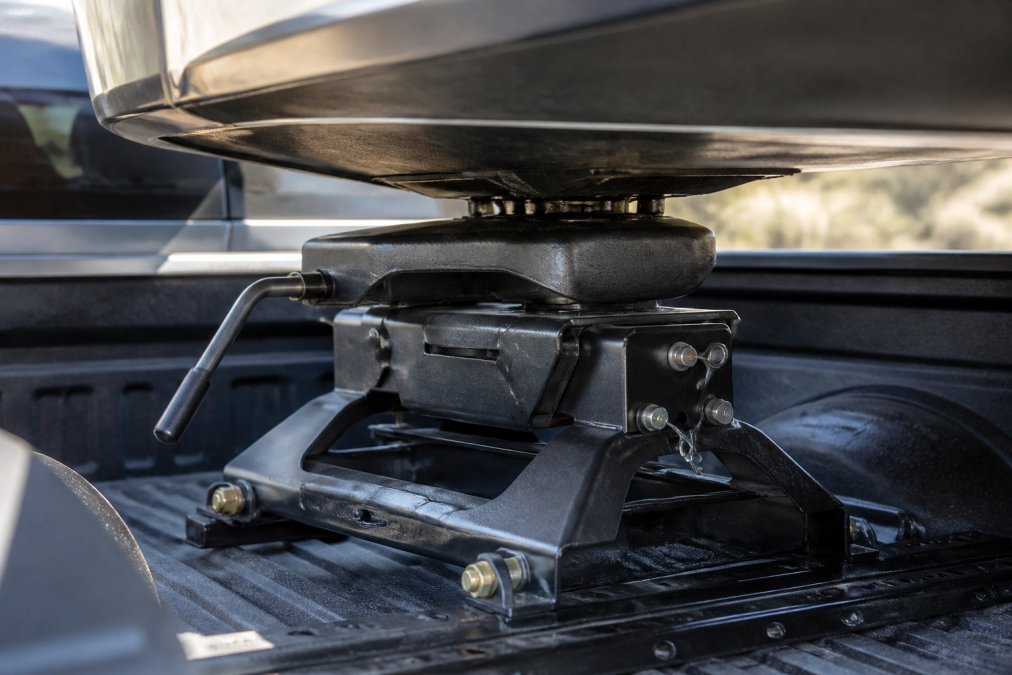
The safety advantage is real. Fifth wheel and gooseneck trailers experience less sway in crosswinds and better braking control because weight is distributed more favorably. They’re also easier to back up because the hitch pivot point is inside the truck bed rather than at the bumper.
However, the pin weight requirement creates a constraint. A 40-foot fifth wheel might weigh 15,000 pounds total, with 3,500 pounds of pin weight. Your truck’s payload capacity must accommodate that 3,500 pounds plus any cargo you’re carrying. Many RV owners discover their truck’s GVWR prevents them from legally towing a fifth wheel they thought their towing capacity supported.
The Ram 3500 and Ford F-250 Super Duty handle this better than lighter trucks because their payload capacities are higher. A Silverado 1500 struggles with large fifth wheels because payload capacity maxes around 2,000-2,500 pounds.
RV Roadside Assistance Plans and Emergency Coverage
Roadside assistance becomes critical when you’re towing an RV. A breakdown on the highway with a 40-foot trailer creates a crisis that standard roadside assistance doesn’t handle.
Premium roadside assistance plans specifically for RV towing cover heavy recovery (extracting a disabled rig from a ditch), fuel delivery, lockout service, and mechanical triage. They also cover accommodation costs if you’re stranded overnight. Standard plans through your auto insurance often exclude RV trailers or cap coverage at light-duty towing.
Fast Towing San Diego offers comprehensive roadside support designed for RV owners and heavy duty truck operators. We respond 24/7 and maintain relationships with repair shops equipped to handle heavy duty diesel engines and RV-specific systems. Our team has over 100 years of combined experience managing complex towing scenarios.
When you’re stranded with an RV, response time matters enormously. A two-hour wait becomes intolerable when you’re blocking a highway lane. Our professionally trained drivers know how to safely secure and move disabled RVs without causing secondary damage.
RV owners who tow regularly (more than 3,000 miles annually) should carry dedicated RV roadside assistance. Standard automotive plans don’t provide adequate coverage for the complexity and cost of RV recovery.
Factors Affecting RV Towing Rates and Total Cost of Ownership
Total cost of ownership for heavy duty towing encompasses purchase price, fuel, maintenance, insurance, depreciation, and opportunity cost.
Purchase price varies widely. A Ram 3500 starts significantly higher than a Silverado 1500. Financing at current interest rates (typically 6-8% for vehicle loans in 2026) adds substantial carrying costs. A $70,000 truck financed over 72 months at 7% costs roughly $1,100 monthly before insurance, fuel, and maintenance.
Fuel costs depend on towing frequency and distance.
The Verdict: When Heavy Duty Towing Is Worth the Investment
Heavy duty towing for RVs is worth the cost if and only if you meet specific criteria.
Buy a heavy duty truck if:
- You tow a fifth wheel or gooseneck trailer weighing more than 12,000 pounds
- You tow regularly (more than 5,000 miles annually)
- You plan to keep the truck for seven or more years
- You tow in mountainous terrain or frequently face steep grades
- You value the safety margin and reduced mechanical strain of operating well within capacity
Consider a light-duty truck if:
- Your RV or travel trailer weighs under 10,000 pounds
- You tow fewer than 3,000 miles annually
- You plan to replace the truck within five years
- You primarily tow on flat terrain and highways
- Fuel economy and lower operating costs are priorities
Frequently Asked Questions
How much does heavy duty towing for RVs typically cost?
Cost varies based on distance, RV weight, hitch type, and terrain. Heavy duty towing rates depend on whether you need emergency roadside assistance or planned transport. Professional services like Fast Towing San Diego offer 24/7 support with pricing based on your specific situation. Contact directly for a quote tailored to your RV’s gross vehicle weight rating and towing needs.
What factors affect RV towing rates the most?
Key factors include payload capacity required, distance traveled, RV gross vehicle weight rating, hitch type (fifth wheel vs. gooseneck), fuel costs, and whether the tow vehicle uses diesel or gas. Single rear wheel (SRW) configurations cost less than dually (DRW) setups. Emergency calls outside business hours may incur additional fees. Weather conditions and road terrain also impact rates.
Do standard roadside assistance plans cover heavy duty RV towing?
Most standard roadside assistance plans have weight limits that exclude heavy RVs. Specialized RV roadside assistance plans offer better coverage for large trailers and fifth wheels. Professional heavy duty towing services like Fast Towing San Diego provide dedicated RV support beyond typical roadside plans, including recovery on steep grades and in challenging terrain where standard tow trucks cannot operate.
Is it safer to hire professional heavy duty towing for RVs?
Yes. Professional heavy duty towing services use specialized equipment, trained drivers with experience handling large trailers, and proper braking systems to manage trailer sway and weight distribution. Attempting DIY towing with inadequate equipment risks jackknifing, brake failure, and loss of control. Professional operators understand axle ratio requirements, transmission cooling needs, and safety margins that prevent accidents on highways and steep grades.