
Table of Contents
- Understanding the Components of Motorcycle Towing Cost Per Mile
- Motorcycle Towing Hook-Up Fee: What You’ll Pay Upfront
- Flatbed Towing vs Wheel Lift for Motorcycles: How Equipment Choice Affects Your Bill
- Factors Affecting Towing Service Rates and Mileage Calculations
- Step-by-Step: Calculate Your Total Motorcycle Towing Cost
- Hidden Fees and After-Hours Surcharges to Watch For
- Getting an Accurate Quote and Avoiding Surprises
- Frequently Asked Questions
Last Updated: October 2, 2026
Understanding the Components of Motorcycle Towing Cost Per Mile
When your motorcycle breaks down, understanding motorcycle towing cost per mile helps you avoid sticker shock. The total cost combines multiple fees: a base hook-up fee, mileage charges, and potential surcharges.
Most towing services charge a base hook-up fee (covering dispatch, setup, and the first 3-5 miles) plus a per-mile rate for additional distance.
Your bill typically includes:
- Base hook-up fee
- Mileage rate (after included distance)
- Equipment surcharges
- After-hours or holiday premiums
Fast Towing San Diego breaks down all costs upfront before arrival.
Motorcycle Towing Hook-Up Fee: What You’ll Pay Upfront
The motorcycle towing hook-up fee is the fixed dispatch and setup charge, the “showing up” fee.
Hook-up fees vary by time of day (daytime is cheaper than midnight calls) and distance from the towing company’s base.
For motorcycles, hook-up fees include specialized equipment costs. Flatbed service with motorcycle-specific straps costs more than wheel-lift options.
The hook-up fee typically covers the first 3-5 miles. Distance beyond that is charged at the per-mile rate.
Ask the dispatcher what distance is included in the hook-up fee before agreeing to service. This one question can save you from unexpected mileage charges on short hauls.
Flatbed Towing vs Wheel Lift for Motorcycles: How Equipment Choice Affects Your Bill
Equipment choice directly impacts your hook-up fee and per-mile rate. For motorcycles, flatbed is the only safe option.
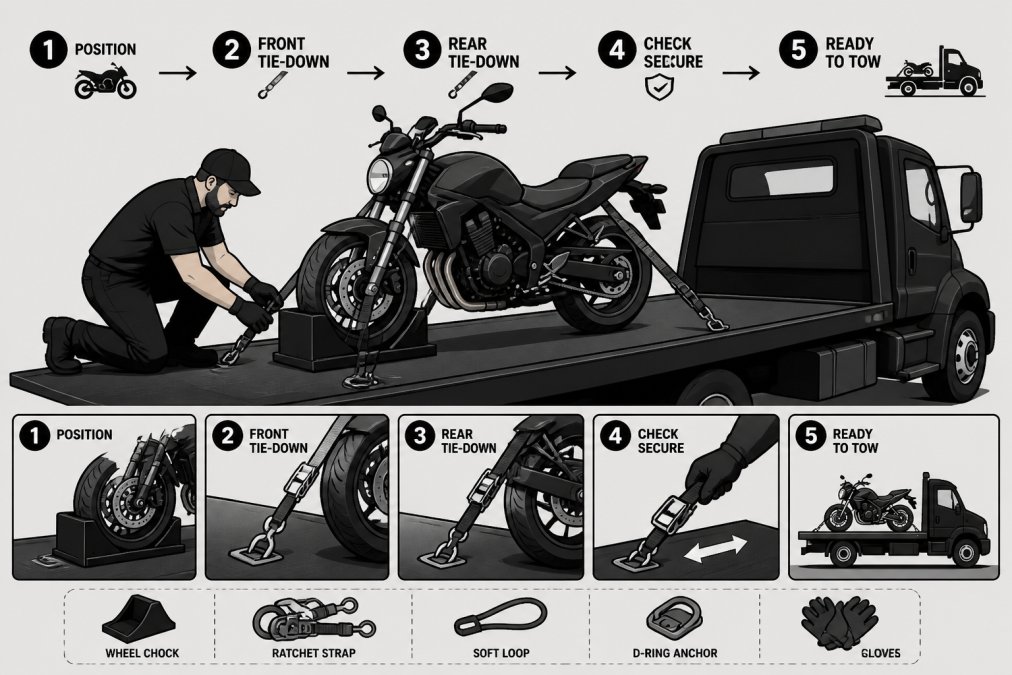
Flatbed towing secures your motorcycle on a flat platform with straps at four anchor points (front and rear). This is the safest method and prevents fuel leakage or fluid damage. It costs more due to specialized equipment and careful positioning required.
Wheel-lift towing raises one end while the other drags.
Flatbed service carries both a higher hook-up fee and per-mile rate.
Wheel-lift may save upfront, but frame damage, cracked fairings, or bent forks can be costly to repair.
Flatbed operators charge more because of heavier fuel consumption, specialized equipment, higher liability insurance, operator training, and slower transport speeds.
Using wheel-lift towing on a motorcycle can cause frame damage, broken mirrors, bent handlebars, transmission fluid leaks, and cracked fairings. The upfront “savings” can turn into significant repair costs. Always specify flatbed towing and confirm the operator has motorcycle-specific equipment before dispatch.
When getting a quote, ask: “What is your flatbed motorcycle per-mile rate?” “Are fuel surcharges included?” “What motorcycle-specific equipment do you use?” If a company quotes wheel-lift or won’t specify their flatbed rate, that’s a red flag.
Factors Affecting Towing Service Rates and Mileage Calculations
Several factors affect your final cost:
Time of day: After-hours surcharges (10-25%) apply for evening, night, and early morning calls. Holiday rates are even higher.
Distance category: Local towing (under 10 miles) may have flat rates; long-distance hauls (50+ miles) use per-mile pricing.
Service radius: Dispatch fees increase if you’re far from the towing company’s base.
Vehicle condition: Accident damage or awkward positioning may require extra equipment or time.
The mileage rate is usually the most transparent part of your bill. Everything else, hook-up fees, surcharges, equipment charges, is where hidden costs hide. Ask about all of these upfront.
Step-by-Step: Calculate Your Total Motorcycle Towing Cost
Total Cost = Hook-Up Fee + (Mileage Rate × Billable Miles) + Surcharges
- Confirm the hook-up fee for flatbed motorcycle towing
- Determine included mileage (typically 3-5 miles)
- Measure distance using Google Maps
- Calculate billable mileage (total distance minus included miles)
- Get the per-mile rate
- Multiply rate by billable miles
- Add hook-up fee and any surcharges (after-hours, holiday, etc.)
Example: $75 hook-up + ($3/mile × 7 billable miles) + 15% after-hours surcharge = $110.40
Here’s a quick reference table to keep handy:
| Cost Component | What It Covers | Example Amount |
|---|---|---|
| Hook-up fee | Dispatch and initial setup | $60-$90 |
| Included mileage | Distance covered in hook-up fee | 3-5 miles |
| Mileage rate | Cost per mile beyond included distance | $2-$5 per mile |
| After-hours surcharge | Evening/night/early morning premium | +10-25% |
| Holiday surcharge | Weekend or holiday premium | +15-30% |
| Equipment surcharge | Flatbed or specialized equipment | +$15-$40 |
Hidden Fees and After-Hours Surcharges to Watch For
Watch for these potential hidden fees:
Dispatch fees: Sometimes separate from hook-up fees. Ask upfront.
Waiting time fees: Charged if truck arrives before you’re ready (usually 15-30 minute grace period).
Fuel surcharges: Percentage-based, especially for long-distance hauls.
After-hours surcharges: 20-30% premium for nights, weekends, and holidays.
Storage fees: Rare for short-term tows but apply if your bike sits at the lot.
Ask for a complete breakdown including all fees before dispatch. Fast Towing San Diego provides upfront estimates.
Getting an Accurate Quote and Avoiding Surprises
Getting an accurate quote requires asking the right questions and understanding what coverage you may already have.
Check your existing coverage first:
Before calling a towing company, review your current policies and memberships:
-
Motorcycle insurance roadside assistance: Many comprehensive or full-coverage motorcycle policies include roadside assistance that covers towing. Coverage typically includes towing costs, sometimes with unlimited mileage or a cap per incident. Check your policy documents or call your insurer to confirm coverage limits and whether there’s a deductible.
-
AAA or motor club membership: AAA membership (Plus or Premier tier) includes towing coverage. Basic AAA, Plus, and Premier tiers include towing coverage. If you’re a member, your towing may be free or heavily subsidized, with the club paying the towing company directly.
-
Credit card roadside assistance: Some premium credit cards (American Express Platinum, certain Visa Infinite cards) include roadside assistance that covers towing. Review your card’s benefits guide or call the number on the back of your card.
-
Employer or union benefits: Some employers offer roadside assistance as an employee benefit. Check your employee handbook or HR portal.
-
Motorcycle dealership warranty: If your bike is still under warranty, some dealerships include roadside assistance or will cover towing to an authorized service center.
How insurance coverage affects your out-of-pocket cost:
If your motorcycle insurance covers a portion of towing and your total bill is higher, you pay the difference out of pocket.
When calling to verify coverage:
Contact your insurance company or membership organization and ask:
- “Do I have roadside assistance or towing coverage included in my policy?”
- “What is the maximum towing distance covered per incident?”
- “Is there a deductible or out-of-pocket maximum?”
- “Do I need to use a specific towing company, or can I choose any provider?”
- “Will you pay the towing company directly, or do I pay and submit for reimbursement?”
Write down the coverage amount and any restrictions.
Getting a quote from a towing company:
Once you’ve confirmed your coverage, call a towing company with this information:
What to tell the dispatcher:
- Your exact location (address or mile marker)
- Your destination (repair shop address, home address, etc.)
- The time of day and day of week
- That you need flatbed towing for a motorcycle
- Whether your bike is still operational or completely disabled
- Your insurance or membership coverage (if applicable)
What to ask them:
- “What is your base hook-up fee for flatbed motorcycle towing?”
- “How many miles are included in that fee?”
- “What is your per-mile rate after that?”
- “Do you accept [my insurance company / AAA / my membership] coverage directly, or do I pay and submit for reimbursement?”
- “Are there any after-hours or holiday surcharges? If so, what percentage?”
- “Is there a dispatch fee separate from the hook-up fee?”
- “What is your total estimated cost to tow from [location A] to [location B], accounting for any insurance coverage I have?”
Write down every number they give you. Repeat the total back to them to confirm.
Understanding the quote breakdown:
A complete quote should itemize:
- Hook-up fee
- Included mileage (e.g., “first 5 miles included”)
- Per-mile rate for distance beyond included mileage
- Any surcharges (after-hours, holiday, equipment)
- Insurance or membership credit (if applicable)
- Final out-of-pocket total
Without understanding your coverage, you might have paid the full $124.30.
Red flags in a quote:
- A company refuses to give you a per-mile rate or total estimate over the phone
- The quote changes significantly when the driver arrives (legitimate quotes may vary by ±$10-$15 due to exact location, but not by $50+)
- They claim they don’t accept your insurance coverage (most reputable companies do)
- They pressure you to authorize payment before confirming the final distance
Get quotes from at least two companies and verify your insurance coverage before dispatch. Price comparison can save you money on the same service. If you have AAA or insurance coverage, mention it upfront, some companies offer additional discounts for members.
After the tow:
Frequently Asked Questions
How much does it typically cost to tow a motorcycle per mile?
Motorcycle towing cost per mile varies based on distance, equipment type, and service provider. Pricing depends on whether you use flatbed transport or wheel-lift equipment, time of day, and your location. Contact Fast Towing San Diego for a specific quote based on your situation.
What is the difference between flatbed towing and wheel-lift for motorcycles?
Flatbed towing transports your entire motorcycle on a flat platform, offering maximum protection and stability, making it ideal for valuable or vintage bikes. Wheel-lift equipment raises the front or rear wheel, keeping one end on the ground, and generally costs less but carries higher risk of damage. For motorcycles, flatbed transport is typically recommended because it prevents stress on the frame and suspension.
What should I look for in a professional motorcycle towing quote?
A clear quote should itemize the base hook-up fee, per-mile mileage rate, equipment type (flatbed vs wheel-lift), and any applicable surcharges (after-hours, holiday, or dispatch fees). Ask whether the quote includes roadside assistance and what happens if your motorcycle requires special handling. Verify the provider has experience with motorcycles specifically, as improper equipment or technique can cause costly damage.
What factors influence the total cost of a motorcycle tow?
Total cost depends on distance traveled, base hook-up fee, mileage rate, towing equipment used, time of service (after-hours surcharges apply late night or holidays), vehicle weight and condition, service radius, and whether recovery or special handling is needed. Local tows and long-distance hauls use different pricing models. Always request an itemized estimate before service to avoid unexpected charges.