
Table of Contents
- What Is Zero Degree Exotic Car Towing
- Flatbed Towing for Exotic Cars: The Safe Transport Method
- Low-Clearance Car Towing: Loading Angle and Ground Protection
- How to Prepare an Exotic Car for Towing
- Why Exotic Cars Require Specialized Towing Equipment
- Understanding Exotic Car Towing Cost and Pricing Factors
- What to Confirm Before Dispatch
- Frequently Asked Questions
Last Updated: October 10, 2026
What Is Zero Degree Exotic Car Towing
Zero degree exotic car towing refers to a transport method in which the vehicle remains perfectly level, at a zero-degree angle, throughout the entire pickup, loading, transport, and delivery process. The term emphasizes that neither the front nor the rear of the car is lifted, tilted, or angled at any point. This contrasts sharply with standard towing methods that inherently tilt or lift one end of the vehicle.
The “zero degree” designation is a practical descriptor used by exotic car transport specialists to promise that your vehicle will not be subjected to any angular stress or suspension load imbalance during towing.
How zero degree towing differs from other methods:
Wheel-lift towing lifts either the front or rear wheels off the ground, tilting the vehicle 10 to 20 degrees. This is dangerous for exotic cars because it stresses suspension components, bends frame rails, and risks damage to low-hanging bumpers or splitters.
Partial flatbed towing loads the vehicle at an angle, exposing bumpers and undercarriage components to scraping or collision with the ramp edge.
Open flatbed towing keeps the vehicle level but exposes it to weather, road debris, and UV damage.
Enclosed flatbed towing combines zero-degree levelness with weather and debris protection. The vehicle sits perfectly level on a fully enclosed trailer, shielded from the elements and prying eyes. This is the gold standard for exotic cars, supercars, and vintage vehicles.
Why zero degree matters for exotic cars:
Exotic vehicles, supercars, high-performance sports cars, luxury sedans, and vintage classics, have characteristics that make them vulnerable to standard towing:
- Low ground clearance: Many exotic cars sit 3 to 4 inches off the ground, compared to 5 to 6 inches for typical sedans. Custom aerodynamic components like splitters, diffusers, and carbon fiber bumpers hang even lower.
- Precision suspension tuning: Exotic cars use independent suspension systems engineered for performance. Tilting the car stresses components not designed to support asymmetrical weight.
- Sensitive drivetrain: Front-wheel-drive exotics require flatbed towing to protect transmissions. All-wheel-drive vehicles also require flatbed towing to avoid drivetrain strain.
- Expensive paint and trim: A single scratch on an exotic car’s body can cost $2,000 to $5,000 to repair. Hard chains or metal tie-downs used in standard towing can dent wheels, crack carbon fiber, or damage custom panels.
Zero degree towing eliminates these risks by keeping the entire vehicle level, supporting all four wheels evenly, and using soft, padded straps that protect paint and trim.
Before dispatch, confirm your vehicle’s ground clearance and any low-hanging components (splitters, diffusers, or custom bumpers). This information helps your towing operator plan the safest loading angle and tie-down placement.
Flatbed Towing for Exotic Cars: The Safe Transport Method
Flatbed towing is the industry standard for exotic cars. A flatbed truck has a completely flat, level platform where your car sits with all four wheels supported evenly.
Flatbed towing keeps your car level throughout transport, protects low bumpers and splitters, supports the entire undercarriage, works for any vehicle type, and prevents fluid leaks.
Your exotic car should be secured with soft straps (padded tie-downs) at multiple points on the frame or suspension. Hard chains or metal straps can dent body panels or crack wheels.
Enclosed flatbeds shield your car from weather, road debris, and prying eyes. Enclosed transport is worth the investment for long-distance moves or high-value vehicles.
A professional towing operator positions your car to maximize stability, confirms your vehicle’s specifications before loading, and adjusts their approach based on your car’s design.
Flatbed towing is non-negotiable for exotic cars. It’s the only method that keeps your entire vehicle level and protected during transport.
Low-Clearance Car Towing: Loading Angle and Ground Protection
Low-clearance vehicles require a low-clearance flatbed with a hydraulic ramp that lowers gradually, allowing the operator to load your car at a shallow angle and protect bumpers.
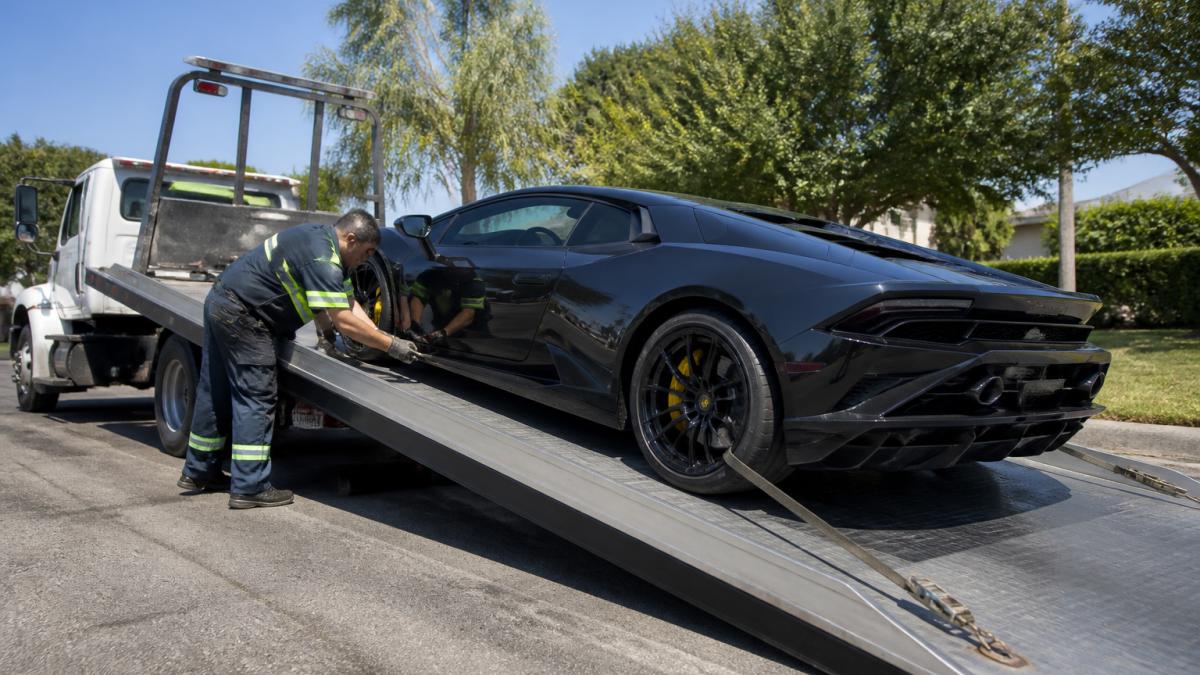
During low-clearance loading: the operator assesses ground clearance, lowers the ramp to 10-15 degrees, guides the car onto the flatbed slowly, secures it with soft straps at frame rails or suspension points, and verifies no parts hang over the edge.
Soft straps should attach to the frame, suspension components, or manufacturer-designated hard points, never around painted body panels or delicate trim.
Once secured, the operator should verify the vehicle is stable and won’t shift during transport using proper weight distribution and multiple tie-down points.
How to Prepare an Exotic Car for Towing
Preparing your exotic car for towing involves both pre-dispatch steps and understanding the loading and unloading procedure itself.
Before the towing operator arrives:
Check your vehicle’s documentation. Locate your owner’s manual for manufacturer guidance on towing, tie-down points, and special handling instructions. Document any restrictions and share them with your dispatcher.
Document your car’s condition. Take photos of the exterior, undercarriage, and interior before towing to protect you if damage occurs during transport.
Disable any security features. Inform your towing operator about alarm systems, kill switches, or immobilizers so they can avoid unexpected issues during loading.
Leave the fuel tank partially full. A quarter to half-full tank prevents fuel pump damage and fuel sloshing during transport.
Ensure the battery is charged. A dead battery can prevent safe loading. Charge the battery before dispatch if your car has been sitting.
Provide access. Make sure the towing operator can reach your car easily. Clear obstacles, move other vehicles, and unlock gates or garage doors if needed.
Communicate any concerns. If your car has a custom suspension, aftermarket bumper, or low-hanging components, tell the operator. They’ll adjust their approach to protect those parts.
The loading procedure, step by step:
Understanding what happens during loading helps you prepare mentally and ensures the operator follows safe practices.
Step 1: Vehicle assessment and positioning. The operator inspects your car’s ground clearance, bumpers, splitters, and modifications, then positions the flatbed truck parallel to your car.
Step 2: Ramp lowering and angle confirmation. The operator lowers the ramp hydraulically to 10-15 degrees and verifies it won’t contact the bumper, splitter, or undercarriage.
Step 4: Positioning on the flatbed. The operator positions the car to maximize stability and weight distribution, centering it lengthwise and widthwise on the bed.
Step 6: Clearance and stability verification. The operator confirms no parts hang over the flatbed edge, all straps are secure, and the vehicle won’t shift during transport.
The unloading procedure, step by step:
Unloading requires the same care as loading to prevent damage at the final stage.
Step 2: Strap removal. The operator carefully removes all soft straps slowly to prevent the vehicle from shifting.
Step 5: Documentation and handoff. The operator provides a signed delivery confirmation and any damage reports, confirming the correct delivery location.
Never attempt to tow an exotic car yourself using a standard tow bar or dolly. Improper towing can damage the transmission, suspension, and frame. The cost of repairs often exceeds the cost of professional towing. Always hire a specialized exotic car towing operator who understands the unique requirements of high-value vehicles.
Why Exotic Cars Require Specialized Towing Equipment
Exotic cars and luxury vehicles are engineered differently than standard passenger cars. Their lower ground clearance, lighter materials, and precision suspension systems demand specialized care.
Ground clearance is the biggest factor. A typical sedan sits 5-6 inches off the ground; a sports car or supercar sits 3-4 inches. A standard tow truck that lifts the front end will catch and damage low-hanging parts immediately.
Suspension geometry is delicate. Exotic cars use independent suspension systems tuned for performance. Tilting the car can bend control arms, damage bushings, or misalign the suspension.
Drivetrain vulnerability varies by model. Front-wheel-drive exotics must be towed on a flatbed to protect the transmission. All-wheel-drive vehicles require flatbed towing. A standard operator might make a mistake without knowing your car’s drivetrain.
Paint and trim are expensive. A single scratch on an exotic car’s bumper can cost $2,000-$5,000 to repair. Soft straps with padding are non-negotiable.
Manufacturer guidance matters. Many exotic car manufacturers provide specific towing instructions. A specialized operator knows to ask for and follow these guidelines.
Understanding Exotic Car Towing Cost and Pricing Factors
Exotic car towing costs more than standard towing, and understanding why helps you plan accordingly.
Several factors influence the final price: distance, vehicle type, time of day, accessibility, enclosed vs. open transport, specialized equipment, and distance from the operator.
For accurate pricing, contact us directly with details about your vehicle, location, and destination for an upfront quote.
Owners of exotic cars, supercars, and vintage vehicles who need reliable, professional transport without the risk of damage from standard towing methods.
What to Confirm Before Dispatch
Before your towing operator arrives, confirm these details to ensure a smooth pickup.
Vehicle specifications: Tell the dispatcher your car’s make, model, year, custom modifications, and any low-hanging components.
Location details: Confirm your exact address, gate codes, parking location, and any access restrictions.
Destination: Provide the full address where your car will be delivered. If it’s a repair shop, body shop, or storage facility, confirm they’re expecting the vehicle.
Contact information: Give a phone number where you can be reached during the tow. The operator may need to contact you if there are questions or delays.
Special instructions: Mention any alarm systems, battery concerns, or mechanical issues. If your car hasn’t run recently, let the operator know so they can adjust their approach.
Insurance and documentation: Have your proof of ownership and insurance information ready. Some operators may ask for these details.
Preferred tie-down points: If you have the owner’s manual, share the manufacturer’s recommended tie-down locations. This helps the operator secure your car safely.
A few minutes of communication before dispatch prevents confusion and protects your vehicle. Professional towing operators ask these questions routinely. They want the same outcome you do: safe transport of your exotic car.
Exotic car towing isn’t just about moving your vehicle from point A to point B. It’s about protecting an investment using specialized equipment, trained operators, and proven methods. Zero degree exotic car towing eliminates the guesswork and risk that comes with standard towing. When your high-value vehicle needs transport, choosing a professional team with experience in exotic cars makes all the difference. Fast Towing San Diego has the expertise, equipment, and commitment to get your car where it needs to go safely. Contact us for a quote.
Frequently Asked Questions
What does zero degree exotic car towing mean?
Zero degree towing refers to loading a vehicle onto a flatbed at a completely horizontal angle, with no incline or decline. This method protects the undercarriage, bumpers, and suspension of exotic cars and other high-value vehicles from damage. The vehicle is secured flat and level on the transport bed, preventing scraping or stress on low-clearance components. This approach is standard for luxury vehicles, vintage cars, and supercars that cannot tolerate the strain of traditional towing methods.
How does flatbed towing for exotic cars differ from standard towing?
Flatbed towing for exotic cars uses a completely flat, level platform to support the entire vehicle, whereas standard towing often relies on wheel lifts that raise the front or rear wheels off the ground. Flatbed transport eliminates contact between the vehicle’s drivetrain and the road, protecting all-wheel-drive systems, low bumpers, and custom suspension. Exotic cars, classics, and luxury vehicles require flatbed methods because their design, ground clearance, and value make them vulnerable to damage from wheel-lift or hook-and-chain techniques.
What should I tell a towing company before it transports my exotic car?
Before dispatch, confirm your vehicle’s ground clearance, bumper height, and any aftermarket modifications that affect loading. Mention if it’s all-wheel-drive, has a custom suspension, or includes low-profile spoilers or air dams. Provide the manufacturer’s towing guidance if available. Specify whether the vehicle is in running condition and disclose any existing damage. Request a flatbed and confirm the operator’s experience with exotic vehicles. Ask whether the company has insurance coverage for high-value transport to protect your investment during the journey.
Why does ground clearance matter in low-clearance car towing?
Ground clearance determines the angle and method required to safely load a vehicle onto a flatbed without scraping the bumper, splitter, or underbody. Exotic cars and performance vehicles often have very low clearance by design, sometimes just 4-5 inches from the ground. If a towing operator attempts to drive the vehicle onto a ramp at too steep an angle, the front or rear bumper will strike the equipment or truck bed, causing expensive damage. Proper loading at zero degrees, completely horizontal, ensures the vehicle clears all obstacles and reaches the flatbed safely.