
Table of Contents
- What Are Towing Surcharges and Why They Exist
- Distance and Mileage: The Foundation of Towing Charges
- After-Hours Towing Fees and Peak-Demand Pricing
- Vehicle Type, Size, and Weight Impact on Surcharges
- Winching and Recovery Charges for Difficult Extractions
- Specialized Equipment and Service-Call Fees
- How to Dispute Towing Charges and Verify Fees
- Reading Your Towing Estimate and Fee Breakdown
- Frequently Asked Questions
Last Updated: October 18, 2026
What Are Towing Surcharges and Why They Exist
Towing surcharges are extra fees added to your base towing charge. They cover specific services, circumstances, or conditions beyond a standard tow.
Towing companies add surcharges because certain situations require extra equipment, time, or expertise.
The most common surcharges fall into four categories: distance-based charges, time-based fees, vehicle-specific costs, and recovery or equipment charges. Each reflects real expenses the towing company incurs.
Distance and Mileage: The Foundation of Towing Charges
Distance is the primary cost driver in towing. Your base tow charge usually covers a set distance, typically 5-10 miles.
Here’s how distance pricing typically works:
- Base rate: Covers the first 5-10 miles (varies by company)
- Per-mile charge: Applies to every mile beyond the included distance
- Return trip: If the tow truck must return empty, some companies charge a return-mileage fee
A 15-mile tow isn’t twice as expensive as a 7-mile tow: you pay the base rate once, then per-mile charges for the extra 8 miles.
The per-mile rate depends on your vehicle type and local market.
Always ask for the per-mile rate before authorizing the tow.
After-Hours Towing Fees and Peak-Demand Pricing
After-hours fees apply when you need a tow outside normal business hours. Late-night, weekend, and holiday service costs more because the company must staff drivers when demand is low and labor costs are higher.
Time-based surcharges are not one fee. They are a stack of separate triggers, and each one should appear as its own line item on your estimate. The common triggers are:
- Night surcharge: Applies when dispatch or service occurs during a defined overnight window, commonly 10 PM to 6 AM. Companies usually express it as a percentage above the base rate rather than a flat dollar amount.
- Weekend surcharge: Applies to Saturday and Sunday service. Some companies apply it only to certain hours, so confirm the exact window.
- Holiday surcharge: Applies on major holidays. Holiday rates are often the highest time-based premium because staffing is hardest to arrange.
- Dispatch or service-call fee: Charged whenever a truck is sent, separate from any time-based surcharge. This fee can apply even during normal business hours.
How the surcharges stack
A single tow can trigger more than one time-based fee: a 2 AM tow on New Year’s Day could combine a night surcharge, a holiday surcharge, and a dispatch fee. Ask the dispatcher which triggers apply and whether they stack or only the highest one applies.
How to verify time-based surcharges before you authorize
Use this checklist before the truck rolls:
- Ask for the after-hours rate sheet. Request the company’s written schedule of night, weekend, and holiday percentages. A legitimate operator can provide it.
- Confirm the time window. Ask whether the surcharge is based on when you called, when the truck was dispatched, or when service began. The three can fall in different windows.
- Confirm stacking rules. Ask directly: “If a night and holiday surcharge both apply, do you charge both or the higher one?”
- Get the dispatch fee in writing. Confirm whether it is included in the base rate or added separately.
- Ask about storm pricing. If severe weather is active, ask whether peak-demand pricing is in effect and how it is calculated.
- Record the quote. Note the dispatcher’s name, the time of your call, and the quoted total. This record matters if the final invoice differs.
If you are stranded late at night, call your insurance company or roadside-assistance provider before authorizing the tow. Many policies and membership plans cover after-hours service or reimburse time-based surcharges, and knowing your coverage first prevents paying out of pocket for a fee that would have been covered.
Why the premium exists
Late-night, weekend, and holiday tows compensate drivers for working when most people sleep and reflect higher labor costs. Peak-demand pricing reflects scarcity: when a storm hits and dozens of drivers need help at once, trucks are limited.
If you are stranded at 2 AM on a holiday, expect to pay significantly more than for a Monday morning tow. Confirm the triggers in advance so the final bill matches the quote.
Vehicle Type, Size, and Weight Impact on Surcharges
Not all vehicles tow the same: a motorcycle tows cheaper than an SUV, which tows cheaper than a heavy truck.
Size and weight determine surcharges because:
- Heavier vehicles require more powerful equipment and burn more fuel
- Larger vehicles take up more truck space, limiting other jobs
- Specialty vehicles (exotic cars, motorcycles, boats) need specialized carriers
- Tall or wide vehicles may need special routing to avoid obstacles
Common vehicle surcharges:
- Heavy-duty surcharge: Applies to trucks over 10,000 lbs (adds 25-50% to base rate)
- Motorcycle discount: Often 20-30% below standard car rate
- Luxury or exotic vehicle surcharge: High-value cars may charge 30-75% extra due to liability
- Boat or trailer surcharge: Specialized equipment required (can add 50-100%)
Fast Towing San Diego handles everything from compact cars to large boats and exotic vehicles. Tell us your vehicle type and weight when you call, and we’ll quote the exact surcharges that apply.
Winching and Recovery Charges for Difficult Extractions
When your vehicle is stuck, in a ditch, mud, snow, or wreckage, simple towing won’t work. Winching and recovery charges apply when the tow truck must pull or extract your vehicle from a difficult position.
Recovery situations include:
- Vehicle in a ditch: Requires winching at an angle
- Vehicle in mud or sand: Needs extra pulling power and time
- Vehicle in snow or ice: May need multiple attempts
- Vehicle in water: Requires specialized recovery equipment
The tow operator assesses the situation and quotes a recovery fee before starting work, covering equipment setup, winch operation, additional vehicles or personnel if needed, and extraction time.
Always ask what recovery charges apply before authorizing work.
Specialized Equipment and Service-Call Fees
Some situations require equipment beyond a standard tow truck. Specialized equipment surcharges cover the cost of deploying extra tools and vehicles.
Common specialized equipment includes:
- Flatbed towing: For low-clearance vehicles, luxury cars, or vehicles with damage
- Heavy wrecker: For extremely heavy vehicles or complex extractions
- Air cushion or pneumatic lift: For vehicles that can’t be towed normally
- Rotator or rotational equipment: For accident scenes requiring precise positioning
A service-call fee or dispatch fee is charged whenever a truck is sent, covering dispatcher coordination, fuel, driver time en route, and vehicle wear and tear.
Flatbeds are more expensive to operate and maintain, and a heavy wrecker for accident recovery is specialized equipment.
How to Dispute Towing Charges and Verify Fees
Overcharging happens, and the way you document the tow determines whether a dispute succeeds. Here is a repeatable process for verifying fees before you authorize a tow and challenging them afterward.
First, know which kind of tow you are dealing with
The rules and your leverage differ depending on whether the tow is consensual or nonconsensual.
- Consensual tow: You called for the tow or agreed to it. You have the most leverage because you can refuse service, compare quotes, and negotiate before the truck arrives.
- Nonconsensual tow: Your vehicle was towed without your prior agreement, typically from private property at the request of a property owner or manager. These tows are subject to state and local rules on signage, notice, and maximum fees, and consumer protections are often stronger. If your car was towed from a private lot, ask the lot and the towing company for the authorization record and the posted signage rules before paying.
A fee that is legitimate in a consensual roadside tow may be capped or prohibited in a nonconsensual private-property tow.
Before authorizing the tow
- Ask for a written estimate or quote, including every surcharge that applies.
- Request an itemized breakdown: base or hookup fee, per-mile rate, time-based surcharges, equipment fees, and any recovery charge.
- Confirm the per-mile rate and the included distance.
- Ask what happens if the tow takes longer than expected or if access is harder than described.
After receiving your invoice
- Compare each line item to your pre-authorization quote.
- Check that distance and surcharges match what was quoted.
- Look for duplicate charges, unexplained line items, and fees that do not match your situation (for example, a night surcharge on a daytime tow).
- Verify that the base rate, per-mile charges, and each surcharge appear separately and are described.
Steps for disputing a surcharge
- Contact the company in writing. Send an email or text rather than relying on a phone call, so you have a record. State the charge you dispute and the amount you were quoted.
- Request an itemized explanation. Ask the company to explain each disputed charge and to provide documentation of distance traveled, time on scene, or equipment used.
- Assemble your evidence. Keep the original quote, the final invoice, photos of your vehicle and its location, the posted rate sheet if you have one, and all messages with the company.
- Escalate if the company will not explain the charge. File a complaint with your state’s Attorney General or consumer protection agency. For nonconsensual private-property tows, also contact the local agency that regulates towing in your area.
- Involve your insurer if they are covering the tow. Your insurance company or roadside-assistance provider may dispute overcharges on your behalf.
A company that refuses to quote charges before dispatching, or that will not provide an itemized invoice afterward, is a red flag. Document the refusal in writing. That record strengthens any complaint you file later.
Documentation is your strongest tool
Keep your original quote, the final invoice, photos of your vehicle’s location, and all communication with the tow company, including any dispute conversation. Getting a quote in writing prevents most disputes, and a written record turns a he-said-she-said argument into a documented claim.
Reading Your Towing Estimate and Fee Breakdown
A proper towing estimate breaks down every charge so you understand what you’re paying for. Here’s what a typical estimate includes:
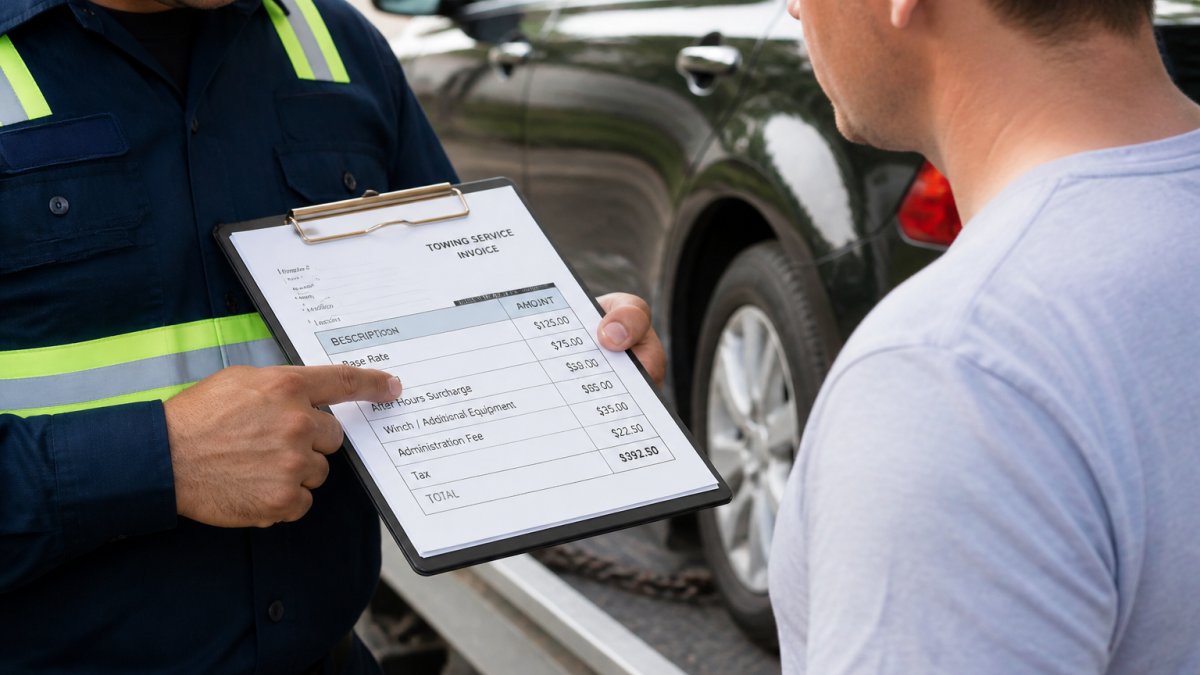
Line items you should see:
- Base rate or hookup fee: The standard charge for dispatching a truck
- Mileage charge: Per-mile rate multiplied by distance traveled
- After-hours surcharge: If applicable (night, weekend, holiday)
- Vehicle type surcharge: If your vehicle requires special handling
- Recovery or winching charge: If extraction is needed
A sample estimate might look like this:
| Charge | Amount |
|---|---|
| Base rate | $85 |
| Mileage (12 miles @ $3/mile) | $36 |
| After-hours surcharge (night) | $25 |
| Recovery/winching | $150 |
| Total | $296 |
Each line item reflects a real cost. If one is missing or unexplained, ask the company what it covers.
Red flags on an estimate:
- Charges with no description (just a dollar amount)
- Surcharges that don’t match your situation (night surcharge for a daytime tow)
- Vague fees like “miscellaneous” or “service charge” without explanation
- Charges that exceed what was quoted before dispatch
Legitimate towing companies explain surcharges upfront and don’t surprise you with hidden fees on the final bill. If a company won’t provide an estimate, find another towing service.
Frequently Asked Questions
What are the most common reasons for towing surcharges?
Towing surcharges typically result from distance traveled, after-hours service, vehicle size and weight, difficult recovery situations requiring winching, specialized equipment needs, and peak-demand pricing. Each factor reflects the actual cost and resources required to safely transport your vehicle. Understanding these charges helps you anticipate costs and avoid surprise fees when you call for roadside assistance.
How can I verify a towing surcharge before authorizing a tow?
Ask the dispatcher for an itemized estimate that breaks down the base rate, per-mile charge, and any applicable surcharges (after-hours, recovery, equipment). Request this information before authorizing the tow so you know the full cost. A reputable towing company will provide this transparency. If charges seem excessive or unclear, ask for clarification or get a second estimate before proceeding.
Can I dispute a towing charge if I think it’s excessive?
Yes. Request an itemized invoice showing every charge, then document the service details (date, time, distance, vehicle condition). Compare charges against your state’s towing regulations and the company’s rate sheet. If overcharging occurred, contact the company with your evidence and request a refund. If they refuse, file a complaint with your state’s Attorney General or relevant consumer protection agency.
Why do after-hours towing fees cost more?
After-hours towing surcharges reflect higher labor costs when dispatchers and drivers work nights, weekends, or holidays. Driver availability decreases outside business hours, and many operators pay premium wages for off-peak shifts. These surcharges also account for reduced competition during late-night hours, which can affect pricing.
Understanding towing surcharges protects you from unexpected bills and helps you make smart decisions when you’re stranded. The charges exist because towing is complex work requiring specialized equipment, trained drivers, and rapid response. When you need help, Fast Towing San Diego provides transparent pricing and expert service. We explain every charge before we dispatch and stand behind our work. Call us when you need a tow, we’re available 24/7 and we’ll get you back on the road safely.