
Table of Contents
- Step 1: Recognize When You Need to Pull Over
- Step 2: Signal and Scan Before You Move
- Step 3: Move Gradually Toward the Shoulder
- What to Do If Your Car Stops on the Freeway and You Can’t Reach the Shoulder
- What to Do When Your Car Breaks Down on the Freeway: After You Stop
- Freeway Shoulder Safety Tips for Night, Rain, and Narrow Shoulders
- When to Call a Tow Truck After a Breakdown
- How to Re-Enter Traffic Safely After Pulling Over
- Frequently Asked Questions
Last Updated: October 21, 2026
Step 1: Recognize When You Need to Pull Over
Knowing how to safely pull over on a busy freeway starts with one decision: do you actually need to stop? A flat tire, a smoking hood, or an unfamiliar warning light justifies it.
Our rule: if the vehicle can still move under control, move it.
Reasons to pull over right away:
- A flat tire or tire pressure warning
- Smoke, steam, or a burning smell
- Brake or steering problems
If none of those apply, keep driving to the next exit or rest stop. A parking lot beats a shoulder every time.
Never stop in a live traffic lane to check your phone, read a map, or argue with a passenger. Drivers behind you are closing at highway speed and will not expect a stationary car.
Step 2: Signal and Scan Before You Move
Signal early, then scan. Your turn signal tells drivers behind you what you plan to do, but it does not make the move safe on its own.
Here is the sequence we recommend:
- Check your mirrors, then glance over your shoulder at the blind spot.
- Turn on your right turn signal at least a few seconds before you move.
- Scan the shoulder ahead for debris, parked cars, or a narrow strip.
- Confirm a safe stopping distance before you commit.
Do not brake hard while you signal. Ease off the gas first, let your speed drop, and keep the wheel steady.
A common mistake is signaling and moving in the same second. Give drivers time to react, you want gradual deceleration, not a surprise.
Step 3: Move Gradually Toward the Shoulder
Move in one smooth arc, not a sharp cut. Sudden steering at freeway speed can spin a car, especially in rain or with a blown tire.
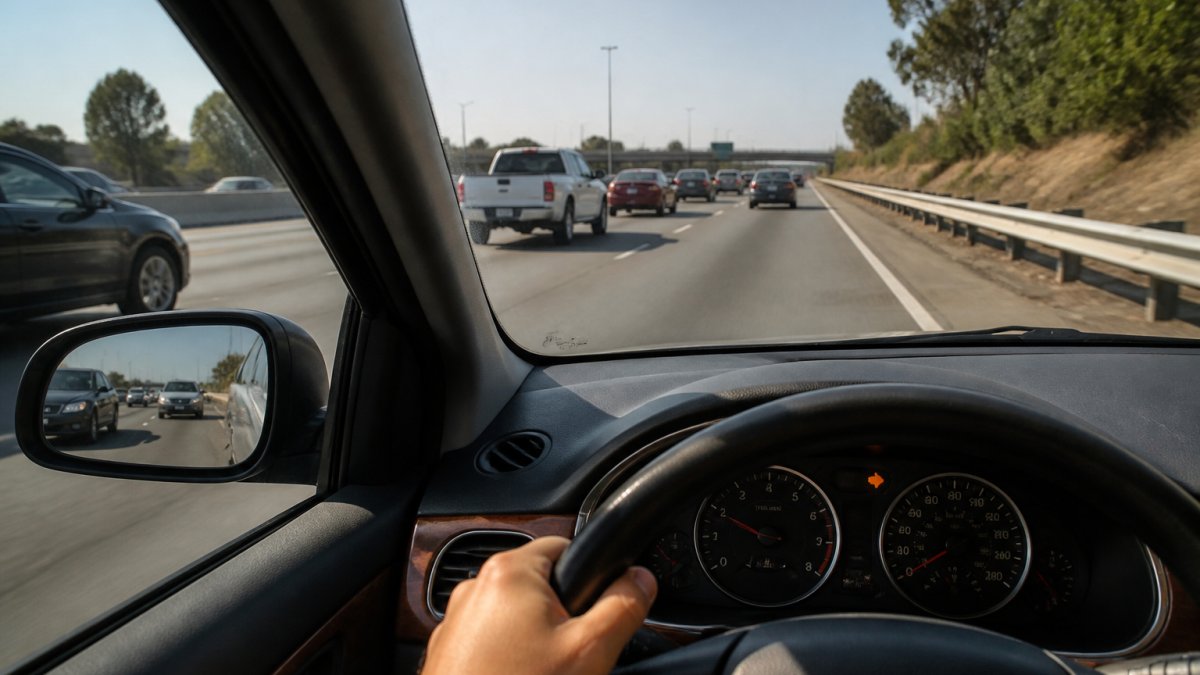
Cross the right lane at a shallow angle, matching traffic speed until you are clear, then slow down.
Once stopped, turn the wheels slightly away from traffic. If the car rolls, it rolls away from the lane, not into it.
On a narrow shoulder, angle the front wheels toward the guardrail and stay close to the wheel. If a passing truck clips your door, you want to be nowhere near it.
What to Do If Your Car Stops on the Freeway and You Can’t Reach the Shoulder
This is the scenario most guides skip, and the one that kills people. A dead car in a live lane gives trailing drivers seconds to react, and a person on foot there has no protection. The response depends on one question: can the car still move, even slowly?
If the car still rolls, even barely
Keep steering. Do not give up on the shoulder just because the engine quit.
- Turn on your hazard lights immediately, before anything else.
- Shift to neutral if the engine is dead, and use the starter or remaining momentum to creep right.
- Steer for the right edge or shoulder at a shallow angle. Do not cut across lanes.
- If the car will not roll on its own, put it in park, set the parking brake, and move to the next step.
A car that coasts even 50 feet to the right edge is dramatically safer than one stopped in the center lane. The biggest survival factor is getting the vehicle out of the travel lane, not the speed of the rescue.
If the car will not move at all
- Stay belted inside the car. Do not stand behind or beside it in a live lane.
- Hazards on, and at night raise the hood so approaching drivers see a disabled vehicle, not a shadow.
- Call 911 and give your exact location: direction of travel, nearest mile marker or exit sign, and a description of your car. Dispatchers can often alert highway patrol or a courtesy patrol faster than a private tow.
If you must exit the vehicle
Exit only when there is a clear gap in traffic, and move to the far side of the guardrail, away from the road, not along the shoulder. Keep children and pets inside until help arrives unless there is a fire or another immediate threat. If there is no barrier, stay inside with seatbelts on and doors locked.
A common instinct is to stand at the rear of the car and wave. Resist it. A stopped car in a live lane is already a hazard; a person standing next to it is a second one, and drivers closing at highway speed will not see you in time.
If the driver cannot act
A medical emergency changes the math. If you feel symptoms coming on, chest pain, dizziness, vision changes, signal right, slow gradually, and get to the shoulder or right edge before you lose control. Have a passenger call 911 with symptoms and location. If the driver becomes incapacitated, do not grab the wheel abruptly; use the parking brake gently and steer for the right edge.
The no-shoulder case
Some stretches have no usable shoulder, bridges, tunnels, construction zones, narrow urban stretches. If the car still moves, keep right and roll slowly to the next exit, wide spot, or parking lot; a slow-moving car is easier to avoid than a stopped one. If it dies completely, treat it as a live-lane stop: hazards, seatbelts, 911, and stay put.
What to Do When Your Car Breaks Down on the Freeway: After You Stop
What to do when your car breaks down on the freeway comes down to three things: get visible, get safe, get help.
Turn on hazards the moment you stop. At night, raise the hood so drivers see you are disabled.
Occupants should wait behind the guardrail, away from traffic, not next to the car.
Then call for help.
At Fast Towing San Diego, our drivers handle freeway breakdowns around the clock. We can also point you toward a trusted repair shop once your car is off the road.
The most dangerous minutes are the first few after you stop. Hazards on, occupants behind the barrier, and a call for help placed early are what keep a breakdown from becoming a crash.
Freeway Shoulder Safety Tips for Night, Rain, and Narrow Shoulders
Shoulder safety changes with conditions and with why you stopped. The generic advice (hazards on, stay behind the barrier) is the floor, not the ceiling. Here is how the approach shifts.
Night and low visibility
At night, drivers judge distance poorly and closing speeds look slower than they are. Raise the hood, turn on hazards, and wear a reflective vest if you have one. Place triangles behind the car only when safe to walk, never in a live lane. Stay behind the guardrail; with no barrier, stay inside belted.
Rain, snow, and spray
Spray from passing trucks can hide a stopped car entirely. Move as far right as possible, keep hazards on, and expect longer stopping distances. Do not stand outside in heavy spray, you are invisible until drivers are on top of you. Avoid soft grass or dirt that could trap a tire.
Narrow shoulders and construction zones
A narrow shoulder may offer no safe gap. Stop as far right as possible, keep everyone inside, and do not open doors into the traffic lane. In construction zones, follow posted signs; if the car still moves, roll to the next exit rather than forcing a stop in a work zone.
Flat tire
If the tire is flat but the car still rolls, get to the shoulder before stopping. Set the parking brake, turn on hazards, and assess: change it yourself only if you are well clear of traffic; on a narrow shoulder, at night, or in rain, call for roadside assistance. Never change a tire on the traffic side.
Mechanical failure
Smoke, steam, or a burning smell means stop as soon as safe and shut off the engine. If you see flames, do not open the hood, get everyone behind the barrier and call 911. For overheating or fluid leaks without fire, pull to the shoulder, shut down, and call for a tow rather than restarting.
Medical emergency
If you are the driver, signal right and get to the shoulder or right edge before symptoms overwhelm you. If a passenger is able, have them call 911 with your location and symptoms. If the driver becomes incapacitated, a passenger should use the parking brake gently and steer for the right edge, not grab the wheel abruptly.
Police stop
When an officer signals you to stop, pull to the right shoulder as soon as safe, turn on hazards, and stay in the car with hands visible on the wheel. Do not exit unless instructed. If unsure it is a real stop, you may slow, signal, and continue to a well-lit public place, but do not flee.
Roadside debris is its own hazard. Scan the shoulder before you commit, and avoid glass, metal, or soft ground that could trap a tire or hide a sharp edge.
If the shoulder is too narrow to be safe, do not force it. Slow down, keep right, and roll to the next exit if the car allows. A slow-moving car in the right lane is easier for traffic to avoid than a stopped one.
When to Call a Tow Truck After a Breakdown
Call a tow truck when the car cannot be driven safely, when you cannot change the tire yourself, or when you are stopped in a risky spot.
Signs it is time to call:
- A flat tire you cannot change on the shoulder
- Smoke, steam, or fluid leaking under the car
- Warning lights for brakes, steering, or overheating
- Any breakdown at night or in heavy rain
Roadside assistance can often handle a jump start or a tire change on the spot.
Cost depends on the distance, the vehicle, and the time of day, so ask for a quote up front.
How to Re-Enter Traffic Safely After Pulling Over
Re-entering traffic is where many drivers undo a good pull-over.
Here is how to do it:
- Buckle up and secure everything inside the car.
- Turn on your left turn signal.
- Check mirrors and your blind spot.
- Build speed on the shoulder if there is room, then merge into a clear gap.
- Match traffic speed as you enter the lane, and cancel the signal.
Do not creep into the lane at low speed. A slow merge forces traffic to brake hard, which is how rear-end crashes start.
If you cannot build speed safely, stay put and call for a tow.
A breakdown on a busy freeway is stressful, and the wrong move in the first minute is what turns it dangerous.
Frequently Asked Questions
How do you pull over safely on a busy freeway?
Check your mirrors and blind spot, signal early, and ease off the accelerator so you decelerate gradually. Move one lane at a time toward the right shoulder, keeping your speed steady until you are clear of traffic. Once on the shoulder, pull as far right as possible, turn on your hazard lights, and stay buckled until you confirm it is safe to exit. Avoid abrupt braking or sudden steering, which can cause the drivers behind you to swerve or collide.
Should you stay in your car if it breaks down on the freeway?
In most cases, yes. Staying buckled inside the vehicle with your seatbelt on is safer than standing on the shoulder, where passing traffic poses a serious collision risk. Call roadside assistance and keep your hazard lights on. If you can safely exit on the passenger side and stand behind a guardrail or well off the roadway, do so, especially at night or in low visibility. Never stand between your car and oncoming traffic.
What should you do if you cannot reach the shoulder?
If your car stops in a live lane, keep your hazard lights on, stay buckled, and call 911 immediately. Do not attempt to push the vehicle across traffic. If the car still rolls, steer toward the right edge while slowing. Once stopped, exit only if you can do so on the side away from traffic, and move to a safe location behind a barrier. Emergency responders can block traffic so a tow truck can reach you safely.
When should you call a tow truck after a breakdown?
Call for a tow when the vehicle cannot be driven safely, such as a flat tire without a spare, a dead battery you cannot jump, overheating, smoke, or damage from a collision. Also call if you are stopped on a freeway shoulder, since those spots are dangerous. A professional tow operator can move the vehicle to a repair shop and help you arrange next steps.