
Can You Tow an Electric Car Safely?
⏱️ Read Time: 5 mins
📍 Service Area: San Diego County
⭐ By: Fast Towing San Diego
You do not want to guess with an EV on the side of the road. One bad towing move can turn a simple breakdown into battery damage, motor damage, or a repair bill that hurts. If you’re asking, can you tow an electric car safely, the short answer is yes – but only if the vehicle is handled the right way from the start.
Electric vehicles are not like gas cars when it comes to towing. With many traditional vehicles, a short pull with two wheels on the ground might get the job done. With an EV, that same move can be a serious mistake. The reason is simple: many electric cars use regenerative systems and drive motors that can be damaged if the wheels turn while the car is off or not properly prepared for transport.
Can You Tow an Electric Car Safely on Any Tow Truck?
No. That is where a lot of people get into trouble.
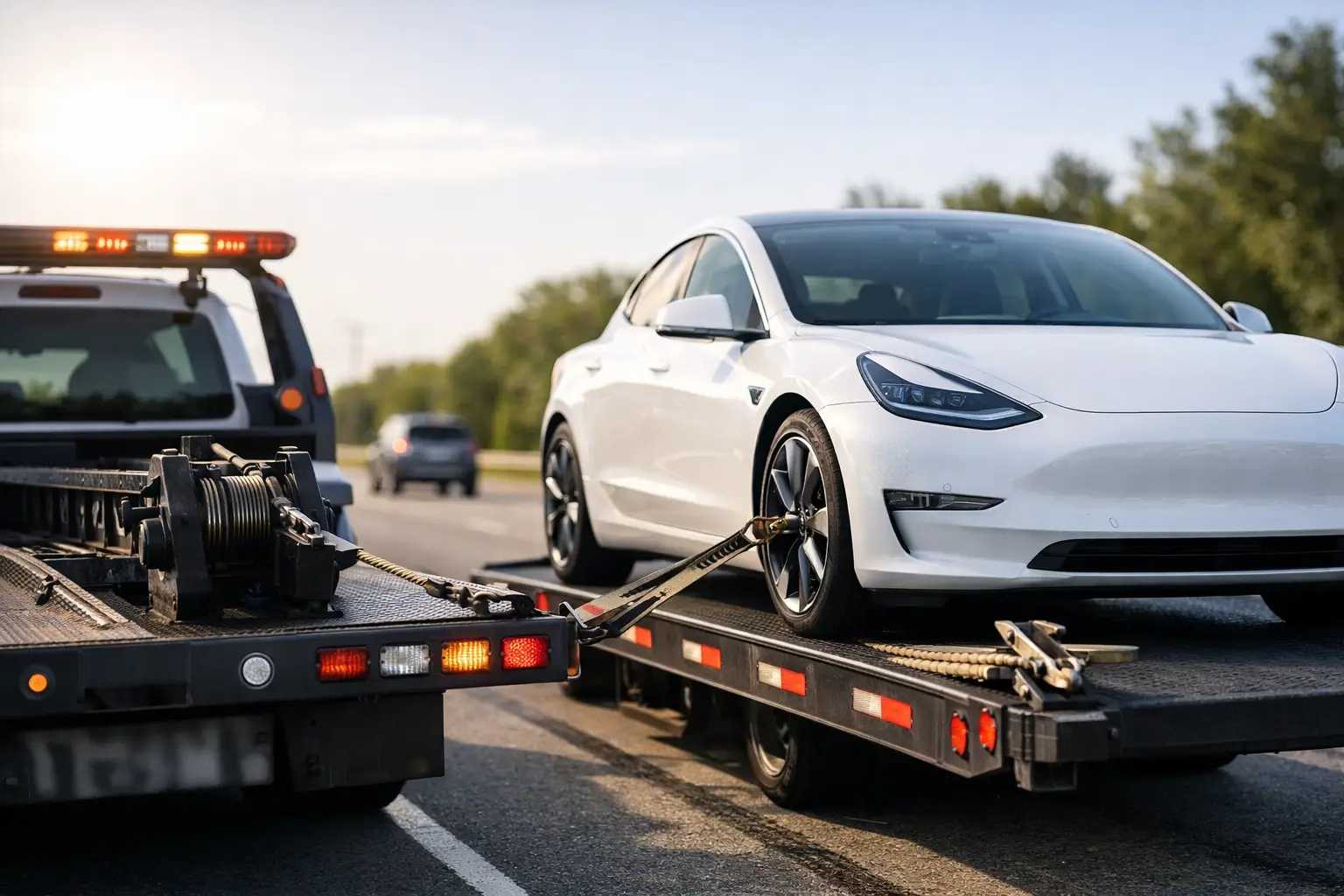
The safest answer for most EVs is a flatbed tow truck. That keeps all four wheels off the ground and avoids unwanted rotation through the drivetrain. It is the cleanest, safest option, especially when the vehicle has a dead 12-volt battery, a high-voltage fault, collision damage, or locked wheels.
Wheel-lift towing or dolly towing may be allowed in limited situations for certain models, but that depends on the manufacturer. Some EVs can be moved short distances with special procedures. Others should never be towed that way. If the wrong axle stays on the ground, or the car is not placed in the correct transport mode, damage can happen fast.
That is why experienced EV towing matters. Speed matters too, but speed without the right equipment is a gamble. A professional operator should know how to load an electric car, where to secure it, and when a flatbed is non-negotiable.
Why Towing an EV Is Different
An electric car has no traditional transmission in the same sense most drivers are used to. Instead, it relies on electric drive components that react differently when the wheels are spinning. In many models, rolling the vehicle can cause the motor to generate electricity. If the system is not active and ready to manage that energy, you can end up with damaged components.
There is also the battery pack to think about. The big traction battery is usually mounted low in the vehicle floor. That helps stability on the road, but it also means improper lifting can be dangerous. Jacking, dragging, or securing the vehicle at the wrong points can damage the battery housing or underbody.
Then there is weight. EVs are often heavier than similar gas-powered cars because of the battery pack. A tow setup that works fine for a compact sedan may not be ideal for an electric crossover or performance EV. The truck, bed angle, winching approach, and tie-down method all matter.
The Biggest Mistakes People Make
The first mistake is assuming all cars can be towed the same way. They cannot. A driver, a friend, or even an inexperienced tow company might think a quick hook-and-go is fine. On an EV, that can be the expensive mistake.
The second mistake is trying to pull the vehicle out of trouble without checking for transport mode, neutral release procedures, or wheel lock status. Some EVs need power to shift into neutral. If the 12-volt system is dead, getting the car into a movable state may take specific steps.
The third mistake is ignoring accident damage. If an EV has been in a collision, especially with undercarriage impact, towing should be handled with extra care. A damaged battery pack is not something to take lightly. The car may need isolation, careful loading, and transport to a qualified repair facility.
When Flatbed Towing Is the Right Call
Most of the time, flatbed towing is the right call for an electric vehicle. It removes the biggest risks and gives the operator better control during loading and transport.
A flatbed is especially important when the EV will not power on, when the suspension is damaged, when the tires are flat, when the car is stuck in park, or when the manufacturer specifically requires all four wheels off the ground. It is also the best choice for higher-end electric vehicles where underbody clearance and wheel protection matter.
This is one of those situations where doing it the cheap way can become the expensive way. A proper flatbed tow may cost more than a basic pull, but it is far cheaper than replacing damaged driveline or battery-related components.
What to Check Before an Electric Car Is Towed
If the car is safe to access and you have time, check the owner’s manual or the manufacturer’s roadside instructions. Look for sections on emergency towing, transport mode, neutral override, and winching. Those details can vary by make and model.
If you can communicate with the tow operator before they arrive, tell them the vehicle is electric right away. Share whether it powers on, whether it is stuck in park, whether the 12-volt battery is dead, and whether there has been any crash damage. That helps them bring the right truck and tools.
If the vehicle has been in a significant accident, mention any warning messages, smoke, strange smells, or visible underbody damage. Those details matter. They change how the vehicle should be approached and where it should be taken.
Can You Tow an Electric Car Safely After a Breakdown?
Yes, but the towing method has to match the failure.
A simple flat tire, software issue, dead 12-volt battery, or sudden no-start condition may still allow safe loading and transport if the operator follows the right process. In some cases, the problem is minor and roadside service can get the car moving again without a tow.
But if the vehicle has lost drive power in traffic, will not shift, or is showing serious battery or electrical warnings, it should be treated carefully and moved by someone who knows EV procedures. This is not the time for trial and error.
For drivers in a hurry, that is the frustrating part. The car may look fine from the outside, but EVs often need more planning before they can even be rolled onto the bed. A professional team gets that done faster because they have done it before.
What About Pulling an EV a Short Distance?
This is where people try to bend the rules. They think a short distance means low risk. Not always.
Even a brief tow with the wrong wheels on the ground can cause damage. Some vehicles are less forgiving than others. Some have a transport mode that makes controlled movement possible. Some do not. Distance is only one factor. The bigger issue is whether the vehicle is designed to be moved that way at all.
If the goal is just to get the car out of traffic or out of a driveway, there may be safe ways to reposition it using skates, dollies, or controlled winching onto a flatbed. That is very different from towing it down the road like a standard car.
Why Experience Matters With EV Towing
The right equipment is only half the job. The other half is judgment.
A good towing operator knows that electric cars have different lift points, different weight balance, and different failure modes. They know when not to drag the vehicle. They know how to load a low-clearance EV without scraping it. They know that an exotic EV, a family crossover EV, and an electric delivery van each bring their own challenges.
That is exactly why companies like Fast Towing treat EV calls differently. You need the right truck, the right loading method, and a technician who will not guess. When the vehicle is expensive, disabled, or sitting in a bad spot, that experience is what keeps the situation from getting worse.
The Bottom Line for Drivers
If you are stranded and wondering whether you can tow an electric car safely, think less about whether it can be moved and more about how it will be moved. That is the whole game.
The safe answer for most electric vehicles is a flatbed handled by someone who understands EV transport. Not a quick hook. Not a shortcut. Not a maybe.
When the car matters, the method matters too. Get the right tow the first time, and you protect the vehicle, the warranty, and your wallet. If something feels off, trust that instinct and ask questions before anyone starts pulling on your EV.
Licensed, insured, and rapid response units on standby across all San Diego corridors.