
Table of Contents
- 1. Get to Safety: Immediate Actions When Your Car Breaks Down at Night
- 2. Stay in or Exit Your Vehicle? What Keeps You Safest
- 3. When to Call 911 for a Car Breakdown
- 4. How to Signal for Help and Stay Visible in the Dark
- 5. Finding Emergency Towing Services Near Me: What to Expect
- 6. What to Keep in Your Car for Emergencies: A Night-Ready Kit
- 7. Managing Panic and Special Situations: Solo Drivers, EVs, and Passengers
- Frequently Asked Questions
Last Updated: September 16, 2026
1. Get to Safety: Immediate Actions When Your Car Breaks Down at Night
Knowing what to do if your car breaks down on highway at night starts with one decision: get off the travel lanes before you do anything else. A disabled vehicle in a live lane is the single most dangerous place you can be after dark. This guide walks through the exact sequence, from the moment the engine quits to the moment a tow truck hooks up your vehicle.
Every year, first responders respond to thousands of crashes involving pedestrians on highway shoulders. The pattern is consistent: a driver stops, steps out to inspect the damage, and becomes invisible to traffic moving at highway speed.
Steer to the Right Shoulder and Stop
If the car still rolls or steers, aim for the right shoulder or the rightmost lane edge. Cross traffic lanes only when you have no alternative, and never stop in a curve, on a bridge, or just over the crest of a hill where oncoming drivers cannot see you in time.
Once you are off the travel lanes, stop as far from traffic flow as the shoulder allows. Turn the wheels slightly away from the road so the vehicle cannot roll back into a lane. Set the emergency brake.
If the car dies in a live lane and will not move, stay buckled, turn on your hazard lights, and call 911. Do not attempt to push the vehicle alone.
Turn On Hazard Lights and Set the Emergency Brake
Hazard lights are your first and most important visibility tool. Switch them on the moment you realize the car is failing, before you even reach the shoulder. This warns drivers behind you while you are still moving slowly.
Set the emergency brake once stopped. If you carry reflective markers or a safety triangle, this is the moment to think about them, but only deploy them if you can do so safely from the passenger side. We will cover that in detail below.
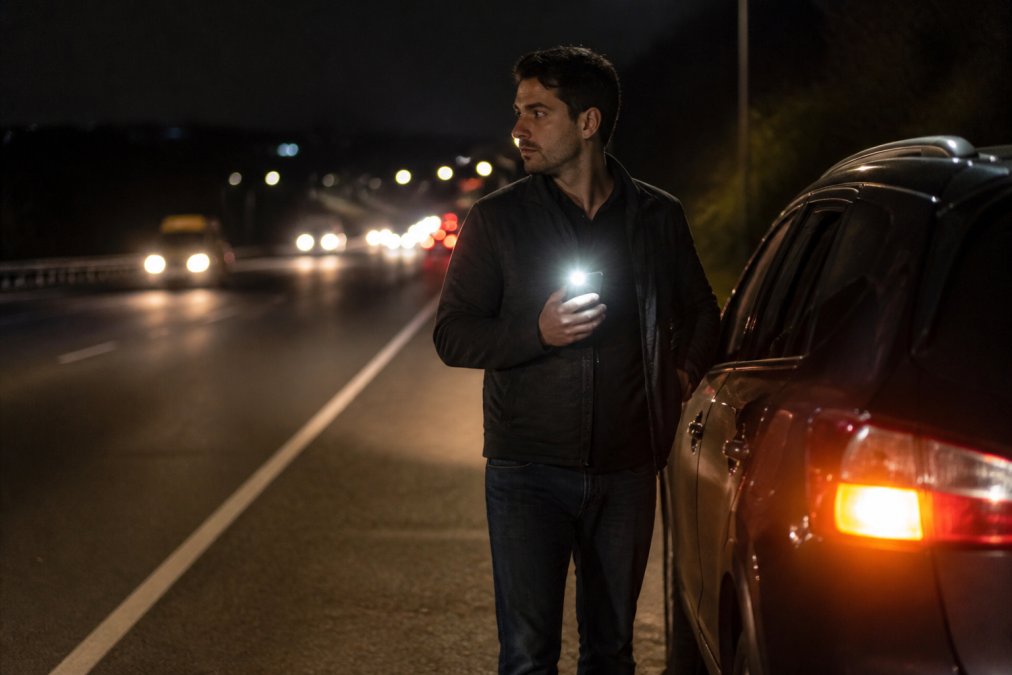
2. Stay in or Exit Your Vehicle? What Keeps You Safest
The safest place during a nighttime highway breakdown is inside your vehicle with your seat belt fastened, unless the car is on fire, in a live lane, or at risk of being struck. Most drivers instinctively get out to inspect the problem. That instinct is the one that gets people killed.
When Staying Inside Is the Right Call
Remain buckled in the driver’s seat or move to the passenger side if traffic is close. Keep your hazard lights on and your doors locked. Use your phone to call for roadside assistance and stay put until help arrives.
This is not passive. It is the single most protective choice available to you on a dark shoulder.
When You Must Exit: Passenger-Side and Guardrail Safety
Exit only when staying inside is more dangerous than leaving: a fire, a vehicle in a live lane, or a hazard you cannot avoid. When you do exit, leave through the passenger-side door, away from traffic.
Move immediately to the far side of the guardrail or well beyond the shoulder edge. Never stand between your car and oncoming traffic, and never stand in front of or behind the vehicle where a drifting driver could strike you.
Standing behind your car to wave down help is one of the most common fatal mistakes on a dark highway. Drivers fixate on your hazard lights and never see you until it is too late. Stay behind the guardrail, not behind the bumper.
3. When to Call 911 for a Car Breakdown
Call 911 immediately if anyone is injured, if your vehicle is stopped in a live traffic lane, if you see fire or smoke, or if you feel unsafe for any reason. For a routine breakdown on a safe shoulder with no injuries, a non-emergency line or a tow service is usually the faster path.
The distinction matters because it keeps emergency dispatchers free for actual emergencies. A dead battery on a wide, well-lit shoulder is not a 911 call. A stalled car in the center lane of a freeway at midnight is.
When you call, be ready to give three things fast: your location, your vehicle description, and whether you are in a travel lane or on the shoulder. On a highway, the best location marker is often the last exit number you passed or the mile marker nearest you.
4. How to Signal for Help and Stay Visible in the Dark
Visibility is the whole game at night. Your hazard lights, reflective markers, and a raised hood all signal “disabled vehicle” to approaching traffic long before a driver can read your situation.
Using Flares, Reflective Triangles, and Your Hood
Reflective triangles and roadside flares are the standard tools for marking a disabled vehicle. Deploy them only from the passenger side, only when traffic allows, and place them behind the vehicle so oncoming drivers see the warning before they reach you.
If you have no markers, raise your hood. A raised hood is a universal signal that your car is disabled and not simply parked. Some drivers tie a white cloth to the antenna or door handle for the same reason.
Place your first reflective triangle roughly 10 to 15 paces behind the vehicle on the shoulder edge, not in the travel lane. Adding a second marker further back gives drivers more warning distance at highway speeds.
Digital Safety: Battery Conservation and Live Location Sharing
Your phone is your lifeline, so treat the battery like one. Drop the screen brightness, close background apps, and avoid streaming or gaming while you wait. If your battery is critically low, send your location once and then stop using the phone until your tow arrives.
Share your live location with a trusted contact through your maps app or messaging app.
5. Finding Emergency Towing Services Near Me: What to Expect
Searching for emergency towing services near me works best when you already know what to say and what to ask. Give the dispatcher your location, vehicle type, and whether the car is drivable. Ask for an estimated arrival window and a price range before you commit.
6. What to Keep in Your Car for Emergencies: A Night-Ready Kit
What to keep in your car for emergencies comes down to three categories: visibility, communication, and warmth. Build the kit before you need it, and check it twice a year.
- Reflective triangles or roadside flares
- Working flashlight with fresh batteries
- Reflective vest or bright jacket
- Portable phone charger or power bank
- Warm blanket and gloves
- Bottled water and non-perishable snacks
- Basic first-aid kit
- Jumper cables or a jump-starter pack
- Tire pressure gauge and a spare tire in good condition
- Paper map or downloaded offline map of your area
| Kit Category | Items | Why It Matters at Night |
|---|---|---|
| Visibility | Triangles, flares, reflective vest | Helps traffic see you before it is too late |
| Communication | Charged phone, power bank | Keeps you reachable for dispatch and family |
| Warmth | Blanket, gloves, layers | Night temperatures drop fast while you wait |
| Vehicle basics | Jumper cables, spare tire, gauge | Handles the most common breakdown causes |
A night-ready kit is not about preparing for disaster. It is about buying yourself visibility and time until a tow truck reaches you.
7. Managing Panic and Special Situations: Solo Drivers, EVs, and Passengers
Panic is the real hazard in a nighttime breakdown, and it is manageable. Breathe slowly, focus on one action at a time, and remember that staying inside a locked car on a safe shoulder is a genuinely safe position. The feeling of danger is often louder than the actual danger.
Fast Towing San Diego offers reliable 24/7 response, with special discounts for first responders, military personnel, and fleet accounts.
Frequently Asked Questions
How long can you leave a broken down car on the freeway?
Most states and local jurisdictions have abandoned vehicle rules, and a car left on the shoulder for more than a few hours can be ticketed or towed. If your car breaks down on the highway at night, plan to have it removed the same night through emergency towing services. If you cannot arrange a tow immediately, call 911 or the non-emergency line to let authorities know the vehicle is disabled and where it is parked.
Should you stay in your car if it breaks down on the highway?
Stay inside with your seatbelt on if you are on a busy highway shoulder, especially at night. Exiting puts you close to oncoming traffic and blind spots. Turn on hazard lights, keep your doors locked, and call for help. Exit only if the car is on fire, in a live traffic lane, or in another immediate danger, and always exit from the passenger side away from traffic.
When should you call 911 for a car breakdown?
Call 911 if anyone is injured, your car is stopped in a live traffic lane, you smell smoke or see flames, or you feel unsafe because of another person. For a routine breakdown on the shoulder with no injuries, contact a towing company directly. When in doubt, calling 911 is never wrong; dispatchers can route you to the right help.
What should I keep in my car for emergencies at night?
Pack a flashlight with fresh batteries, reflective triangles or road flares, a reflective vest, a phone charger or power bank, a blanket, water, and a first-aid kit. Keep your insurance card and registration accessible. A small emergency kit turns a frightening night breakdown into a manageable wait, and it helps you stay visible to traffic and to the tow truck driver looking for you.