
Table of Contents
- Why Response Speed Separates Busy Shops from Empty Bays
- What Is a Realistic Average Auto Repair Turnaround Time?
- The 5 Biggest Roadblocks to Fast Response Times
- How to Speed Up Car Repair Process with a Triage System
- What to Do After Car Accident for Repairs: A Shop’s Intake Checklist
- Setting Accurate Expectations with Customers
- Conclusion: Make Speed a System, Not a Slogan
- Frequently Asked Questions
Last Updated: September 8, 2026
When a customer calls your shop, the clock starts ticking in their mind. Fast response times for auto repair shops are the deciding factor between a booked calendar and empty bays. This guide draws on over 100 years of combined industry experience to build a system that gets vehicles diagnosed, repaired, and returned without the chaos.
The gap between thriving and struggling shops rarely comes down to technical skill, it comes down to workflow. Most shops lose hours on the silence between intake and completion.
Below, we’ll show you how to audit turnaround time, implement a triage system, and communicate delays proactively.
Why Response Speed Separates Busy Shops from Empty Bays
Speed is a signal. A quick response or accurate first-call estimate tells the customer the business is competent, organized, and respects their time, building immediate trust.
Slow communication creates friction. A customer waiting days for a quote is likely calling other shops; the one that answers first with a clear plan often wins the job, even at a higher labor rate.
This isn’t just about the front desk. Fast response times require synchronized effort between the advisor, technician, and parts department. True responsiveness is setting an accurate expectation and meeting it consistently.
What Is a Realistic Average Auto Repair Turnaround Time?
Average turnaround varies with scope and parts availability. A realistic benchmark for a standard repair, brake pads or an alternator, is 24 to 48 hours (ase.com).
For major failures like transmission rebuilds, expect several days to a week or more (autoserviceprofessional.com). The key is the accuracy of the intake estimate.
Common Jobs and Their Typical Timeframes
To manage expectations, your team needs a reliable baseline for standard jobs; a labor time guide standardizes estimates.
| Repair Type | Typical Labor Time | Estimated Turnaround |
|---|---|---|
| Brake Pad Replacement | 1.5 – 2.5 hours | Same day |
| Alternator Replacement | 1.5 – 3 hours | Same day |
| Timing Belt Service | 4 – 6 hours | 1-2 days |
| Transmission Rebuild | 10 – 20 hours | 3-7 days |
These figures assume parts are in stock or available within 24 hours. When parts are not local, turnaround extends.
The 5 Biggest Roadblocks to Fast Response Times
Even with skilled technicians, most shops miss turnaround targets due to process bottlenecks.
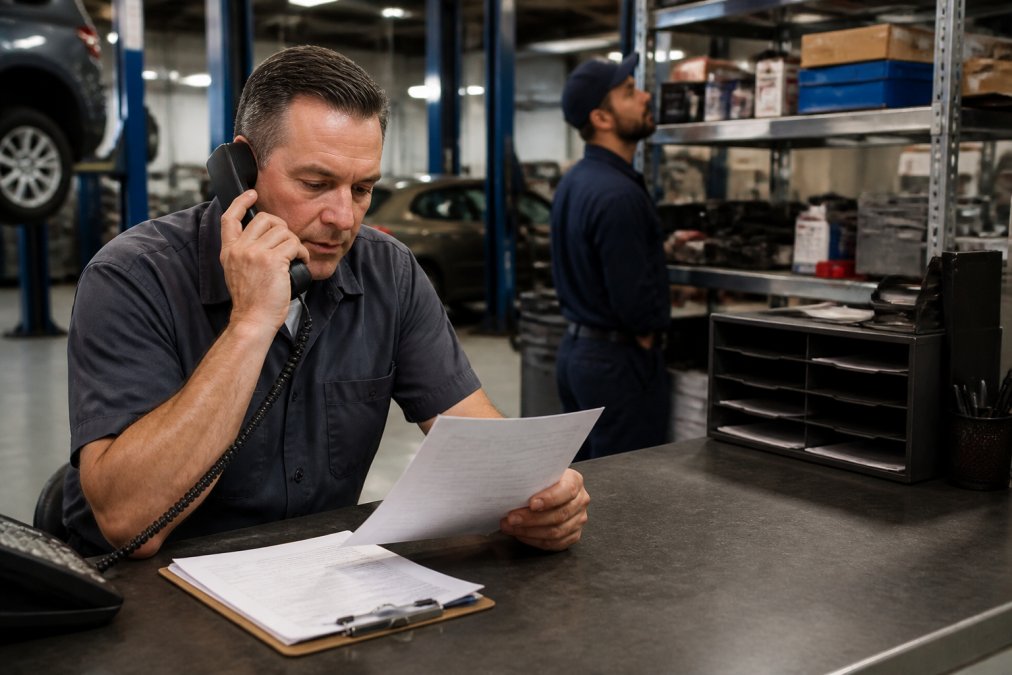
- Vague Triage: Taking in every car without a defined diagnostic priority.
- Reactive Parts Ordering: Waiting until the technician is ready to order parts, rather than ordering immediately after diagnosis.
- Poor Communication: Failing to update the customer, leading to “check-in” calls that interrupt workflow.
- Unrealistic Scheduling: Overbooking bays without accounting for diagnostic time.
- Lack of a Daily Huddle: Starting the day without a clear plan for bay use and technician assignments.
Parts Procurement: The Silent Killer of Deadlines
The most common cause of a missed deadline is waiting on parts, not slow labor. Shops that excel at speed treat parts procurement as a race.
The fix is a procurement protocol: as soon as diagnosis is complete, flag the parts immediately. The advisor checks stock, places the order, and confirms delivery time before promising a completion date.
Failing to confirm parts availability before quoting a completion time is the fastest way to destroy your shop’s credibility. A single missed deadline can erase a decade of good reviews, as the customer will likely share their frustration online.
If a part is on national backorder, tell the customer immediately and offer alternatives like a quality used or refurbished part.
How to Speed Up Car Repair Process with a Triage System
To speed up the car repair process, implement a triage system that prioritizes work by urgency and bay availability.
A triage system categorizes work into three lanes: Express Maintenance (oil changes), Standard Repairs (brakes, suspension), and Major Diagnostics (check engine lights).
Building a Daily Workflow That Eliminates Downtime
Downtime is the enemy of profitability. A structured daily workflow ensures technicians are never idle.
Start each morning with a 10-minute huddle: review the day’s repair orders, confirm parts have arrived, and assign each vehicle to a bay.
- Morning (8:00 AM – 10:00 AM): Focus on Express Maintenance and completing any “promised by noon” jobs.
- Midday (10:00 AM – 2:00 PM): Tackle Standard Repairs and begin diagnostics on new arrivals.
- Afternoon (2:00 PM – Close): Begin tear-downs on major jobs and prepare vehicles for the next day.
This workflow prevents the bottleneck of too many cars in the lot and not enough finished work leaving the bays.
What to Do After Car Accident for Repairs: A Shop’s Intake Checklist
Most accident-repair content is written for the owner, not the shop. The biggest lever on your collision response time is how fast you move a car from the tow hook to the lift.
To compress that window, replace the paper clipboard with a digital intake system that captures everything before the vehicle arrives. Send the customer a secure link at the moment they book the tow, collecting:
- Insurance carrier and claim number
- Photos of the damage taken at the scene
- A signed authorization for diagnostic work
- Preferred method of contact (text beats phone for updates)
The goal is to have the claim file open and parts catalog pulled before the car is off the flatbed. Intake should then take no more than 15 minutes.
The 15-Minute Accident Intake Protocol
A reliable intake protocol follows a fixed sequence so no step gets skipped when busy:
- Confirm the tow ETA (60 minutes before arrival): Verify the driver’s location and the vehicle’s condition. If the car is undriveable, confirm whether the tow truck has a wheel lift or flatbed, this affects how the vehicle is unloaded.
- Pre-load the claim (30 minutes before arrival): Enter the customer’s insurance info into your management system. If you use a digital estimating platform, create the job file and attach the customer’s photos.
- Photograph on arrival (0-5 minutes): Take 20-30 photos covering all four sides, the odometer, and any pre-existing damage. Do this before the vehicle is moved so you have a defensible record.
- Walk the vehicle with the driver (5-10 minutes): Note fluid leaks, tire condition, and whether the airbags deployed. Airbag deployment often means the vehicle will need a supplemental restraint system reset, which adds time and parts.
- Start the parts order (10-15 minutes): If the damage is visible, bumper, fender, headlamp, begin the parts estimate immediately. Do not wait for full disassembly. Order the obvious components while the technician performs the tear-down.
Why the Towing Relationship Is a Response-Time Multiplier
Your tow partner is the first stage of your intake pipeline. A company that communicates delays, sends a driver who can handle a low-clearance sports car, and delivers to your reserved bay saves you 30 to 60 minutes per accident job.
Without a dedicated towing partner, you leave response time to chance. Establish a single preferred provider that knows your hours, lot layout, and drop-off preferences.
When you book the tow, ask the dispatcher for the driver’s direct cell number and the truck’s unit number. This gives your service advisor a live line to the driver, not a call center queue, when the customer calls asking for a status update.
The Hidden Time Trap: Teardown and Supplement Approval
Accident repairs rarely stay within the initial estimate. Once the bumper cover is removed, technicians often find damage to the reinforcement bar, crash sensor, or radiator support, each triggering a supplement authorization request.
Your accident response speed depends on how fast you submit supplements. Batch photos and documentation and send them to the adjuster before 4:00 PM, adjusters review in order.
Some shops use a pre-authorization clause allowing up to $500 in additional work without adjuster approval (insurance.ca.gov). When accepted, this eliminates a full day of downtime.
Measuring Your Accident Intake Speed
You cannot improve what you do not measure. Track these metrics for every accident vehicle:
- Tow-to-photo time: Minutes from arrival to completed photo documentation. Target: under 10 minutes.
- Photo-to-parts-order time: Minutes from documentation to the first parts order. Target: under 15 minutes.
- Arrival-to-diagnosis-start time: Minutes from drop-off to the technician beginning tear-down. Target: under 60 minutes for visible damage.
- Supplement submission lag: Hours from discovery of hidden damage to submission to the insurer. Target: same business day.
Shops that track these numbers consistently see accident turnaround drop by a full day within the first month.
Setting Accurate Expectations with Customers
Setting an accurate expectation is a communication system from booking to pickup. The shops with the fastest perceived response times never let a customer go silent for more than a few hours.
The Three-Touch Communication Protocol
A reliable protocol many high-performing shops use is the Three-Touch system, ensuring the customer hears from you at three fixed points.
Touch 1: The Booking Confirmation (Immediate)
When the customer schedules, send an automated text or email confirming the date, time, and what to bring (keys, proof of insurance, aftermarket parts). State your diagnostic fee and the expected window for a diagnosis callback.
Example template:
“Hi [Name], your [Year Make Model] is booked for [Date] at [Time]. Please bring your keys and insurance card. We will call you by [Time + 3 hours] with a diagnostic update. Reply STOP to opt out of texts.”
Touch 2: The Diagnosis Update (Day of Drop-Off)
Within three hours of drop-off, the advisor must send a status update. Even if incomplete, state what has been checked and when the full estimate will be ready.
Example template:
“Hi [Name], your [Year Make Model] is on the lift now. We have confirmed the [brake/engine/electrical] issue and are pulling the final parts pricing. Expect your full estimate by [Time]. We will not start any work without your approval.”
Touch 3: The Completion or Delay Notification (Before End of Day)
If on track, send a completion message with final cost and pickup time. If delayed, due to parts, hidden damage, or an additional issue, send the delay notification before the customer has to call.
Example delay template:
“Hi [Name], an update on your [Year Make Model]. We discovered [specific issue, e.g., a cracked motor mount] during the repair that needs attention. The part will arrive by [Date]. Your new completion time is [Time] on [Date]. We will not proceed with this additional work without your approval. The estimate for the added repair is [amount].”
The Parts Delay Playbook
Parts delays are the most common and avoidable cause of missed deadlines. Communicate the delay the moment you know about it.
A structured playbook for parts delays:
- Identify the delay (as soon as the parts order is confirmed): If the supplier says the part ships in 3 days instead of 1, flag the repair order immediately.
- Check for alternatives (within 30 minutes): Call a second local supplier, check if a used or remanufactured part is available, or ask the customer if they have a preferred source. Do not present a delay to the customer until you have exhausted same-day sourcing options.
- Communicate the delay with a solution (same business day): When you call the customer, lead with the solution, not the problem. Say, “We found a remanufactured alternator that will be here tomorrow morning, which keeps your completion time on schedule,” rather than “Your part is delayed.”
- Document the new promise (immediately): Update the repair order with the new completion time and send a written confirmation to the customer. Verbal promises are easily forgotten; written ones are not.
Never let a customer discover a delay by calling you. The customer who calls to ask “Is my car ready?” and hears “No, we are waiting on a part” is already frustrated. The customer who receives a proactive text with a new time and a reason is far more likely to be understanding.
The “No Surprise” Estimate Format
Beyond timing, the estimate must prevent disputes. A clear estimate includes three line items customers often confuse:
- Diagnostic fee: The cost to identify the problem. State whether this is waived if the customer approves the repair.
- Labor time: The hours quoted from the labor guide, not the actual time the technician will spend. Explain that the guide time is the industry standard.
- Parts markup: The difference between the shop’s cost and the retail price. Some states require this to be disclosed on the invoice; even where it is not required, showing it builds trust.
Present the estimate in writing with a line stating, “This estimate is valid for 30 days. Additional repairs discovered during disassembly will be communicated before work proceeds.”
Turning Delays into Trust Builders
A delay handled well can strengthen the relationship. Proactive communication demonstrates your shop has visibility into its operations and respects the customer’s time.
Shops with high retention pair a delay notification with a small gesture, a discount, free car wash, or waived diagnostic fee.
Conclusion: Make Speed a System, Not a Slogan
Achieving fast response times for auto repair shops requires a systematic overhaul of intake, triage, and communication. By addressing parts delays, implementing a structured workflow, and maintaining transparency, you turn speed into a reliable competitive advantage.
The shops that win treat every minute of the customer’s time as valuable as their own, building systems that anticipate problems and communicate proactively.
At Fast Towing San Diego, we understand the repair process often begins with a tow. Our 24/7/365 availability and professionally trained drivers ensure vehicles arrive quickly and safely.
Frequently Asked Questions
How long do shops usually take to fix a car?
The average auto repair turnaround time varies by job. A simple brake pad replacement often takes 2-3 hours, while a transmission rebuild can take several days. Most shops quote 1-3 days for standard mechanical repairs once they have the parts. The fastest way to get an accurate estimate is to ask for a specific completion time when you drop the vehicle off, not just a diagnosis timeframe.
What is the 30-60-90 rule for cars?
The 30-60-90 rule is a maintenance schedule guidance, not a repair timescale. It refers to servicing your vehicle at 30,000, 60,000, and 90,000-mile intervals. At 30,000 miles you typically replace filters and fluids; at 60,000 miles you address cooling systems and spark plugs; at 90,000 miles you handle major items like timing belts. Following this schedule prevents breakdowns that slow down your day.
Is $100 an hour fair for mechanic labor?
Labor rates depend on your region and the shop’s specialty. In many areas, dealership rates range from $120 to $180 per hour, while independent shops often charge between $80 and $110. The key is not just the hourly rate, but the labor time guide used. A shop charging $100 an hour that finishes in 2 hours is often cheaper than a shop charging $80 an hour that takes 4 hours.
What should you do if your car repair is taking longer than expected?
Start by reviewing your repair order for the estimated completion time. Call the service advisor directly and ask for a specific reason for the delay, such as parts availability or unexpected damage. If communication is poor, ask for a written update on the repair status. Most delays stem from parts procurement, so asking if the shop has a confirmed delivery date gives you the clearest answer on when you will get your car back.