
Table of Contents
- Flatbed vs Wheel Lift Towing for All-Wheel Drive Vehicles: A Quick Comparison
- What Is Flatbed Towing and Why It Protects AWD Drivetrains
- What Is Wheel-Lift Towing and When It Causes AWD Drivetrain Damage from Towing
- Towing Requirements for All-Wheel Drive Cars: What Your Owner’s Manual Says
- How to Prepare Your Car for Long Distance Towing
- Tow Dolly vs Flatbed vs Wheel Lift: Weighing Cost, Safety, and Insurance
- How to Identify Your Drivetrain and Communicate with Your Dispatcher
- Frequently Asked Questions
Last Updated: September 11, 2026
Flatbed vs Wheel Lift Towing for All-Wheel Drive Vehicles: A Quick Comparison
The difference between flatbed vs wheel lift towing for all-wheel drive vehicles comes down to one thing: whether all four wheels leave the ground. A flatbed carries the entire vehicle on a platform; a wheel-lift truck raises only two wheels and drags the other two. For AWD and 4WD vehicles, that distinction determines whether you drive away with an intact drivetrain or a repair bill.
This guide breaks down how each method works, when wheel-lift towing puts your transmission and transfer case at risk, and how to talk to a dispatcher so the right truck shows up the first time. The NHTSA vehicle safety information is clear that improper towing can cause mechanical failure, and AWD owners are the most exposed.
What Is Flatbed Towing and Why It Protects AWD Drivetrains
Flatbed towing is a recovery method where the entire vehicle is winched onto a tilting platform and secured with all four wheels off the ground. Because nothing rotates and nothing drags, the drivetrain stays completely still during transport.
That stillness is the point. When a vehicle is towed with two wheels rolling and two lifted, the spinning axle can force the transfer case and rear differential to turn without lubrication pressure, causing heat, friction, and eventual failure.
How a Flatbed Trailer Secures All Four Wheels
The driver lowers the deck, winches the vehicle up by its tires, then locks it down with straps at all four corners. Ground clearance stops mattering once the car is on the deck, so low-slung sports cars, modified suspension, and body kits load without scraping.
Safety Benefits of Flatbed Transport
A flatbed also offers stability a wheel-lift cannot match: the vehicle’s full curb weight sits on the platform rather than hanging off a hydraulic boom, reducing sway at highway speeds.
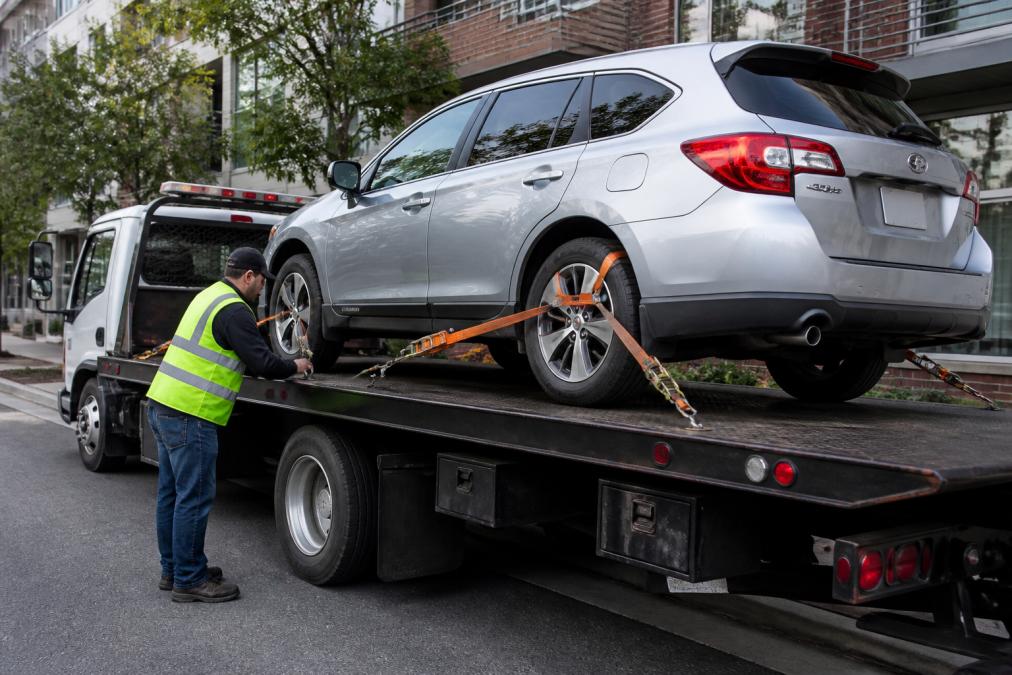
If your vehicle is AWD, 4WD, or has any automatic transmission with an electronic parking brake, flatbed transport is the default safe choice. Everything else is a compromise.
What Is Wheel-Lift Towing and When It Causes AWD Drivetrain Damage from Towing
Wheel-lift towing is a method where a hydraulic boom lifts two wheels off the ground while the other two roll along the pavement. It is fast, widely available, and safe for many two-wheel-drive cars. For AWD, it is often a problem.
The damage mechanism is simple. On many all-wheel drive systems, the front and rear axles are permanently connected through a transfer case or center coupling. If one axle spins and the other is stationary, the coupling is forced to slip or bind.
How Wheel-Lift Towing Works on Two Wheels
The operator backs the truck up, slides a steel crossbar under the raised axle, and secures the tires with straps. A hydraulic lift raises that end while the remaining wheels rotate on the road.
For a front-wheel-drive sedan, this is fine: the non-driven rear wheels spin freely without affecting the transmission. For AWD, that logic collapses.
Why AWD and 4WD Vehicles Are at Risk
Manufacturers generally warn against towing AWD vehicles with any wheels on the ground. The AAA towing and roadside assistance guidance has long advised flatbed transport for all-wheel drive vehicles precisely because of drivetrain coupling. Ignoring that advice can lead to transfer case damage, rear differential wear, and a repair that costs far more than the tow.
A common mistake is assuming that “neutral” makes wheel-lift towing safe on an AWD vehicle. Neutral disengages the transmission, not the transfer case or center coupling. The axles can still bind and overheat.
Towing Requirements for All-Wheel Drive Cars: What Your Owner’s Manual Says
Your owner’s manual is the final authority, and most say the same thing: use a flatbed. Towing requirements for all-wheel drive cars are almost always spelled out in the emergency towing section, and the language is blunt.
Look for a section titled “Towing,” “Emergency Towing,” or “Recreational Towing.” If it says “flatbed only,” that is not a suggestion, it is the manufacturer protecting itself against warranty claims from drivetrain damage. A few part-time 4WD systems can be towed with the transfer case in a true neutral position and the front hubs unlocked, but that is a narrow window that depends entirely on the specific vehicle.
AWD vs. Part-Time 4WD: Drivetrain Differences That Change the Towing Method
This distinction determines whether a wheel-lift truck can touch your vehicle. “AWD” is not one system but a family of systems, and each fails differently when two wheels are dragged.
Viscous coupling (older Subaru-style, some 1990s-2000s systems). A sealed housing filled with silicone fluid sits between the front and rear axles. When one axle spins faster than the other, the fluid shears and heats up to transfer torque. Drag two wheels on the pavement and that fluid overheats within miles. There is no neutral and no unlock. Flatbed only.
Electronically controlled clutch packs (Haldex-style, used on many transverse-engine crossovers). A computer-controlled clutch engages the rear axle only when slip is detected. In theory, a fully disengaged clutch lets the rear wheels roll freely; in practice, the clutch is never fully open, and the pump that pressurizes it is driven by the drivetrain itself. Towing with wheels down can spin the pump without proper lubrication. Most manufacturers still say flatbed only.
Torsen and mechanical gear-type center differentials (Audi quattro with Torsen, some Toyota and Lexus systems). These are purely mechanical and permanently engaged, no clutch to open, no fluid to shear. If one axle turns, the other must turn, so wheel-lift towing binds the gears directly. Flatbed only, no exceptions.
Part-time 4WD with a true transfer-case neutral (older pickups, some body-on-frame SUVs, Jeep Wrangler in 2WD mode with hubs unlocked). This is the one category where a wheel-lift or dolly can sometimes be acceptable, but only with the transfer case in its genuine neutral detent and the front hubs unlocked. Even then, many manuals prefer a flatbed for long distances.
Full-time 4WD with a lockable center differential (Land Cruiser, some G-Wagen and Range Rover configurations). These have a neutral position in the transfer case, but the center diff must be unlocked and the case must be in neutral. Miss either step and you are dragging a locked drivetrain.
The practical takeaway: never assume. Check the manual, identify the drivetrain type, and tell the dispatcher exactly what you drive. “It’s an SUV” is not enough information.
| Drivetrain Type | Wheels on Ground Allowed? | Recommended Method |
|---|---|---|
| Full-time AWD, viscous coupling | No | Flatbed only |
| Full-time AWD, clutch-pack (Haldex-style) | No | Flatbed only |
| Full-time AWD, Torsen/mechanical | No | Flatbed only |
| Part-time 4WD, true transfer-case neutral + unlocked hubs | Sometimes, short distance | Flatbed preferred |
| Full-time 4WD, lockable center diff in neutral | Sometimes, per manual | Flatbed preferred |
| Front-wheel drive | Yes, rear wheels | Wheel-lift acceptable |
| Rear-wheel drive | Yes, front wheels | Wheel-lift acceptable |
A common mistake is assuming that “neutral” makes wheel-lift towing safe on an AWD vehicle. Neutral disengages the transmission, not the transfer case or center coupling. The axles can still bind and overheat.
How to Confirm Your Specific Vehicle’s Towing Rule
Before you call anyone, run this checklist:
- Open the owner’s manual to the emergency towing or recreational towing section. Read the exact wording, not a forum summary.
- Find the drivetrain badge: “AWD,” “4MOTION,” “xDrive,” “4MATIC,” “quattro,” “Symmetrical AWD,” and “4×4” all mean different systems with different rules.
- Decode the VIN through the NHTSA VIN decoder to confirm the exact trim and drivetrain, since the same model year can ship with two different systems.
- If the manual says “flatbed only,” treat that as a hard requirement. If it lists a neutral-tow procedure, follow every step exactly, including speed and distance limits.
- Write the manual’s exact wording on your phone so you can read it to the dispatcher.
How to Prepare Your Car for Long Distance Towing
Preparing your car for long distance towing starts before the truck arrives. A few minutes of prep prevents damage and speeds up the hook-up.
- Note your drivetrain type (AWD, 4WD, FWD, RWD) and have the manual page ready
- Remove valuables, toll transponders, and loose items from the cabin
- Disable the parking brake and confirm the transmission is in neutral if instructed
- Photograph the vehicle’s condition before loading, including existing damage
- Confirm the tow destination and provide the driver with the exact address
- Ask whether the truck is a flatbed or wheel-lift before it arrives
That last item matters most. If a wheel-lift truck shows up for an AWD vehicle, you have the right to refuse the hook-up and request a flatbed. Reputable operators will not argue.
If you are stranded and unsure what you drive, check the badge on the trunk or tailgate. “AWD,” “4MOTION,” “xDrive,” and “4MATIC” all mean all-wheel drive. When in doubt, request a flatbed.
Tow Dolly vs Flatbed vs Wheel Lift: Weighing Cost, Safety, and Insurance
Tow dolly vs flatbed vs wheel lift is a real decision, but for AWD owners it is mostly settled. A tow dolly lifts two wheels and leaves two on the ground, the same drivetrain problem as a wheel-lift. Flatbed is the only method that removes all four wheels from rotation.
When a Tow Dolly Is Actually Acceptable
A dolly is not automatically wrong. It is the right tool in three narrow situations:
- Front-wheel-drive vehicles being towed with the front wheels on the dolly. The rear wheels roll freely and nothing in the drivetrain turns.
- Rear-wheel-drive vehicles being towed with the rear wheels on the dolly and the driveshaft disconnected or the transmission in a manufacturer-approved tow mode.
- Part-time 4WD vehicles with a true transfer-case neutral and unlocked front hubs, and only for the distance and speed the manual allows.
For any full-time AWD system, a dolly is functionally identical to a wheel-lift: two wheels turn, two do not, and the center coupling takes the abuse. If a dispatcher offers a dolly for your AWD vehicle, decline it as you would a wheel-lift.
Cost Differences Between Towing Methods
Pricing varies by market, distance, time of day, and equipment, but the pattern is consistent. Wheel-lift and dolly service is typically least expensive because the trucks are lighter, cheaper to operate, and more common. Flatbed service usually carries a premium because the equipment costs more, the deck takes longer to load and unload, and fewer trucks in a fleet are flatbeds.
Expect the gap to widen with distance: a short local hook-up may show only a modest difference, while long-distance transport grows the flatbed premium because the operator ties up a more expensive truck for more hours. After-hours, weekend, and holiday calls add surcharges across all three methods, and storage, winch-out, and second-driver fees are separate line items on top of the base rate.
For AWD owners, the math is simple: the flatbed premium is almost always smaller than a transfer case or center-coupling repair, which typically runs into four figures.
| Method | AWD Safe? | Best For | Key Drawback |
|---|---|---|---|
| Flatbed | Yes | AWD, 4WD, exotics, low-clearance | Requires flatbed-equipped truck; usually the highest base rate |
| Wheel-lift | No | FWD and RWD vehicles | Drivetrain damage risk on AWD |
| Tow dolly | No (for full-time AWD) | FWD vehicles, some part-time 4WD in neutral | Same two-wheel-rolling problem as wheel-lift |
Insurance and Liability: Who Pays When Improper Towing Damages Your Drivetrain
This is where AWD owners lose the most money. If a tow operator uses a method the manufacturer warns against and your transfer case fails, who pays is not automatic.
Start with your own policy. Many auto policies cover tow-related damage under comprehensive or roadside assistance, but the insurer will ask what method was used and whether it suited the vehicle. If the answer is “wheel-lift on a full-time AWD vehicle,” the claim can be denied or subrogated against the tow company.
The tow company’s commercial liability coverage is the primary target. Reputable operators carry garagekeepers or on-hook coverage for damage caused during a tow. The catch is proof: without documentation that the damage occurred during the tow and that the method was improper, the claim becomes a he-said-she-said.
Your manufacturer’s warranty is not a backstop. Towing damage is almost always excluded because the manual specified the correct method and it was ignored.
What to document, every time:
- Photograph the vehicle from all four sides before the truck arrives, with a timestamp.
- Photograph the truck itself, including the method used (flatbed deck, wheel-lift boom, or dolly) and any visible equipment identifiers.
- Ask the driver to state the method out loud and, if possible, get it in a text or dispatch note.
- Keep the receipt, the dispatch record, and any text messages with the dispatcher.
- Note the odometer reading at pickup and delivery.
- If damage appears later, get a written diagnosis from a qualified shop that ties the failure to the towing method.
If you are stranded and unsure what you drive, check the badge on the trunk or tailgate. “AWD,” “4MOTION,” “xDrive,” and “4MATIC” all mean all-wheel drive. When in doubt, request a flatbed.
Where wheel-lift and dolly towing win is availability and speed: they are lighter, cheaper to operate, and more common, which matters when you need emergency towing on a freeway shoulder at 2 AM. But for an AWD vehicle, the correct call is to wait for the right truck rather than accept the wrong one.
How to Identify Your Drivetrain and Communicate with Your Dispatcher
Identifying your drivetrain takes thirty seconds and saves thousands in repairs. Check the owner’s manual, the badge on the rear of the vehicle, or the VIN decoded through a manufacturer’s portal or NHTSA VIN decoder.
When you call for roadside assistance, be specific. Say “all-wheel drive” and “I need a flatbed”, not “just send a truck.” Dispatchers juggle dozens of calls, and the clearest request gets the right equipment.
Ask these questions before the truck rolls:
- Is the truck a flatbed or a wheel-lift?
- Do you have straps and wheel chocks for a low-clearance vehicle?
- How long until arrival, and can you text me the driver’s ETA?
- Do you help arrange a repair shop after delivery?
Fast Towing San Diego runs 24/7/365 with professionally trained drivers and a fleet that includes flatbed equipment, so an AWD vehicle gets the right truck the first time. The team also connects drivers with trusted repair shops after an accident.
Frequently Asked Questions
Can you tow an AWD vehicle on a wheel lift?
Towing an AWD vehicle on a wheel lift is not recommended. When two wheels remain on the ground, the drivetrain spins without lubrication, which can damage the transmission, transfer case, and rear differential. Most manufacturers require all four wheels off the ground, so a flatbed is the safer choice. If your AWD car must be moved a short distance, a wheel lift with a tow dolly under the rear wheels may work, but check your owner’s manual first.
Does towing an AWD vehicle with two wheels down damage the transmission?
It can. When two wheels spin and two are lifted, the internal components of an AWD drivetrain rotate without proper fluid circulation. That lack of lubrication causes heat and friction inside the transmission and transfer case. Damage may not appear immediately, but it often shows up as slipping, grinding, or a failing differential weeks later. Flatbed towing keeps all four wheels stationary and avoids this risk entirely.
How should an AWD vehicle be towed?
An AWD vehicle should be towed on a flatbed trailer with all four wheels off the ground. This prevents the drivetrain from spinning and eliminates the risk of transmission damage. Before the tow, check your owner’s manual for any manufacturer recommendations, such as shifting the transfer case to neutral or disconnecting the driveshaft. Tell the dispatcher your vehicle is AWD so they send the right equipment instead of a wheel-lift truck.
What should I do to prepare my AWD car for a long-distance tow?
To prepare your car for long distance towing, start by checking the owner’s manual for AWD-specific towing requirements. Remove personal items, secure loose parts, and note any leaks or warning lights. Disable the parking brake, leave the transmission in the position the manual specifies, and confirm the tow operator knows your drivetrain type. Ask about insurance coverage and get a written estimate before the truck leaves.
Getting stranded with an AWD vehicle is stressful enough without worrying about whether the tow itself will cause damage. Choosing the right method is the difference between a repair bill and a clean recovery. Fast Towing San Diego offers 24/7 dispatch, flatbed-capable equipment, professionally trained drivers, and discounts for first responders, military, and fleet accounts. Call Fast Towing San Diego for a quote and get your vehicle moved the right way.