
Table of Contents
- First Steps at the Accident Scene
- How to File a Police Report After a Car Accident
- Documenting Car Accident Evidence: A Checklist
- The Uninsured Motorist Claim Process with Your Insurer
- Suing an Uninsured Driver: Small Claims Court and Beyond
- What Happens to Your Insurance Premiums After an Uninsured Driver Hits You
- When the Other Driver Has No Insurance: Handling Excuses and Hit-and-Runs
- Conclusion: Protect Yourself Before and After
- Frequently Asked Questions
Last Updated: September 22, 2026
First Steps at the Accident Scene
If the other driver has no insurance, your first job is safety, not paperwork. Move to the shoulder, turn on your hazards, and check for injuries before you do anything else.
A crash with an uninsured driver changes the playbook. There’s no other policy to lean on, so everything you collect in the next 30 minutes becomes your evidence.
Here’s what to do, in order:
- Get yourself and passengers to a safe spot away from traffic
- Call 911 if anyone is hurt, or if the other driver flees
- Turn on hazard lights and set out flares or cones if you have them
- Do not admit fault or argue about who caused the crash
- Exchange names, phone numbers, and vehicle details
- Ask for the other driver’s insurance card, even if you expect bad news
At Fast Towing San Diego, our drivers respond to accident calls across the region every day. The calls that go smoothly are almost always the ones where the driver stayed calm, stayed safe, and started collecting information early.
One warning: never chase a driver who leaves the scene. A hit-and-run is a police matter, and your safety matters more than their plate number.
How to File a Police Report After a Car Accident
A police report is the backbone of almost every uninsured motorist claim. In most places, you should call law enforcement to the scene if there are injuries, significant property damage, or a driver who won’t share insurance details.
When officers arrive, give them the facts:
- What happened, in plain order
- The other driver’s name and vehicle description
- Whether the other driver showed proof of insurance
- Any statements the other driver made about coverage
Ask for the report number before you leave. That number is how your insurer, and later a court, will pull the official record.
Some departments won’t send an officer for a minor fender-bender. If that happens, you can usually file a self-report online or at a station within a few days. Do it anyway.
Documenting Car Accident Evidence: A Checklist
Documenting car accident evidence means capturing photos, video, and written details at the scene before anything gets moved. This is the single most important thing you can do when the at-fault driver has no coverage.
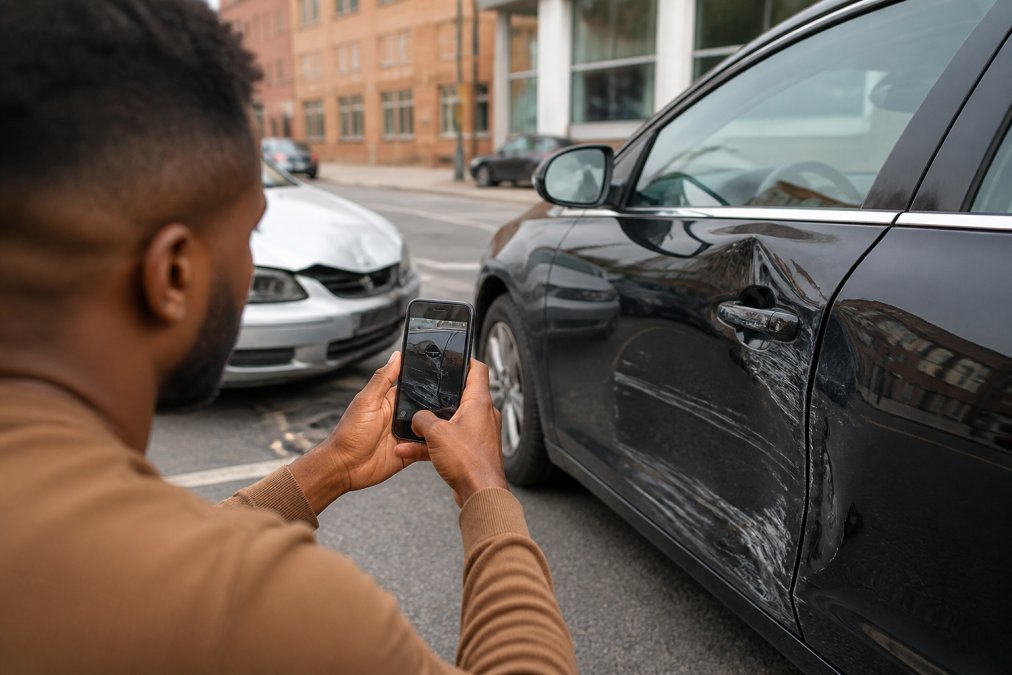
- Photograph all four sides of both vehicles
- Close-ups of every dent, scratch, and broken light
- Wide shots showing the road, lanes, and traffic signals
- The other driver’s license plate and VIN
- Their driver’s license and insurance card, if they have one
- Names and numbers of any witnesses
- Skid marks, debris, and weather conditions
- Your own visible injuries, the same day
The Uninsured Motorist Claim Process with Your Insurer
A few mechanics matter before you file:
- UM is usually triggered by physical contact or a hit-and-run. Some states require actual contact with the other vehicle; others allow a “miss-and-run” claim if an unidentified driver forced you off the road. Check your policy language.
- UM typically covers bodily injury; UMPD (uninsured motorist property damage) is a separate line item that may or may not exist on your policy. If you don’t have UMPD, your collision coverage, minus your deductible, is usually how your car gets fixed.
- Stacking. If you insure multiple vehicles on one policy, some states let you “stack” UM limits across those vehicles, effectively multiplying your available coverage. Other states prohibit stacking. This single rule can change your recovery by tens of thousands of dollars.
- Notice deadlines. Most policies require prompt notice, often within days, not weeks. Late notice is one of the most common reasons insurers deny UM claims.
Here’s how the claim usually unfolds:
- Report the accident to your insurer right away and open the claim under your UM (or UMPD) coverage.
- Provide the police report number, the other driver’s information, and your evidence file.
- Meet with the insurance adjuster and give a recorded statement, you are contractually required to cooperate, but you can ask for the questions in advance.
- Submit medical records, repair estimates, and wage-loss proof. Keep a running log of every provider, date, and dollar amount.
- Negotiate the settlement. The adjuster’s first offer is rarely the final one; UM claims are negotiable just like third-party claims.
- If you and the insurer can’t agree, most policies allow binding arbitration instead of a lawsuit. That clause is buried in your policy, find it before you sign anything.
If you sign a quick settlement before you know the full extent of your injuries, you usually can’t reopen the claim. Wait until a doctor confirms you’re stable.
Check your state insurance department’s consumer guide on uninsured motorist coverage
Suing an Uninsured Driver: Small Claims Court and Beyond
Suing an uninsured driver is possible, but you need to weigh the cost against the likely payoff. A negligent driver with no insurance often has few assets, so even a winning judgment can be hard to collect. That said, a judgment is not worthless, it can be enforced for years, reported to credit bureaus in some states, and used to garnish wages or place a lien on property if the driver’s situation improves.
- Confirm the cap in your state covers your damages. If it doesn’t, you can sometimes waive the excess and sue for the cap amount.
- File a complaint at the courthouse in the county where the accident happened or where the defendant lives. Filing fees are typically modest and often recoverable if you win.
- Serve the defendant. The court clerk can explain the accepted methods, certified mail, sheriff service, or a process server.
- Show up to the hearing with your evidence file: police report, photos, repair estimates, medical bills, and any correspondence with the other driver.
- If you win, you receive a judgment, not a check. Collecting is a separate step.
- The other driver has a job or property you can collect from
- Your injuries are serious and well documented
- Your own uninsured motorist coverage won’t cover the full loss
- The other driver’s insurer (if any) is disputing coverage in a way a lawyer can challenge
Before you file, run a quick asset check. A county property-records search and a glance at the driver’s employment (if you know it) tell you whether a judgment is likely to be collectible. Suing someone with no wages and no property usually costs more than it recovers.
What Happens to Your Insurance Premiums After an Uninsured Driver Hits You
Your premiums usually don’t jump when the other driver is at fault and uninsured. Most insurers base rate increases on your own driving record and claims history, not on someone else’s lack of coverage.
- Filing a claim under your own collision or uninsured motorist coverage
- Your state’s rules on rate adjustments after not-at-fault claims
- Your overall claims history with the insurer
If your insurer does raise your rate after a not-at-fault uninsured motorist claim, shop your policy at renewal. Loyalty rarely pays, and a competing quote often resets the math.
When the Other Driver Has No Insurance: Handling Excuses and Hit-and-Runs
Drivers without coverage tend to offer the same lines. “I left my card at home.” “I’ll pay you cash, let’s skip the report.” “My cousin’s policy covers me.” Treat every one of these as a reason to call the police and document harder.
Common excuses and what to do:
| Excuse | What It Usually Means | Your Move |
|---|---|---|
| “My insurance card is at home” | No active policy | Call police, get a report |
| “Let’s handle it in cash” | Wants to avoid a paper trail | Refuse, file the claim |
| “I’m covered under someone else’s policy” | Often untrue | Ask for the policy, note the name |
| “I’ll mail you my info later” | They’ll disappear | Get everything at the scene |
The excuse doesn’t change your plan. Police report, photos, medical records, then file with your own insurer. Every time.
Conclusion: Protect Yourself Before and After
A crash with an uninsured driver tests your patience and your paperwork at the same time. The drivers who come out ahead are the ones who document everything, file fast, and lean on their own coverage instead of chasing someone who may never pay.
Frequently Asked Questions
Will my insurance go up if I am hit by an uninsured driver?
In most states, your insurance premiums cannot be increased solely because you were hit by an uninsured driver. Insurance regulations generally prohibit surcharges for not-at-fault accidents. However, if you file a claim under your collision coverage, some insurers may still apply a surcharge if they determine you were partially at fault. Check your policy and state laws. Filing under uninsured motorist coverage typically has no effect on your rates.
How do I file a claim if the other driver has no insurance?
Start by filing a claim with your own insurance company under your uninsured motorist (UM) coverage or collision coverage. You will need to provide a police report, photos of the damage, medical records if applicable, and the other driver’s information. Your insurer will then investigate and pay for covered damages, up to your policy limits. If you don’t have UM coverage, you may need to sue the at-fault driver directly. An attorney can help you navigate the uninsured motorist claim process.
Can I sue a driver who has no insurance?
Yes, you can sue an uninsured driver for your damages, but collecting the judgment is often difficult if they have no assets. For smaller claims, small claims court is a practical option; the limit varies by state for individuals. For larger claims, you might need an attorney. Even if the driver has no insurance, they may have personal assets or future wages that can be garnished. However, many uninsured drivers are judgment-proof, so suing may not be worth the cost.
What is uninsured motorist bodily injury coverage?
Uninsured motorist bodily injury (UMBI) coverage pays for your medical expenses, lost wages, and pain and suffering when you’re hit by a driver who has no insurance or in a hit-and-run. It also covers passengers and family members. In many states, insurers must offer UMBI, but you can reject it in writing. Minimum required UMBI limits vary by state, but you can often purchase higher limits. This coverage is separate from collision coverage, which handles vehicle damage.