
How Flat Tire Service Works in Real Life
⏱️ Read Time: 5 mins
📍 Service Area: San Diego County
⭐ By: Fast Towing San Diego
A flat tire never shows up at a good time. It hits when you are late for work, stuck on the shoulder, parked in a dark lot, or trying to get home with kids in the back seat. That is exactly why people ask how flat tire service works – they want to know how fast help comes, what the technician actually does, and whether the problem gets fixed on the spot or turns into a tow.
The short answer is simple. You call for roadside help, give your location and vehicle details, a technician is dispatched, and the tire is either changed, inflated, repaired temporarily if appropriate, or the vehicle is towed if the damage is too severe. The real answer is more useful, because not every flat is the same and not every vehicle should be handled the same way.
How flat tire service works from the first call
The first step is dispatch. When you call, the company needs a few key details fast: your exact location, the type of vehicle, whether you are in traffic or parked somewhere safe, and what you can see about the tire. If you ran over a nail in a parking lot, that is one kind of call. If you blew a tire at highway speed and now your wheel may be damaged too, that is a different response.
Good roadside service starts by figuring out whether the job is a basic tire change or a bigger recovery. That matters because the right truck, tools, and technician save time. If your vehicle is an SUV, dually truck, EV, motorcycle, trailer, or exotic car, that should be said up front. A real operator does not guess. They prepare.
Once dispatch has the details, the technician heads out. In a busy area like San Diego, arrival time depends on traffic, distance, and how dangerous the location is. If you are on a freeway shoulder or blocking traffic, urgent response matters even more. Speed is not just convenience there. It is safety.
What the technician checks when they arrive
When roadside help gets to you, the first job is not grabbing a jack. The first job is making sure the vehicle can be serviced safely. That means checking where the car is sitting, whether the ground is stable, whether traffic is too close, and whether the tire damage is the only issue.
A trained technician will usually inspect the flat, the wheel, and the surrounding area before starting. If the sidewall is shredded, the rim is bent, the suspension looks damaged, or the tire came off the bead after an impact, a simple roadside change may not be the smartest move. Some vehicles also have locking lug nuts, missing spare tires, damaged jack points, or cargo packed over the spare access area. These little details are often what slow down a flat tire call.
This is where experience makes a big difference. A professional is not there to force a quick fix that creates a bigger problem. They are there to get you moving again the right way.
The most common outcome – a spare tire change
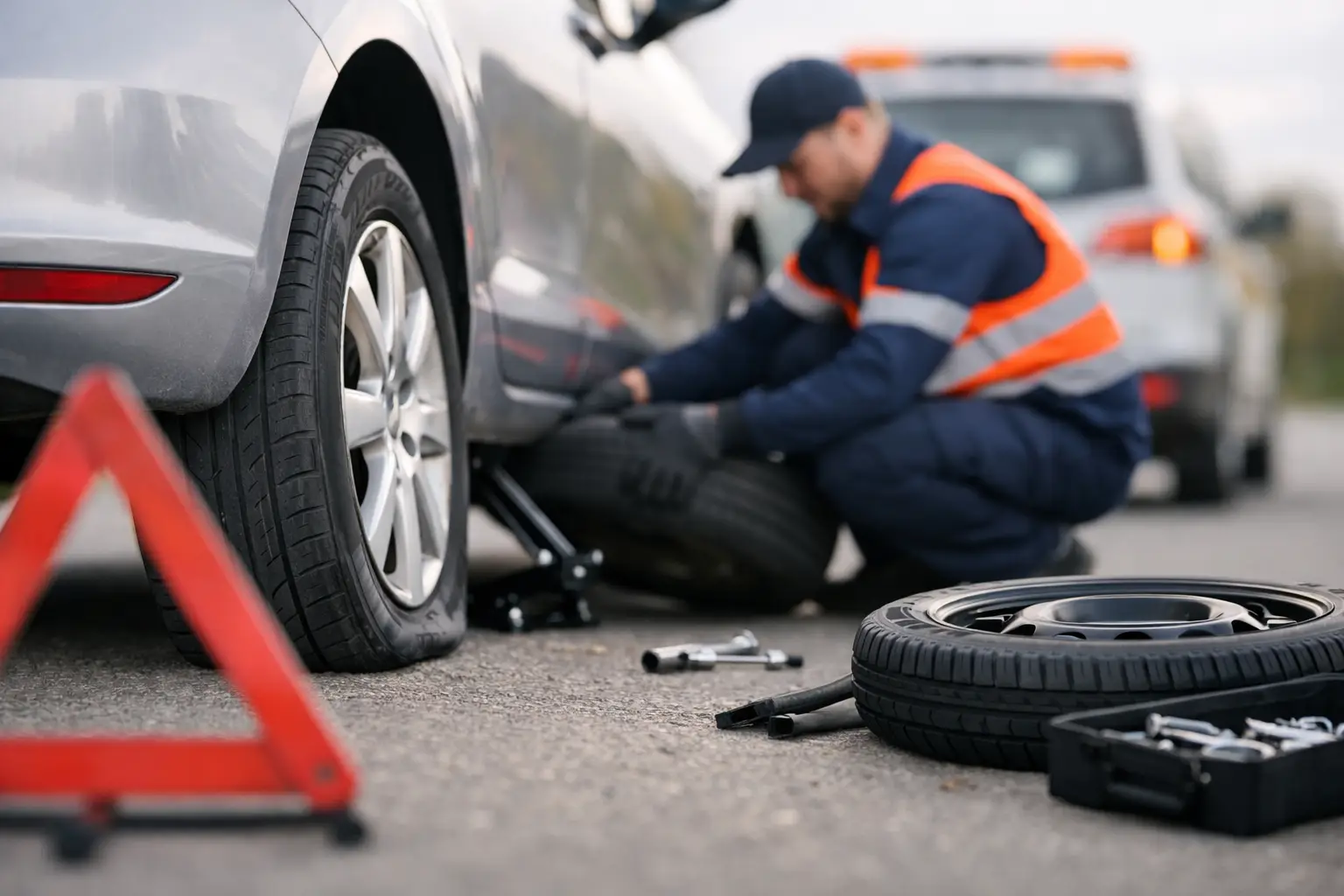
In many cases, flat tire service means installing your spare. If your spare is present, inflated, and the wheel hardware is in usable condition, the technician will lift the vehicle at the correct jack points, remove the damaged tire, mount the spare, tighten the lug nuts properly, and lower the vehicle safely.
That sounds simple, and sometimes it is. But modern vehicles can complicate the job. Low-profile tires may be stuck to the hub. Oversized wheels can be heavy. Some trucks and SUVs carry spares underneath the vehicle, which can be difficult to access if the release mechanism is rusted or jammed. On some luxury or performance vehicles, improper lifting can damage body panels or undercarriage components. That is why roadside tire service is not just about muscle. It is about knowing what you are touching.
Once the spare is on, the technician may remind you that most compact spares are temporary. You can usually drive on them only for a limited distance and at reduced speed. If the spare is a full-size replacement, you have more flexibility, but the damaged tire still needs proper inspection and repair.
When air, not a tire change, solves the problem
Not every flat is completely flat. Sometimes the tire has lost enough air to be unsafe, but the leak is slow. In that case, roadside service may include inflation to get the tire to a safer pressure level. This can be helpful if the issue is a bead leak, minor puncture, or seasonal pressure drop.
That said, adding air is not the same as fixing the tire. If a tire has a nail, cut, bulge, sidewall damage, or visible separation, air is only a short-term step and sometimes not a smart one at all. A good technician should tell you the truth. If the tire can hold enough pressure to move to a tire shop safely, fine. If not, forcing it can ruin the wheel or create a blowout risk a few miles later.
When a tow is the better call
This is the part many drivers do not expect. Sometimes flat tire service ends with a tow, and that is the right move.
If there is no spare, if the spare is flat too, if the lug nuts are seized, if the rim is cracked, or if the vehicle took impact damage, roadside tire service may not be enough. The same goes for specialty vehicles that need careful handling. EVs, lowered cars, motorcycles, trailers, and exotic vehicles all come with their own loading and transport requirements. Pushing a quick roadside fix on those vehicles can do more harm than good.
A strong roadside company should be able to pivot immediately. If the tire cannot be changed safely on-site, the next step should not be confusion. It should be a clear plan to tow the vehicle to your home, your preferred shop, or a trusted local tire facility. That kind of follow-through matters when you are already losing time.
How flat tire service works on different vehicles
The basic idea stays the same, but the job changes depending on what you drive. A sedan with a trunk spare is usually straightforward. A lifted truck with oversized tires may require heavier-duty equipment. A motorcycle flat needs special care to secure and transport without damage. A trailer flat may involve load considerations and roadside positioning issues. An EV adds another layer because proper lift points and towing procedures matter.
This is one reason drivers should not shop roadside assistance by price alone. Cheap service can get expensive fast if the wrong operator shows up without the right tools or experience. In urgent situations, you want someone who knows how to handle your exact vehicle without guessing.
What you can do while waiting for help
If you are in a safe spot, stay with the vehicle unless the environment makes that dangerous. Turn on your hazard lights. If you have cones or reflectors, use them when possible. If you are on a freeway shoulder, stay away from moving traffic and wait somewhere safer if you can do so without risking injury.
It also helps to have your wheel lock key, if your car uses one, ready for the technician. If your spare and jack are stored under cargo, clearing access can save time. But if you are in an unsafe location, do not worry about any of that first. Safety wins.
What fast, professional service should feel like
The best flat tire calls are the ones that lower your stress the minute someone answers the phone. You want a clear ETA, honest communication, and a technician who shows up ready to work. No runaround. No guessing. No careless handling.
That is what drivers are really asking when they ask how flat tire service works. They are asking whether help will show up fast, whether the person knows what they are doing, and whether the problem will actually get solved. In the real world, good service means a fast assessment, the right fix for the situation, and a backup plan if the tire cannot be handled roadside.
Fast Towing works that way because roadside service is not just about getting there. It is about getting you out of a bad spot without wasting time or making things worse. Some flats need a simple spare change. Some need air. Some need a tow. The right call is the one that gets you safely back on the road or safely to the right shop.
If your tire goes down, do not guess, do not keep driving on it, and do not let a small problem turn into wheel or suspension damage. Get real help, get a proper assessment, and let the next move be the smart one.
Licensed, insured, and rapid response units on standby across all San Diego corridors.