
Table of Contents
- How to Find Reliable Towing Near Me: Step-by-Step
- What to Look for in a 24/7 Towing Service
- Average Cost of Towing Service: What Affects Your Bill
- How to Verify Towing Company License and Insurance
- Emergency Roadside Assistance Checklist
- Red Flags of Predatory Towing and How to Avoid Them
- What Happens After the Tow: Repair Shop Help
- Conclusion: Your Next Steps for Reliable Towing
- Frequently Asked Questions
Last Updated: September 15, 2026
How to Find Reliable Towing Near Me: Step-by-Step
Finding reliable towing near me starts with preparation before you ever need a tow. According to AAA’s roadside assistance guidance, drivers who keep a verified towing contact saved in their phone reach help faster than those searching in an emergency.
Here’s the step-by-step process:
- Save two licensed towing companies in your phone contacts before you need them
- Verify each company’s license and insurance through your state’s motor vehicle department
- Ask about flat-rate pricing versus mileage-based fees upfront
- Confirm 24/7 availability, including holidays
- Check recent customer reviews on Google and Yelp
- Note the dispatch center’s direct number, not just a national call line
- Keep your insurance card and roadside assistance plan number accessible
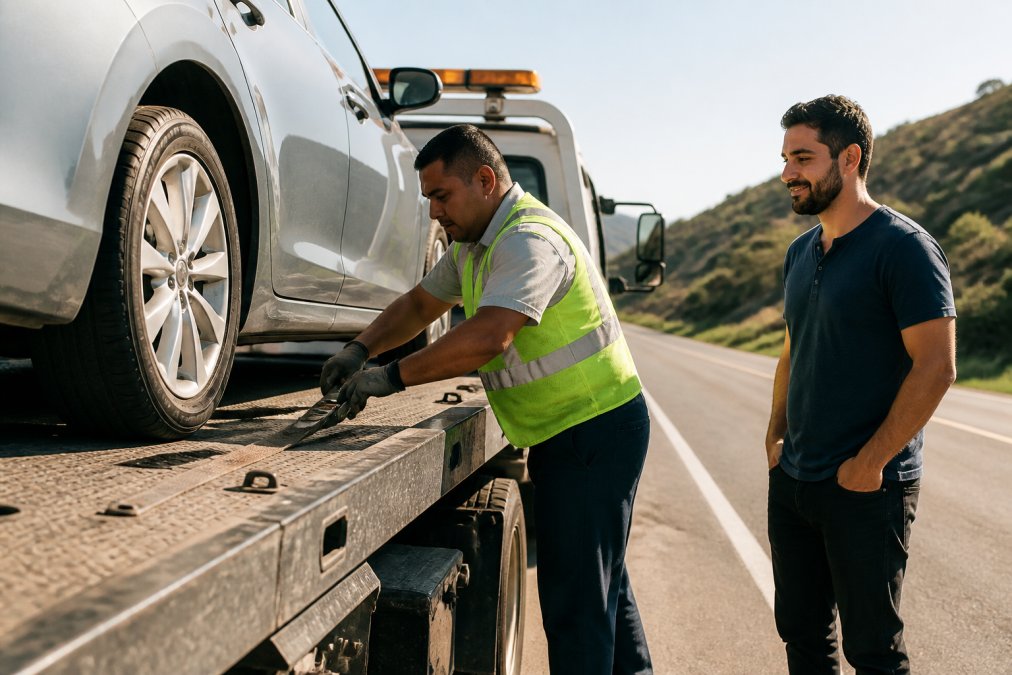
Ask the dispatcher for a service radius and estimated arrival time before you confirm. A company that can’t give you a window isn’t one you want on the freeway at 2 AM.
What to Look for in a 24/7 Towing Service
A 24/7 towing service should answer within three rings, dispatch a licensed operator, and give you a real arrival estimate. Anything less, and you’re gambling with your vehicle.
Look for these markers of a professional operator:
- Licensed and insured: Every legitimate company carries commercial liability coverage and a state-issued motor carrier permit
- Real-time tracking: Modern dispatch centers can text you a driver ETA and a tracking link
- Flat-rate or transparent pricing: You should know the hook-up fee and mileage rate before the truck rolls
- Vehicle range: A company equipped for wheel-lift and flatbed towing handles more situations
- Reviews that mention punctuality: Look for patterns, not one-off complaints
Fast Towing San Diego operates 24/7/365 with professionally trained drivers.
Average Cost of Towing Service: What Affects Your Bill
Towing bills are not one number. They are a stack of line items, and knowing how each one is calculated is the difference between a fair invoice and a padded one. Most reputable operators quote in three parts: a hook-up fee, a per-mile rate, and any specialty surcharge. Ask for all three before you authorize the tow.
Here is how the pieces typically work:
| Line Item | How It Is Calculated | What to Ask Before Dispatch |
|---|---|---|
| Hook-up fee | Flat charge to secure the vehicle | Is this waived if the tow is canceled before the truck arrives? |
| Per-mile rate | Charged from the pickup point to the drop-off | Is mileage measured from dispatch or from the pickup point? |
| After-hours surcharge | Added for nights, weekends, and holidays | What hours count as after-hours, and is there a holiday premium? |
| Specialty equipment | Flatbed, dolly, or heavy-duty surcharge | Does my vehicle require a flatbed, and is that included? |
| Storage | Daily rate after the tow | What is the daily rate, and does the first day count? |
| Winch-out | Charged if the vehicle is off-road or in a ditch | Is there a per-foot winch rate? |
A common pattern is that the hook-up fee is the smallest part of the bill and the per-mile rate is the largest, so a short tow with a high hook-up fee can still be cheaper than a long tow with a low one. Always ask for the total estimated cost, not just the rate.
Check Your Insurance and Roadside Plan First
Before you pay out of pocket, check whether you are already covered. Many auto insurance policies include towing and labor coverage as an optional add-on, and several credit cards and membership programs bundle roadside assistance. Calling your insurer’s roadside line or your card’s benefits number before you call a tow company can turn a several-hundred-dollar bill into a covered claim.
- Auto insurance: Look for “towing and labor” or “roadside assistance” on your declarations page. Coverage often has a per-incident cap and a reimbursement process.
- Credit cards: Some premium cards include roadside dispatch as a benefit. Check your card’s guide to benefits, not the marketing page.
- Membership programs: Auto clubs and warehouse memberships often sell roadside plans that cover towing, jump starts, lockouts, and fuel delivery.
- Extended warranties: Some vehicle service contracts include towing to a covered repair facility.
If your insurer dispatches the tow, use their network. If you call your own operator, keep the itemized receipt and the driver’s name and truck number. Reimbursement almost always requires the original receipt, not a photo of a handwritten note.
Never agree to a tow without a written or texted quote that lists the hook-up fee, the per-mile rate, and any surcharge. Predatory operators inflate final bills with vague “fuel surcharges” and “administrative fees” that were never disclosed. If the final bill does not match the quote, ask for an itemized breakdown before you pay.
How to Verify Towing Company License and Insurance
Verifying a towing company‘s license takes about five minutes and protects you from uninsured operators who disappear after damaging your vehicle. The Federal Motor Carrier Safety Administration maintains a searchable database of registered motor carriers, and most states require an additional towing permit or motor carrier permit on top of the federal registration.
Here is the verification checklist, with what each item actually tells you:
- Ask for the company’s USDOT number and MC number. The USDOT number identifies the carrier; the MC number identifies the operating authority. A legitimate interstate operator can give you both without hesitation.
- Search both numbers on the FMCSA SAFER system. The record shows the carrier’s operating status, safety rating, and out-of-service history. An “inactive” or “out-of-service” status is a stop sign.
- Confirm the insurance certificate lists commercial auto liability. A certificate of insurance is a snapshot, not a guarantee, but it should name the towing company as the insured and show the policy period and limits.
- Check your state’s motor vehicle department for a towing permit. Many states issue a separate permit for non-consensual or police-initiated tows, and that permit is a stronger signal than a business license.
- Request the certificate of insurance directly, not just a verbal confirmation. Ask the dispatcher to text or email it. If they cannot produce it, call someone else.
How to Read the Numbers on the Truck
Trucks operating legally usually display their USDOT number and, in many states, a state permit number on the door. If the truck that arrives has no markings, no USDOT number, and no company name, that is a red flag. A professional operator arrives in a branded, clearly identified vehicle.
Red Flags of Predatory Towing and How to Avoid Them
Predatory towing shows up in predictable patterns, and recognizing them early saves you hundreds. The Federal Trade Commission’s consumer protection guidance outlines common scams including unauthorized tows and inflated release fees. Watch for these red flags:
- No written estimate: A quote should be texted or emailed before the truck moves.
- Cash-only demands: Legitimate operators accept cards and provide itemized receipts.
- Pressure to sign immediately: You have the right to read any release form.
- Unmarked trucks: A professional operator arrives in a branded, clearly identified vehicle.
- Refusal to name the destination shop: You choose where your car goes, not the driver.
- Threats to call police if you don’t pay on the spot: That is intimidation, not policy.
- Chaser trucks: Vehicles that arrive unrequested after a crash and pressure you to sign a tow authorization. You are not obligated to accept a tow you did not call for.
If any of these appear, stop the transaction and call your insurance company’s roadside line instead. A legitimate operator will hand over license and insurance information without hesitation. If they dodge the question, call someone else.
Verification is not a one-time task. Save the USDOT number and insurance certificate for your two preferred operators in your phone, so you can confirm them again if the truck that arrives does not match the company you called.
Emergency Roadside Assistance Checklist
An emergency roadside assistance checklist keeps you safe while you wait and speeds up the tow once help arrives. Keep this list in your glovebox or saved on your phone.
Breakdown safety during the wait matters as much as the tow itself. Most roadside injuries happen because drivers stand in or near traffic instead of behind the barrier.
Red Flags of Predatory Towing and How to Avoid Them
Watch for these red flags:
What Happens After the Tow: Repair Shop Help
Your next steps:
Conclusion: Your Next Steps for Reliable Towing
Frequently Asked Questions
How can I tell if a towing company is reputable?
Check for a valid license and insurance, read recent customer reviews, and look for clear pricing before you agree to service. A reputable company will provide a written estimate and won’t pressure you. Fast Towing San Diego, for example, has over 100 years of combined experience and trained drivers.
What should I look for in a 24/7 towing service?
Confirm they actually answer calls at 2 AM, not just during business hours. Ask about whether they handle your vehicle type (motorcycles, boats, exotics). A good 24/7 service will also offer jump starts, tire changes, and lockout help. Verify they are licensed and insured before you need them.
Are there standard pricing structures for towing services?
Most companies use a hook-up fee plus a per-mile rate. Some offer flat-rate pricing for local tows. Additional fees may apply for winching, after-hours calls, or special equipment. Always ask for the total before the truck arrives. Pricing depends on distance, vehicle type, and time of day. For current rates, it’s best to request a quote directly from Fast Towing San Diego.
How do I avoid predatory towing practices?
Never sign a blank authorization form. Get the price in writing before the hook-up. Be wary of unsolicited tow trucks that appear within minutes of a breakdown, as they may be scanning police radios. Check for a license plate and company name on the truck. If pressured, call another provider. Predatory operators often target accident scenes and charge excessive fees for release.