
How to Handle Roadside Breakdowns Fast
⏱️ Read Time: 5 mins
📍 Service Area: San Diego County
⭐ By: Fast Towing San Diego
Your car never picks a convenient place to quit. It happens in freeway traffic, on a dark shoulder, in a parking lot before work, or halfway through a weekend plan. If you want to know how to handle roadside breakdowns without making a bad situation worse, start with one rule – protect yourself first, then deal with the vehicle.
Panic is what turns a breakdown into a bigger problem. The right move is to slow things down for 30 seconds, look at your surroundings, and make smart decisions in order. A dead battery is annoying. A flat tire on a narrow shoulder is dangerous. An overheating engine in stop-and-go traffic needs a different response than a car that simply will not start. The details matter.
How to handle roadside breakdowns safely
The moment you realize something is wrong, get out of the flow of traffic if you can. Do not slam on the brakes unless you have no choice. Ease off the gas, turn on your hazard lights, and guide the vehicle to the safest nearby spot. That might be a wide shoulder, an exit ramp, a parking lot, a gas station, or any area away from moving vehicles.
If the car still has power, try to stop somewhere flat and visible. Curves, hills, and narrow shoulders make it harder for other drivers to see you. If you are on a busy San Diego freeway, a little extra distance to reach a safer spot is often worth it – as long as the vehicle is still controllable.
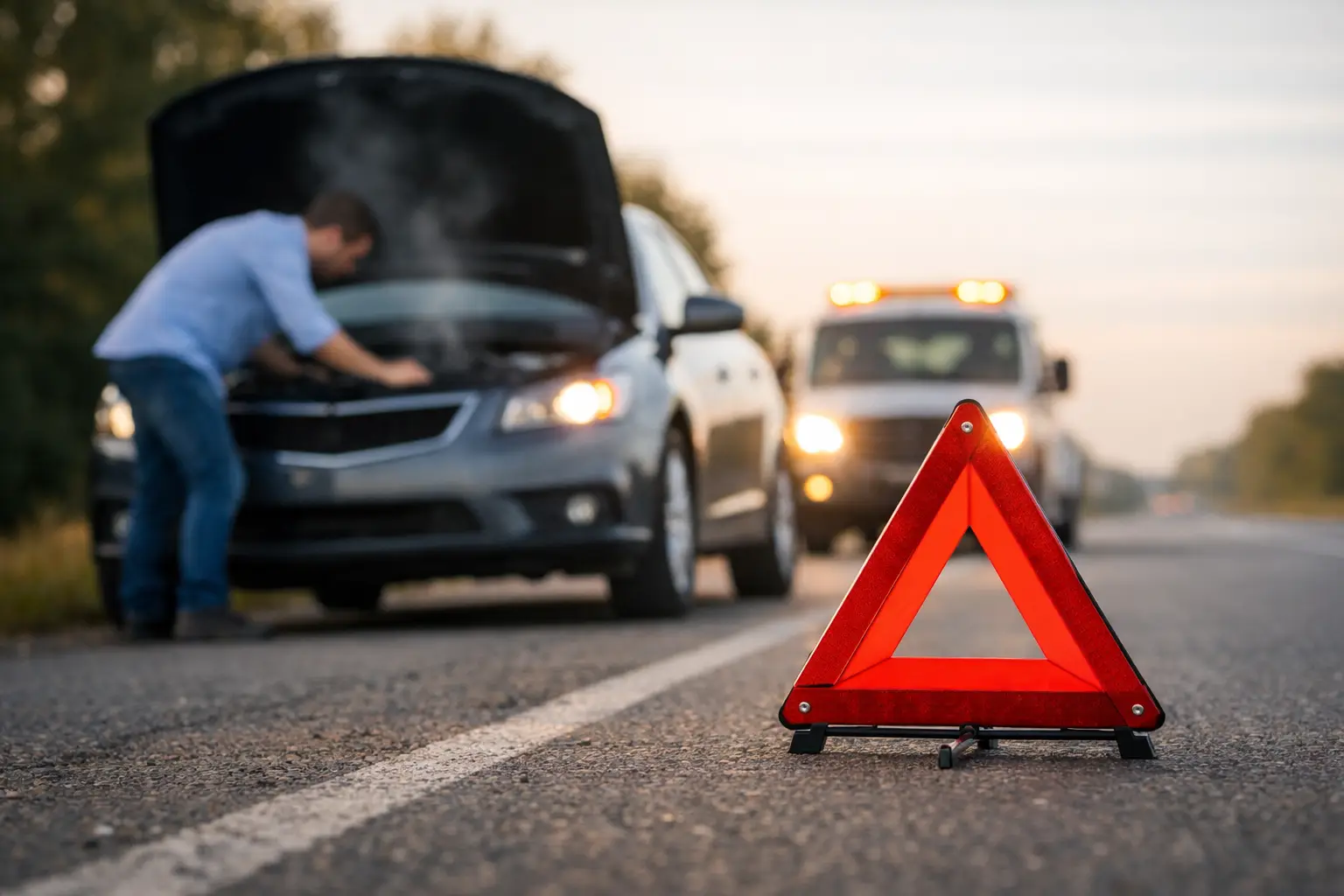
Once stopped, put the car in park, set the parking brake, and keep your hazards on. At night, turn on the interior dome light if it helps make you more visible. If you have reflective triangles or road flares and it is safe to place them, use them. If stepping outside puts you close to fast traffic, stay inside instead. Visibility helps, but not at the cost of your safety.
Stay in or get out? It depends
This is where a lot of drivers hesitate, and the answer is not always the same. If you are parked well off the road in a safe area like a lot or side street, getting out may be fine. If you are stuck on the shoulder of a high-speed road with traffic whipping past your door, staying inside with your seat belt on is often the safer call.
If you do exit the vehicle, use the side away from traffic whenever possible. Move well away from the road and never stand directly in front of or behind your vehicle. Another driver may not see you in time, especially at night or in bad weather.
If you have passengers, get them to a safe location too. Kids and pets should never be left wandering near traffic while you inspect the problem. Keep everyone calm and together.
If you are on a freeway shoulder
Treat the situation as high risk. A simple mechanical issue can wait a few minutes. Traffic will not. Stay buckled if you are in a dangerous spot and call for professional help right away. This is not the place to test your tire-changing skills for the first time.
Figure out what failed, but do not guess your way into damage
A roadside breakdown can come from a handful of common problems. The battery may be dead. A tire may have blown. The engine may be overheating. You may have run out of gas, locked yourself out, or noticed warning lights that make continuing unsafe.
Do a quick check, not a full diagnosis. Look for obvious signs: a flat tire, steam from under the hood, a strong burning smell, fluid leaking under the car, or dashboard warnings. Listen too. Clicking when you turn the key often points to battery trouble. Grinding, knocking, or sudden loss of power can mean something more serious.
This is where restraint matters. If the engine is overheating, do not keep driving to see if it clears up. If you hear metal-on-metal noise, do not try to limp it home. If you see smoke, get to safety and stop. Trying to squeeze out a few more miles is one of the fastest ways to turn a repair bill into a major failure.
When you should not pop the hood right away
If there is smoke, fire risk, leaking fuel, or traffic is too close, leave it alone. If the engine overheated, wait before opening anything. A hot cooling system can cause serious burns. If you are not sure what you are looking at, that is fine. You do not need to be your own mechanic on the roadside.
Call the right help, not just the fastest number you find
Once you are safe, get help moving. Tell the dispatcher exactly where you are, what vehicle you have, and what happened. Good information cuts response time and gets the right truck or technician to you the first time.
Be specific. Saying “I broke down on the freeway” is not enough. Give the freeway name, direction of travel, nearest exit, lane or shoulder position, and any visible landmark. Share whether you are in a sedan, lifted truck, motorcycle, EV, SUV, motorhome, or something specialty. Not every company can handle every vehicle correctly, and that matters more than people realize.
If you drive an exotic vehicle, EV, all-wheel-drive vehicle, or oversized truck, mention that upfront. The wrong tow setup can do real damage. The same goes for trailers, boats, and motorcycles. Breakdown help is not one-size-fits-all.
If the issue might be solved on the spot, roadside assistance may be enough. That includes jump starts, tire changes, fuel delivery, or lockout service. If the vehicle is unsafe to drive, has collision damage, or suffered a major mechanical failure, towing is the better call. A fast, honest operator will tell you which one makes sense instead of selling you the wrong service.
What you can handle yourself – and what should wait
Some breakdowns are manageable if conditions are safe and you know what you are doing. A dead battery in a parking lot is very different from a dead battery on the side of Interstate 5. A flat tire in your driveway is routine. A flat tire next to fast traffic is not.
If you have a spare, tools, and room to work far away from moving cars, changing a tire may be reasonable. If not, call it in. The same goes for jump starts. Modern vehicles are more sensitive than many drivers think, and incorrect boosting can create electrical problems.
Fuel delivery is straightforward. Overheating is not. If your car is running hot, shut it off and let it cool. Do not open the radiator cap while the system is pressurized. If fluids are pouring out, there is no smart shortcut. You need professional help.
There is also the simple truth that stress changes judgment. Plenty of people know how to do a tire change in theory, then find out the lug nuts are seized, the jack point is wrong, or the shoulder is too soft to work on safely. There is no shame in skipping the roadside experiment and getting the job done right.
What to do while you wait
Stay visible, stay aware, and keep your phone charged if you can. If you are in a safe location outside the vehicle, stand far from traffic. If you are inside, keep your seat belt on. Watch for the responding truck and confirm the company name before accepting service.
It also helps to have a destination in mind. Do you want a tow home, to a tire shop, to a repair shop, or to a body shop after an accident? If you do not know where to send it, say so. A good local company should be able to point you toward the right next step instead of dropping your vehicle somewhere inconvenient.
If you are in San Diego and the vehicle needs proper roadside help or specialized towing, Fast Towing is built for exactly this kind of call – urgent response, experienced operators, and the equipment to handle everything from daily drivers to EVs, motorcycles, exotics, trailers, and heavy personal vehicles.
A roadside breakdown kit still matters
Most people do not think about preparation until they need it. Keep the basics in your vehicle: a charged phone cable, flashlight, water, reflective warning gear, a tire pressure gauge, and your wheel lock key if your wheels use one. A portable jump pack can help, but only if you know how to use it correctly.
In Southern California, heat matters too. Batteries fail faster, engines run hotter in traffic, and standing on the roadside in direct sun gets miserable fast. A little preparation buys you time and better options.
The real goal is not to become a roadside hero. It is to avoid getting hurt, avoid making the damage worse, and get the right help moving fast. When your vehicle breaks down, stay calm, think safety first, and make the next smart move – that is how you get back on the road without turning one problem into three.
Licensed, insured, and rapid response units on standby across all San Diego corridors.