
Table of Contents
- Loyalty Towing Services vs Pacific Auto: Side-by-Side Overview
- Towing Service Cost Factors: What Drives the Bill Up
- 24/7 Emergency Roadside Assistance: Availability That Holds Up
- How to Avoid Towing Scams: Licensing, Insurance, and Red Flags
- Loyalty Towing Services vs Pacific Auto: Who Each One Fits
- Consumer Rights and Dispute Resolution After a Tow
- Verdict: Which Towing Service Model Wins in 2026
- Frequently Asked Questions
Last Updated: September 14, 2026
Loyalty Towing Services vs Pacific Auto: Side-by-Side Overview
Choosing between loyalty towing services and a Pacific Auto-style provider comes down to one question: do you want a membership model or a pay-per-call model? This comparison from Fast Towing San Diego breaks down how each approach handles emergency dispatch, pricing, and vehicle recovery so you can pick the right fit before you’re stranded on the shoulder at 2 AM.
The two models work very differently. Loyalty towing services is a membership-based roadside assistance program: you pay an annual fee and receive towing, battery help, and lockout support as part of your plan. A Pacific Auto-style provider is a per-service operation: you call, they dispatch a truck, and you pay for that specific tow. Neither is universally better. The right choice depends on how often you drive, what you drive, and whether you want predictable annual costs or pay-as-you-go flexibility.
| Factor | Membership Model (Loyalty Towing Services) | Per-Service Model (Pacific Auto-Style) |
|---|---|---|
| Payment structure | Annual membership fee | Per-service fee |
| Best for | Frequent drivers, older vehicles | Occasional drivers, one-off tows |
| Coverage type | Recurring roadside assistance | Single emergency dispatch |
| Mileage limits | Tier-based caps | Varies by provider |
| Commitment | 12-month term typical | None |
The membership model wins on predictability. The per-service model wins on flexibility. If you drive an older vehicle daily, membership usually pays for itself. If you drive a newer car and rarely break down, pay-per-service is cheaper.
Towing Service Cost Factors: What Drives the Bill Up
Most towing pages tell you to “ask for a quote” and stop there. That’s the gap this section fills: a transparent breakdown of what actually appears on a tow invoice, which charges are standard, and which ones signal a predatory operator. Knowing the line items before you call is the single best defense against an inflated bill.
A typical invoice is built from a base hookup fee plus a per-mile rate, then modified by the factors below. The base and per-mile numbers vary by market and provider, so treat any quote that omits them as incomplete.
Standard charges you should expect
- Base hookup fee, covers the truck rolling to your location and the first portion of the tow. This is the anchor number; everything else is added to it.
- Per-mile rate, applies after the included mileage. Long-distance tows to a specific repair facility multiply this fast, so ask where the included mileage ends.
- After-hours surcharge, overnight, weekend, and holiday calls commonly carry a premium because the operator is paying overtime or running a thin overnight crew.
- Specialized equipment surcharge, motorcycles, boats, motorhomes, and exotic vehicles need different rigging, a heavier truck, or a flatbed with a winch, and that takes longer to secure.
- Storage, daily charges that begin after a free window, often 24 hours. This is the most common billing surprise.
Charges that deserve a second look
- Gate or after-hours release fees for picking up your vehicle outside business hours
- Administrative or “paperwork” fees that appear only at payment
- Fuel or mileage surcharges layered on top of an already-quoted per-mile rate
- Winch or recovery fees when the vehicle is off-road, in a ditch, or on a lower level of a parking structure
The most common billing surprise is storage. Many drivers assume the tow fee covers everything, then discover daily storage charges added after 24 hours. Ask about the free storage window before you authorize the tow, and get the daily rate in writing.
How to get a real number before the truck rolls
- Give the dispatcher your exact pickup and drop-off addresses so the mileage is calculated, not guessed.
- State your vehicle type and condition, running, not running, in gear, wheels locked.
- Ask for the base fee, the included mileage, the per-mile rate, and any after-hours surcharge as separate numbers.
- Confirm the free storage window and the daily rate that follows it.
- Ask whether the quote is binding or an estimate, and get it in writing or by text before you authorize the hookup.
A provider that answers these five questions clearly is almost always operating above board. A provider that deflects, quotes a single vague number, or pressures you to sign is showing you the pattern. The Federal Trade Commission’s consumer guidance outlines your right to a written estimate and to dispute unauthorized charges, and many states cap non-consensual tow rates, so knowing your local rules gives you leverage.
Transparency is the tell. A provider who itemizes before the tow is a provider who won’t surprise you after it. If the numbers only appear once your car is on the bed, you’ve lost your negotiating position.
24/7 Emergency Roadside Assistance: Availability That Holds Up
Genuine 24/7 emergency roadside assistance means a live dispatcher answers at 3 AM, not a voicemail box. The gap between advertised availability and real availability is where most complaints originate. A provider that runs three trucks during the day and one overnight will quote you a 45-minute response time and deliver in 90.
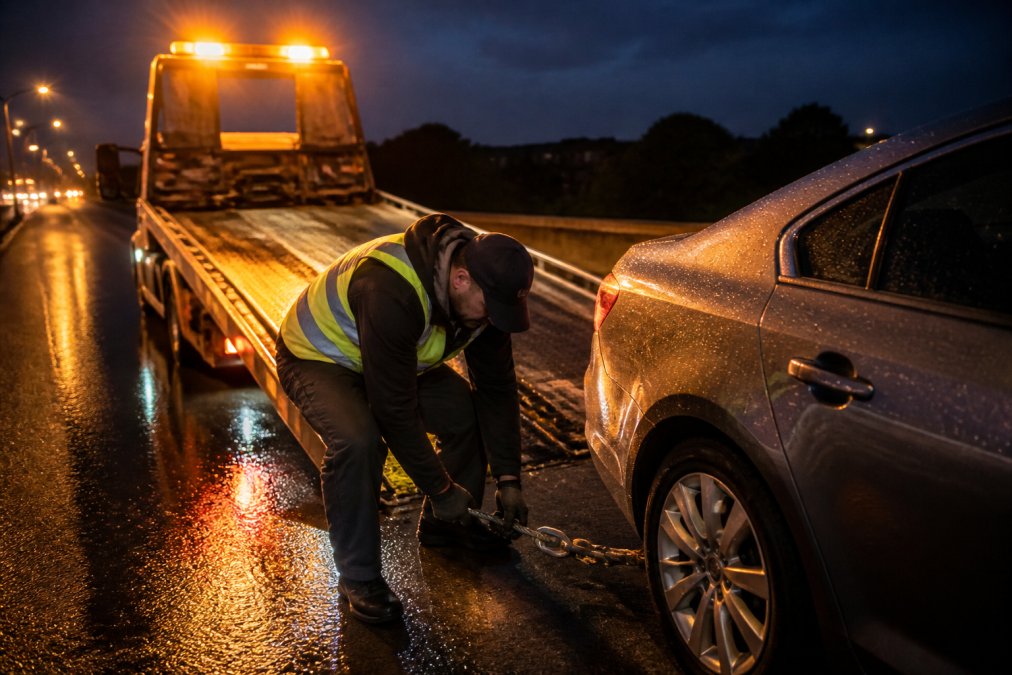
The two service models handle overnight dispatch very differently, and that difference drives response time more than any marketing claim.
Membership model dispatch
Membership programs typically route through a national dispatch center. Your call goes to an operator who then locates the nearest contracted provider and relays the job. That extra layer adds time, and the contracted provider may be finishing another call when yours comes in. The upside is nationwide coverage, a membership usually follows you across state lines, which matters on long road trips.
Per-service model dispatch
Local per-service operations dispatch directly from their own yard. There’s no relay, so the person answering the phone is often the person deciding which truck rolls. That usually shortens response time, but the service radius is limited to how far the operator is willing to send a truck, and coverage doesn’t travel with you.
How to test availability before you need it
Don’t wait for a breakdown to find out whether the phone line is real. Run this check now:
- Call the number at an off-peak hour and see whether a human answers or a machine picks up.
- Ask how many trucks operate in your area overnight and what the typical overnight response window is.
- Ask whether the quoted response time is a guarantee with a remedy or a soft estimate.
- Confirm whether the dispatcher can see your location or needs you to describe it.
- Ask what happens if no truck is available, do they refer you elsewhere or leave you waiting?
What “24/7” should actually mean
A legitimate 24/7 operation staffs overnight, not just forwards calls. The practical test is simple: if you can reach a live person who can commit a truck to your location at 3 AM, the claim holds. If you reach an answering service that takes a message and promises a callback, you’re relying on someone else’s schedule.
Save the dispatch number in your phone before you need it, and note whether it’s a local line or a national one. A local line usually means a local truck. A national line usually means a relay, useful for road trips, slower for a Tuesday-night breakdown at home.
The National Highway Traffic Safety Administration tracks crash and breakdown data that underscores why fast roadside response matters on high-speed corridors. A truck that arrives in 30 minutes versus 90 changes the risk profile for everyone stopped on the shoulder.
Availability is a claim until you test it. One off-peak phone call tells you more about a provider’s overnight operation than any page on their website.
How to Avoid Towing Scams: Licensing, Insurance, and Red Flags
Learning how to avoid towing scams starts with one verification step: confirm the operator is licensed and insured before you let them hook your vehicle. Predatory towing thrives on urgency. A driver who appears within minutes of a breakdown, quotes a vague price, and pressures you to sign immediately is running a pattern worth recognizing.
Red flags to watch for:
- No company name or license number on the truck
- A quote given verbally with no written estimate
- Pressure to sign a release before you’ve seen the price
- A destination you didn’t choose
- Cash-only payment demands
Legitimate professional towing operations carry commercial insurance and can produce a license number on request. The Federal Trade Commission’s consumer guidance outlines your right to a written estimate and to dispute unauthorized charges. Towing regulations vary by state, and many states cap non-consensual tow rates, so knowing your local rules gives you use.
Photograph the truck, the license plate, and the driver’s paperwork before the tow begins. If a dispute arises later, that documentation is the difference between a refund and a dead end.
Loyalty Towing Services vs Pacific Auto: Who Each One Fits
Match the model to your situation, not the other way around. Membership programs suit drivers who want one number to call and predictable annual costs. Per-service providers suit drivers who want no commitment and are willing to shop each call.
Choose a membership model if you:
- Drive an older, higher-mileage vehicle
- Want battery, lockout, and fuel delivery bundled in
- Value a single dispatch number over shopping around
- Take long road trips and want nationwide coverage
Choose a per-service model if you:
- Drive a newer vehicle with low breakdown risk
- Need a one-time tow after an accident
- Own a specialized vehicle and want a provider who confirms capability upfront
- Prefer to compare rates per call
For specialized transport, capability questions matter more than model type. A vintage motorcycle, a boat, or an exotic car needs a flatbed and a driver trained in that equipment. Ask directly whether the provider can handle your vehicle before you commit.
AAA’s roadside assistance program details illustrate how membership tiers scale coverage by mileage, which is useful context when comparing annual plans. The Insurance Information Institute also notes that some auto policies include roadside coverage, so check your policy before paying for a separate membership.
Consumer Rights and Dispute Resolution After a Tow
Consumer protection in towing rests on documentation and timing. If you believe you were overcharged, the dispute process starts with a written complaint to the provider, then escalates to your state’s consumer protection office or the agency that regulates towing in your area.
Steps to take after a disputed tow:
- Request an itemized invoice listing every charge
- Photograph your vehicle and the lot before paying
- Pay under protest in writing if you need the vehicle released
- File a complaint with your state consumer protection agency
- Dispute the charge with your credit card issuer if applicable
Vehicle impound situations follow a different path. Once a vehicle is in impound, storage fees accrue daily, and the release process is governed by state law. Acting fast limits the bill. Consumer protection rules generally require the operator to provide the legal basis for the tow and the fee schedule on request.
Verdict: Which Towing Service Model Wins in 2026
The membership model wins for frequent drivers who want predictable costs and bundled roadside assistance. The per-service model wins for occasional drivers who value flexibility and no annual commitment. There’s no universal champion because the two models solve different problems.
What matters most is the provider behind the model. Availability, licensing, and transparent pricing decide whether a tow goes smoothly, not the payment structure. A membership with a slow dispatch center is worse than a per-service call to a well-run local operation.
For drivers who want a single provider that handles emergency dispatch, accident recovery, and specialized transport without a membership commitment, Fast Towing San Diego operates around the clock with professionally trained drivers and a fleet equipped for cars, motorcycles, boats, and motorhomes. The team also helps locate a trusted auto repair facility after an accident, which removes one more decision from a stressful night.
Getting stranded is stressful enough without wondering whether your provider will actually answer the phone or surprise you with fees. Fast Towing San Diego offers 24/7/365 availability, more than 100 years of combined team experience, and discounts for first responders, military, and fleet accounts. Whether you need a jump start, a tire change, or a full flatbed recovery, you get a live dispatcher and a clear answer on cost before the truck rolls. Get started with Fast Towing San Diego and get off the shoulder faster.
Frequently Asked Questions
What should I look for when choosing a towing service?
Check three things before you call. First, confirm the company is licensed and insured and ask for the license number. Second, get the rate structure in writing before dispatch, including hook fees, per-mile charges, and any storage or gate fees. Third, ask for an estimated response time and a dispatch confirmation. A company that answers these questions plainly is usually easier to deal with than one that dodges them.
Are towing service rates regulated?
It depends on where the tow happens. Tows from private property are often governed by state and municipal rules that cap nonconsensual towing fees and require signage, while tows you request yourself are usually set by the market. Always ask whether a tow is consensual or nonconsensual, because that distinction decides which fee limits apply and what you can dispute later.
How do I know if a towing company is reputable?
Look for a verifiable license, active insurance, and a physical business address. Read recent reviews and pay attention to complaints about surprise charges rather than star averages. Ask the dispatcher for the driver’s name and truck number, and confirm the total before the truck rolls. Reputable operators explain their towing service cost factors up front. Predatory operators pressure you to sign quickly, quote a low number on the phone, and add storage fees after the vehicle is already on the lot.
What is the difference between a towing service and roadside assistance?
Roadside assistance covers fixes at your location: jump starts, tire changes, lockouts, and fuel delivery. Towing moves the vehicle when it cannot be driven. Many companies offer both, but the billing differs. A 24/7 emergency roadside assistance call may be covered by a membership plan, while a tow is usually billed per service plus mileage. If your car starts after a jump, you avoid a tow entirely. If it does not, you pay for both the service call and the transport.
Does my insurance cover towing from specific providers?
Sometimes. Many auto policies include roadside coverage, but insurers often work through a contracted network, so a provider you choose yourself may not be reimbursed. Call your insurer before dispatch and ask whether they pay direct or reimburse you, what the per-incident limit is, and whether you must use an in-network provider. If you are paying out of pocket, ask the towing company for an itemized receipt showing the base fee, mileage, and any storage charges so you can submit a clean claim.