
Table of Contents
- Pacific Auto Center vs Competitors: Overview
- Inventory Selection and Vehicle Types Across Dealerships
- Pricing Transparency and Hidden Fees: What You Actually Pay
- Questions to Ask Before Buying a Used Car at Each Dealership
- Used Car Inspection Checklist and What Each Dealer Guarantees
- How to Negotiate at a Used Car Dealership: Tactics by Dealer Type
- Customer Service, Reviews, and Reputation Analysis
- Which Dealership Should You Choose?
- Frequently Asked Questions
Last Updated: August 14, 2026
Pacific Auto Center vs Competitors: Overview
Buying a used car shouldn’t feel like navigating hidden fees, bait-and-switch tactics, and pressure sales. Understanding how different dealerships approach inventory, pricing, and customer service can mean the difference between a fair deal and thousands of dollars in unexpected costs.
This guide examines key differences between Pacific Auto Center and major competitors including CarMax, Carvana, Enterprise Car Sales, and Shift. We’ll break down what separates transparent dealerships from those that bury costs in fine print, and give you concrete tools to verify out-the-door pricing before signing.
A single hidden documentation fee or dealer markup can add hundreds or thousands to your final bill. By the end of this comparison, you’ll know exactly which dealership model fits your buying style and risk tolerance.
Inventory Selection and Vehicle Types Across Dealerships
Different dealerships stock fundamentally different vehicles, determining both availability and price point.
Pacific Auto Center focuses on curated pre-owned vehicles, typically late-model cars and trucks with moderate mileage. You may need to check regularly for specific models like a 2023 Honda CR-V.
CarMax operates 200+ locations nationwide with hundreds of thousands of vehicles online, filterable by make, model, year, mileage, and price. The advantage is choice; popular models sell quickly.
Carvana offers fully online inventory with nationwide shipping. Delivery times vary by proximity to fulfillment centers; metro areas see faster delivery than rural areas.
Enterprise Car Sales sells vehicles sourced directly from its rental fleet, typically 2-5 years old and well-maintained. Inventory is limited to models Enterprise typically rents: sedans, compact SUVs, and mid-size trucks.
Shift operates as an online marketplace in major metros, offering both dealer-sourced and private-party vehicles with more variety than Enterprise but less scale than CarMax or Carvana.
| Dealership | Inventory Type | Vehicle Age | Best For |
|---|---|---|---|
| Pacific Auto Center | Curated pre-owned | 2-8 years | Local buyers seeking specific models |
| CarMax | Massive nationwide | 1-10 years | Buyers wanting maximum selection |
| Carvana | Online, nationwide | 1-10 years | Digital-first buyers with delivery needs |
| Enterprise Car Sales | Former rentals | 2-5 years | Buyers prioritizing newer, maintained vehicles |
| Shift | Metro-focused online | 1-10 years | Convenience-focused buyers near major cities |
Pricing Transparency and Hidden Fees: What You Actually Pay
This is where dealerships diverge most sharply. The sticker price is never the final price.

Pacific Auto Center operates with traditional dealership pricing. The advertised price is a starting point. Expect additional fees for documentation, dealer prep, registration assistance, and potentially dealer markup. The actual out-the-door price depends on negotiation and financing choices.
CarMax advertises a no-haggle, fixed price model. The price you see online is the price you pay. Delivery fees, extended warranties, and financing terms can add to your total, but the vehicle price itself is transparent.
Carvana uses fixed, transparent pricing with no hidden fees or dealer markup. Like CarMax, financing terms and optional add-ons can increase your total cost.
Enterprise Car Sales operates on a no-haggle model with set, transparent prices. The 7-day repurchase agreement is included at no extra cost.
Shift provides transparent, upfront pricing online with no hidden fees, though financing and trade-in valuations affect your final out-the-door cost.
No-haggle dealerships (CarMax, Carvana, Enterprise, Shift) remove negotiation but lock you into a fixed price. Traditional dealerships like Pacific Auto Center allow negotiation but require you to actively verify all fees are disclosed and reasonable.
Always ask about documentation fees, delivery, warranty options, and financing terms before finalizing any purchase. Request a written quote that includes every charge, not just the vehicle price.
The out-the-door price is what matters, not the advertised sticker price. Many buyers overlook fees that can add 10-15% to the final bill. Always request an itemized quote in writing before committing.
Questions to Ask Before Buying a Used Car at Each Dealership
Before signing paperwork, you need specific answers.
At Pacific Auto Center (traditional dealership):
- What is the out-the-door price in writing, including all fees?
- What documentation, dealer prep, and administrative fees are included?
- Is there a dealer markup applied? If so, how much?
- What warranty or guarantee is included?
- Can I get a vehicle history report before purchasing?
- What is your return or buyback policy?
At CarMax, Enterprise Car Sales, Carvana, or Shift (no-haggle retailers):
- Is the advertised price the final out-the-door price?
- What does the inspection guarantee cover?
- What is the return window and mileage limits?
- Are there extended warranty or service plan options, and what do they cost?
- How is financing handled, and what interest rates are available?
- What happens if I discover a mechanical issue after purchase?
Universal questions (ask at any dealership):
- Can I take the vehicle to an independent mechanic for inspection before purchase?
- What is included in the purchase agreement?
- Are there any recalls or outstanding technical issues?
- How long has this vehicle been on your lot?
- What is your customer service process for roadside assistance or repairs after purchase?
Getting answers in writing protects you. Verbal promises mean nothing if not documented in your purchase agreement.
Request a copy of the vehicle history report (Carfax or AutoCheck) before negotiating. This reveals past accidents, title issues, and maintenance history that directly affect value and reliability.
Used Car Inspection Checklist and What Each Dealer Guarantees
Different dealerships offer different inspection guarantees.
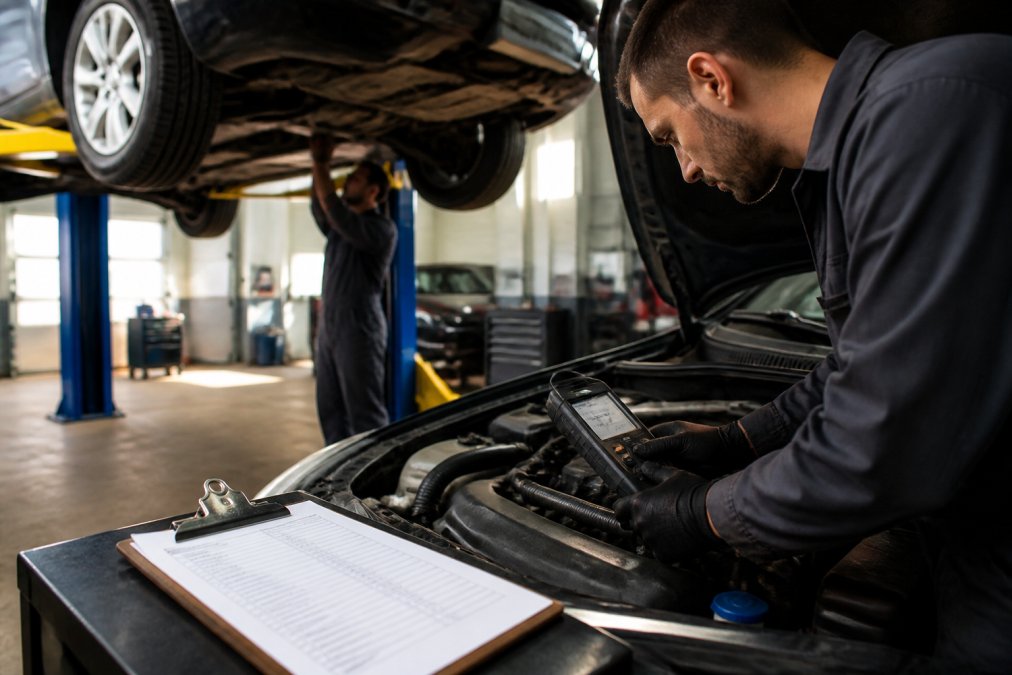
Pacific Auto Center typically provides basic inspection, though depth varies. Always ask what inspection process was completed and request documentation. If the dealership can’t provide detailed inspection records, have an independent mechanic inspect before purchase.
CarMax conducts a 125-point inspection on every vehicle covering mechanical systems, safety features, and appearance. CarMax backs this with a 7-day money-back guarantee, allowing return within 7 days or 1,500 miles if unsatisfied.
Carvana performs a 150-point inspection and includes a 100-day limited warranty on Carvana Certified vehicles, more comprehensive than CarMax’s inspection with an extended warranty window.
Enterprise Car Sales uses a 109-point inspection by an ASE-certified technician and offers a 7-day repurchase agreement (up to 1,000 miles).
Shift completes a 150-point inspection and offers a 7-day money-back guarantee comparable to Carvana’s in depth.
What to inspect yourself:
- Tires: Check tread depth and wear patterns for alignment issues.
- Fluid levels: Engine oil, coolant, brake fluid, transmission fluid. Low levels indicate leaks or poor maintenance.
- Brakes: Listen for grinding or squealing.
- Lights and wipers: Test all exterior and interior lights.
- Interior condition: Check upholstery, dashboard, and electronics for wear patterns.
- Engine bay: Look for leaks, corrosion, or damage.
- Undercarriage: Inspect for rust, damage, or accident signs (misaligned panels, paint overspray).
Always request an independent pre-purchase inspection from an ASE-certified mechanic. This typically costs $100-150 but can save thousands by catching problems before you buy.
| Inspection Type | Dealership | Coverage | Guarantee |
|---|---|---|---|
| 125-point | CarMax | Comprehensive baseline | 7-day return |
| 150-point | Carvana | Extensive, detailed | 100-day warranty |
| 109-point ASE | Enterprise | Professional certified | 7-day repurchase |
| 150-point | Shift | Extensive, detailed | 7-day return |
| Varies | Pacific Auto Center | Depends on dealership | Varies |
How to Negotiate at a Used Car Dealership: Tactics by Dealer Type
Negotiation strategy depends entirely on the dealership’s model.
At Pacific Auto Center (traditional dealership with negotiation):
Start with research. Know the market value using Kelley Blue Book or NADA Guides to understand what similar vehicles sell for in your area.
Make your initial offer 10-15% below the asking price. Traditional dealerships expect this opening move.
Focus on the out-the-door price, not just the vehicle cost. Get everything in writing and calculate the total before agreeing.
Ask about incentives or promotions. End-of-month or end-of-quarter sales often mean more flexibility on pricing.
Walk away if the deal doesn’t feel right. The most powerful negotiation tactic is being willing to leave.
At CarMax, Carvana, Enterprise, or Shift (no-haggle retailers):
Negotiation is off the table; the price is fixed. Focus on timing and comparison shopping. If you find the same vehicle at two no-haggle retailers at different prices, choose the lower one.
Ask about financing options. While the vehicle price is fixed, financing terms can vary. Shop rates from external lenders and compare them to what the dealership offers.
Consider timing. End-of-month or seasonal sales may affect inventory pricing.
Take advantage of return windows. If uncertain about a vehicle, buy it and use the return period to have an independent mechanic inspect it.
At no-haggle dealerships, your negotiation happens before you buy, choose which dealership and vehicle. At traditional dealerships, your negotiation happens during the sales process. Know which model you’re dealing with and adjust accordingly.
Customer Service, Reviews, and Reputation Analysis
How a dealership treats you before the sale often reflects how they’ll treat you after.
Pacific Auto Center reputation depends heavily on location and individual sales staff. Research your specific location’s reviews on Google, Trustpilot, and the Better Business Bureau before visiting.
CarMax consistently receives positive reviews for customer service and transparency. Their no-haggle model removes sales pressure, and their 7-day return guarantee gives customers confidence.
Carvana has faced reputation challenges with some customers reporting delivery delays and financing complications. However, their at-home test drive service and transparent pricing are widely praised. Reviews are mixed.
Enterprise Car Sales benefits from Enterprise’s strong corporate reputation. Customers consistently praise vehicle quality and professional customer service. Reviews are generally positive.
Shift receives positive reviews for convenience and at-home services. Some negative reviews mention inventory limitations in certain areas or delivery delays. Overall reputation is solid but less established than CarMax or Enterprise.
Red flags across all dealerships:
- Pressure to decide immediately or sign paperwork quickly
- Reluctance to provide written quotes or inspection documentation
- Vague answers about fees or financing terms
- Aggressive upselling of warranties or add-ons
- Poor online reviews mentioning bait-and-switch tactics or hidden costs
Check Better Business Bureau reviews for formal complaints and resolution history. Look at Google Reviews and Trustpilot ratings for recent customer feedback. Pay attention to patterns; consistent complaints about the same issue are a warning sign.
Document everything. Get the sales agreement in writing, keep copies of all inspection reports, and photograph the vehicle’s condition before leaving the lot.
Which Dealership Should You Choose?
The right dealership depends on your priorities, buying style, and tolerance for negotiation.
Choose Pacific Auto Center if:
- You prefer a local dealership and want to negotiate
- You’re comfortable with traditional sales processes
- You have specific vehicle preferences
- You’re willing to do research to verify pricing and avoid hidden fees
Always request out-the-door pricing in writing before committing.
Choose CarMax if:
- You want maximum inventory selection and nationwide availability
- You value certainty over negotiation
- You prefer a straightforward, no-pressure buying experience
- You want a well-established company with consistent customer service
CarMax’s 125-point inspection and 7-day return guarantee provide strong consumer protections.
Choose Carvana if:
- You want a fully digital, at-home buying experience
- You value convenience and home delivery
- You’re comfortable with online shopping for major purchases
- You want transparent, fixed pricing
Be aware of potential delivery delays in less-populated areas.
Choose Enterprise Car Sales if:
- You want newer, well-maintained vehicles from a trusted source
- You prefer no-haggle pricing and low-pressure sales
- You value the rental fleet history as a sign of maintenance quality
- You want a 7-day return window with professional service
Inventory is limited to popular rental models.
Choose Shift if:
- You live in a major metro area with good Shift coverage
- You want at-home test drives and delivery
- You value a simplified, digital-first process
- You want transparent pricing without dealership pressure
Geographic limitations make Shift less viable for rural buyers.
Buying a used car doesn’t have to be stressful if you know what questions to ask and which dealership model matches your buying style. Whether you choose a traditional dealership like Pacific Auto Center or a no-haggle retailer, the key is doing your research, verifying pricing in writing, and walking away from any deal that doesn’t feel right. After you’ve purchased your vehicle, Fast Towing San Diego is here if you need roadside assistance, towing, or help connecting with trusted repair shops, available 24/7 with fast response times and professional service for any vehicle type.
Frequently Asked Questions
What are the biggest differences between Pacific Auto Center and online dealers like Carvana?
Pacific Auto Center operates as a traditional dealership with in-person inventory and negotiation options, while Carvana operates entirely online with fixed pricing and home delivery. Pacific Auto Center allows you to inspect vehicles before purchase and negotiate price; Carvana offers convenience and transparency but no price negotiation. Your choice depends on whether you value personal service and flexibility or speed and simplicity.
What questions should I ask before buying a used car at any dealership?
Ask about the vehicle’s full service history, accident history, warranty coverage, and what’s included in the out-the-door price. Request a copy of the inspection report and vehicle history report. Ask about return policies, documentation fees, and whether the dealership will help arrange financing. Confirm the condition of tires, brakes, and battery. These questions help you avoid surprises and assess the dealership’s transparency.
Are there hidden fees at Pacific Auto Center compared to competitors?
All dealerships, including Pacific Auto Center, may charge documentation, registration, and dealer fees. The key difference is transparency: some dealerships clearly disclose all fees upfront (like CarMax and Carvana with no-haggle pricing), while others may not. Always request an itemized out-the-door price in writing before committing. This protects you from unexpected charges and allows fair comparison across dealerships.
How do I negotiate at a used car dealership if I want a better price?
Research the market value of the vehicle using independent sources, arrive with a pre-approved loan offer to show you’re serious, and make a written offer below asking price. Be prepared to walk away if the dealer won’t negotiate. At no-haggle dealerships like CarMax or Carvana, prices are fixed, so negotiation isn’t possible. At traditional dealerships like Pacific Auto Center, negotiation is expected and often successful.