
Roadside Assistance Versus Towing
⏱️ Read Time: 5 mins
📍 Service Area: San Diego County
⭐ By: Fast Towing San Diego
A dead battery in a grocery store parking lot needs one kind of help. A wreck on I-5 needs another. That is where roadside assistance versus towing stops being a technical question and starts costing you time, money, and stress.
A lot of drivers use the terms like they mean the same thing. They do not. One service is meant to get you moving again where your vehicle sits. The other is meant to move a disabled vehicle from one place to another when driving it is unsafe, impossible, or just a bad idea. If you know the difference before trouble hits, you can make a faster call and avoid wasting precious time waiting for the wrong truck.
Roadside assistance versus towing: the basic difference
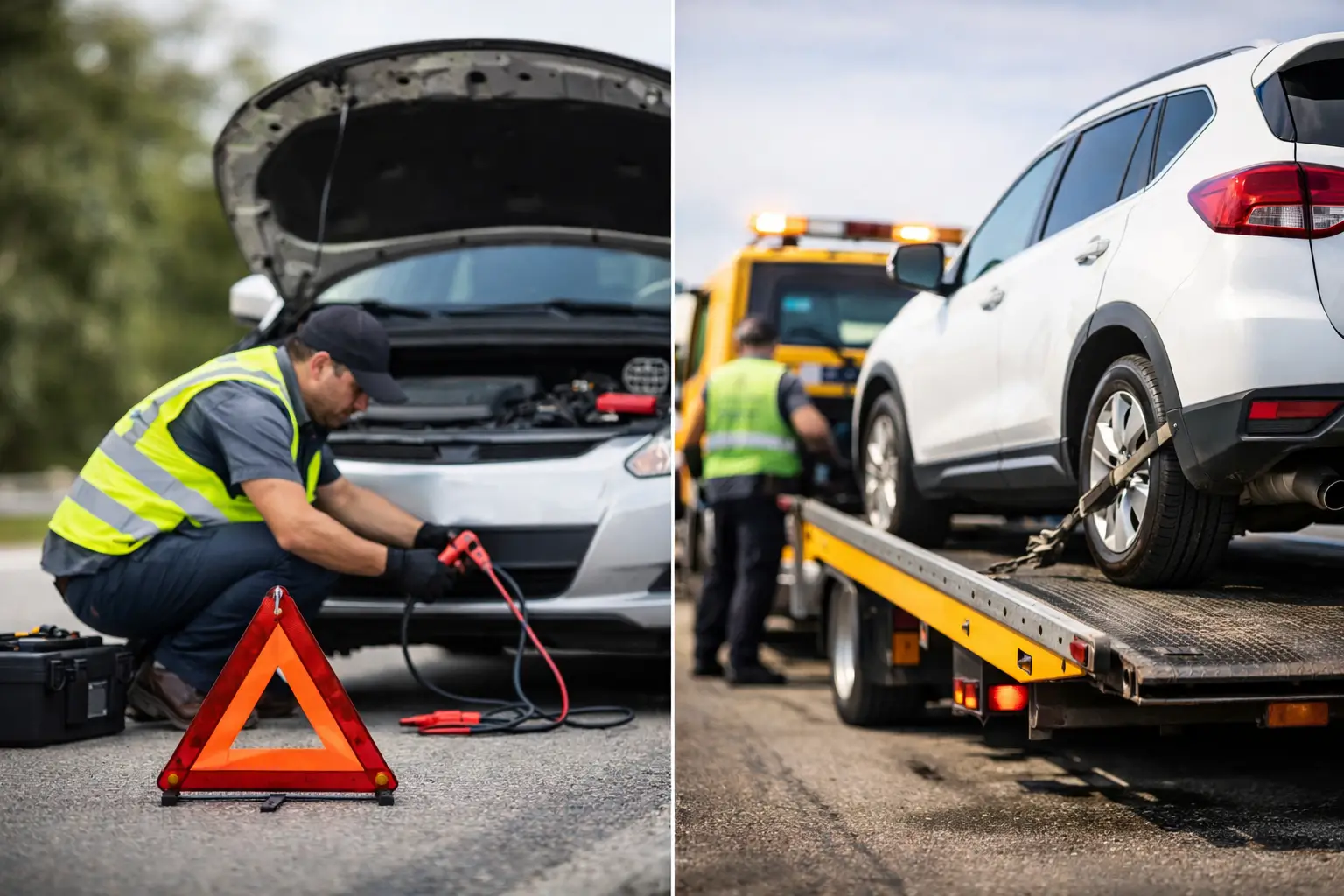
Roadside assistance is on-the-spot help for minor problems that can usually be fixed right where you are. Think jump starts, tire changes, lockouts, fuel delivery, and sometimes light mechanical help. The goal is simple – get you back on the road without hauling the vehicle anywhere.
Towing is different. A tow truck transports your vehicle because it cannot or should not be driven. Maybe the engine quit. Maybe you were in an accident. Maybe the transmission failed, the EV battery system threw a serious fault, or the wheel is damaged badly enough that moving under its own power could make things worse. In those cases, the right move is not a quick fix. It is a safe tow.
That sounds straightforward, but real-life breakdowns are messy. Sometimes the situation starts as roadside assistance and turns into a tow. A flat tire is a perfect example. If you have a usable spare and the lug nuts cooperate, a tire change solves it. If the tire is shredded, the wheel is bent, or the spare is missing, towing becomes the only smart option.
When roadside assistance makes sense
Roadside service is the right call when the problem is small, localized, and fixable without shop equipment. If your battery is dead because you left the lights on, a jump start may have you driving again in minutes. If you ran out of gas, fuel delivery can save the day. If you locked your keys inside, lockout service gets you back in without breaking a window.
This kind of help is usually the fastest and cheapest path when the vehicle itself is otherwise fine. You stay where you are, the tech handles the issue, and you move on. That is the best-case scenario for any driver stranded in a parking lot, at home, or on the shoulder with a simple problem.
But roadside assistance has limits. It is not a cure-all, and pretending it is can backfire. A jump start may get the engine running, but if the battery is old or the alternator is failing, the vehicle may die again ten minutes later. A tire change solves one flat, but not a damaged rim or multiple blown tires. Roadside help is practical, not magical.
When towing is the smarter move
Towing is the safer choice any time driving the vehicle could cause more damage or put people at risk. After an accident, that is often obvious. Even if the car still starts, hidden damage can affect steering, braking, suspension, or alignment. Driving it “just a few miles” can turn a bad situation into a much more expensive one.
Mechanical breakdowns are another clear case. Overheating, transmission failure, serious engine noise, leaking fluids, electrical faults, and no-start conditions that are not solved by a jump are all strong reasons to tow. The same goes for vehicles with broken axles, seized brakes, or wheel damage.
Specialty vehicles raise the stakes even more. EVs, motorcycles, lowered cars, exotic vehicles, trailers, boats, and motorhomes often need the right equipment and the right operator. With these vehicles, the issue is not just whether they can be moved. It is whether they can be moved correctly. One bad hookup can do real damage.
The cost question everybody asks
Most people asking about roadside assistance versus towing really want to know one thing – which one costs less?
Usually, roadside assistance costs less because the service is shorter and simpler. A jump start or lockout is generally less involved than dispatching a tow truck, loading a vehicle, transporting it, and unloading it safely. But lower cost only matters if the service actually fixes the problem.
That is where some drivers lose money. They call for roadside help because it sounds cheaper, only to learn the vehicle still needs a tow. Now they have paid for one service and still need the other. A good dispatcher should help you avoid that by asking the right questions up front.
The honest answer is that it depends on the condition of the vehicle, the type of vehicle, your location, and what happened. A sedan with a dead battery is one thing. A damaged SUV on a freeway shoulder is another. A motorcycle, EV, trailer, or exotic car may require specialized handling that changes the equipment and pricing. Cheap is not the same as cost-effective if the wrong service delays the real solution.
What your membership or insurance may cover
A lot of drivers assume their insurance, warranty, or motor club covers everything. Sometimes it does. Sometimes it covers part of it. Sometimes it comes with long waits, distance limits, service restrictions, or reimbursement rules that are easy to miss until you are stranded.
Roadside plans often include basics like jump starts, tire changes, lockouts, and fuel delivery. Towing may be included too, but usually with mileage caps or limits on where the vehicle can be taken. If your preferred repair shop is farther away, or your vehicle needs specialty transport, you may still be paying out of pocket.
That is why speed matters as much as coverage. When you are stuck on a dark road, blocking traffic, or stranded with family in the car, waiting hours for the lowest-cost option may not feel like a bargain. Fast, competent help has value.
Why dispatch matters more than people think
The best service call starts before the truck rolls. A knowledgeable dispatcher can tell the difference between a quick roadside fix and a vehicle that clearly needs towing. They should ask what the vehicle is doing, whether it starts, whether it rolls, if there was an accident, and whether there is visible damage or fluid leakage.
That conversation saves time. It also protects your vehicle. Sending a roadside tech to a job that really needs a tow only delays the outcome. Sending the wrong tow setup to a specialty vehicle creates a whole different problem. The right call, right away, is the whole game.
For drivers in San Diego, this matters even more because breakdowns happen everywhere – crowded freeways, beach parking lots, apartment garages, side streets, and commercial lots with tight access. Local knowledge helps. Fast Towing built its reputation on exactly that kind of real-world response: quick dispatch, capable operators, and the equipment to handle more than just the easy jobs.
How to decide in the moment
If the vehicle has a small issue and would be safe to drive immediately after a basic fix, roadside assistance is probably the right first call. If the vehicle is damaged, will not start after a likely simple fix, leaks fluid, overheats, makes severe mechanical noise, or feels unsafe to drive, call for a tow.
Trust your eyes and your instincts. If you are unsure, do not gamble with traffic, heat, or vehicle damage just to avoid a tow. A short tow is often cheaper than a major repair caused by forcing a broken vehicle down the road.
The same rule applies after an accident. Even if the damage looks minor, it is smart to assume the vehicle may not be roadworthy until a professional says otherwise. That is not overreacting. That is protecting yourself.
The real takeaway
Roadside assistance gets you going when the fix is simple. Towing gets your vehicle where it needs to go when the problem is bigger than a quick roadside repair. Neither one is “better” in every case. The right one depends on what failed, where you are, and whether driving the vehicle is still safe.
When you are stuck, the goal is not to guess. The goal is to get the right help fast, from people who know the difference and are ready to act. That one decision can turn a long, expensive mess into a problem handled the right way.
Licensed, insured, and rapid response units on standby across all San Diego corridors.