
Table of Contents
- Understanding Towing Capacity for Boat Trailers
- Essential Hitch Types and Ball Size Compatibility
- How to Back Up a Boat Trailer Safely
- Boat Trailer Maintenance Checklist
- Pre-Trip Safety Inspection and Brake Systems
- Safe Driving Speeds, Turning Radius, and Braking Distance
- When to Call Professional Towing Services
- Conclusion
- Frequently Asked Questions
Last Updated: August 26, 2026
Understanding Towing Capacity for Boat Trailers
Towing a boat and trailer requires knowing your vehicle’s limits before you hook up a hitch. The gap between what a vehicle can tow and what it should tow is where accidents happen.
Your vehicle’s owner manual contains three critical numbers: gross vehicle weight rating (GVWR), payload capacity, and towing capacity. These aren’t suggestions, they’re engineering limits. Exceed them, and you compromise braking, handling, and stability.
Gross Vehicle Weight Rating and Payload Capacity
Gross vehicle weight rating is the maximum total weight your vehicle can safely carry, including the vehicle itself, passengers, cargo, and anything attached to it. If your truck weighs 5,000 pounds and has a GVWR of 8,500 pounds, you have 3,500 pounds of total capacity.
Payload capacity is different, it’s the weight you can put in the truck bed and cabin, excluding a trailer. You might have 3,500 pounds of GVWR capacity remaining, but only 1,500 pounds of payload capacity. The remaining 2,000 pounds is reserved for the tongue weight of your trailer.
Tongue weight, the downward force your trailer exerts on the hitch ball, directly affects how much weight your truck can carry in the bed. A boat trailer with a 600-pound tongue weight uses 600 pounds of your payload capacity before you load the boat. Add fuel, gear, and passengers, and you’ve violated your payload limit and GVWR.
Check your vehicle’s door jamb placard or owner manual for exact figures. Then weigh your boat and trailer at a truck scale, don’t estimate.
Weight Distribution and Tongue Weight Calculations
Tongue weight should be 10-15% of your total trailer weight (nhtsa.gov). A 4,000-pound boat and trailer should have 400-600 pounds of tongue weight. Too little and your trailer becomes unstable, prone to sway and jackknife. Too much and you overload your vehicle’s rear axle and hitch, affecting steering and braking.
Proper tongue weight depends on your boat’s dry weight, your trailer’s weight, and where the boat sits on the trailer. The goal is a balanced load where roughly 60% of the boat’s weight sits forward of the trailer’s axles and 40% sits behind them. A weight distribution hitch can help by spreading load across all four wheels of your truck.
Before your first tow, visit a truck scale with your loaded boat and trailer. Weigh just the trailer (tongue weight on the scale, rear lifted), then weigh the whole rig together. This real-world data lets you adjust load distribution before hitting the highway.
Essential Hitch Types and Ball Size Compatibility
Trailer hitches are classified by towing capacity: Class I (up to 2,000 pounds), Class II (up to 3,500 pounds), Class III (up to 8,000 pounds), Class IV (up to 14,000 pounds), and Class V (up to 20,000 pounds and above). A boat trailer typically requires a Class II or Class III hitch. The hitch class must match or exceed your trailer’s gross trailer weight rating.
Ball size matters equally. Standard hitch balls come in 1-7/8 inch, 2-inch, and 2-5/16 inch diameters. The coupler on your trailer is sized for a specific ball diameter. Always match the ball size to your trailer coupler.
Weight distribution hitches are worth considering for boat trailers over 3,500 pounds. They use spring bars to transfer some tongue weight to the truck’s front axle, reducing squat and improving stability. However, they add complexity and cost ($500-$1,200 for quality systems with professional installation).
Safety chains are non-negotiable. Use chains rated for at least 50% of your trailer’s gross weight. Cross them under the tongue so they cradle it if it drops. Attach them to the truck frame, not the bumper.
How to Back Up a Boat Trailer Safely
Backing a boat trailer is counterintuitive: to move the trailer’s rear left, turn the steering wheel left. To move it right, turn right. Your truck’s rear wheels move away from the steering direction, pulling the trailer with them.
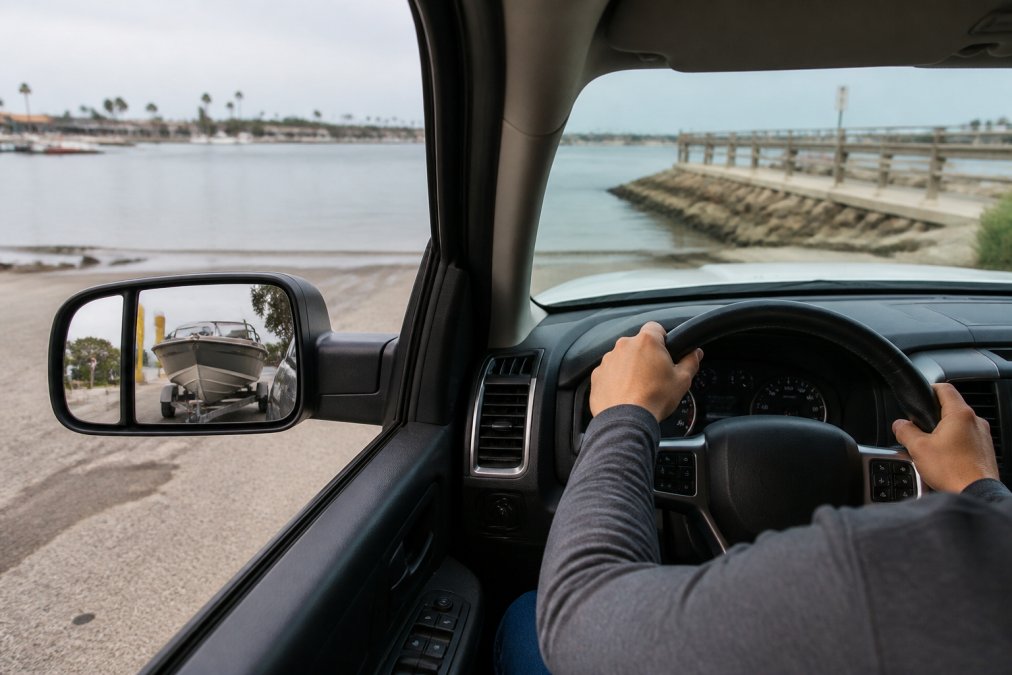
Start with the trailer straight behind your truck. Look in your side mirrors, not over your shoulder. Turn the steering wheel slowly in the direction you want the trailer to go. Make small corrections, overcorrecting is the most common mistake.
If the trailer starts to jackknife, immediately straighten your wheels and pull forward to reset.
Positioning and Blind Spot Awareness
Position yourself so you can see both side mirrors clearly. Adjust mirrors before backing, not while moving.
Blind spots are real with a trailer, the trailer blocks your rear window view entirely. Use a spotter, someone who stands where they can see both truck and trailer, communicating via radio or hand signals. If you don’t have a spotter, back slowly enough to stop instantly if something appears.
At a boat ramp, back at walking speed. Use your brakes, not your transmission, to control descent on a ramp.
Jackknife Prevention and Trailer Sway Control
Jackknife happens when you back too far without straightening the trailer. Prevention is simple: don’t back in tight angles. If you need to back into a tight spot, pull forward and reset frequently.
Trailer sway during forward driving happens when crosswinds, passing trucks, or uneven weight distribution cause the trailer to oscillate. Sway control devices reduce this by limiting how far the trailer can move relative to the truck. They’re inexpensive ($100-$300) and effective.
Better sway prevention comes from proper weight distribution and tongue weight. A trailer that’s balanced and has adequate tongue weight won’t sway as much.
Boat Trailer Maintenance Checklist
A boat trailer that breaks down during towing creates cascading problems. Preventive maintenance takes a few hours per season and costs far less than roadside repairs.
Before each tow, inspect the trailer visually for cracks in the frame, bent components, loose bolts, or rust. Check that all lights work: brake lights, turn signals, and running lights. Test the brakes by backing up and applying pressure.
Wheel Bearings, Axles, and Tire Pressure
Wheel bearings are critical. They’re submerged every time you launch, and saltwater accelerates corrosion. Bearings that aren’t properly sealed or regularly greased will seize and cause a blowout at highway speed.
Inspect bearings at least twice per season. Remove the wheel and hub, and spin the bearing by hand. It should rotate smoothly with no grinding noise. Feel the hub temperature after driving, it should be warm, not hot. A hot hub indicates bearing friction.
Grease wheel bearings every season if you launch frequently, or every two seasons if you tow mainly on dry land. Use marine-grade grease, not automotive grease.
Axles should be inspected for cracks and bending. A bent axle affects wheel alignment and causes uneven tire wear.
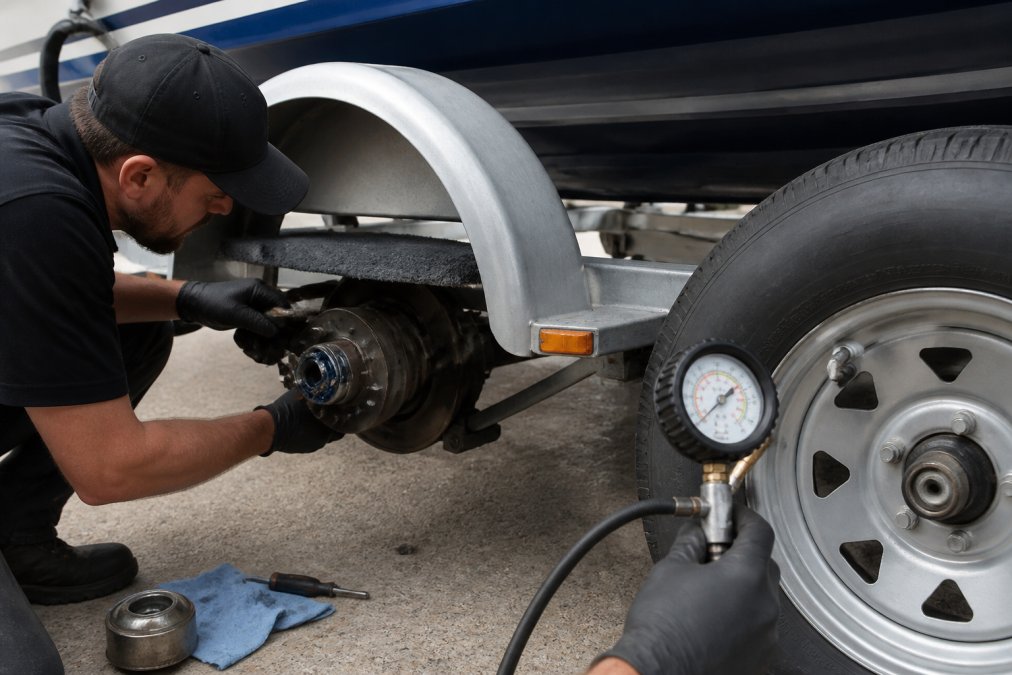
Check tire pressure before every tow, when tires are cold. Trailer tires typically require 50-65 psi (nhtsa.gov). Underinflated tires overheat and can blowout. Overinflated tires wear unevenly.
Trailer tires wear faster than vehicle tires because they’re dragged. Rotate tires every season and replace them when tread depth reaches 4/32 inch. Boat trailer tires often need replacement every 3-5 years even if tread looks acceptable, because UV and saltwater degrade the rubber.
Trailer Lights, Electrical Connections, and Safety Chains
Trailer lights are required by law and critical for safety (nhtsa.gov). Check all lights before every tow. Test brake lights by having someone stand behind the trailer while you press the brake pedal. If a light doesn’t work, replace the bulb immediately. Corroded sockets are common in marine environments.
Electrical connections between truck and trailer are another corrosion point. Every few months, disconnect the connector, inspect the pins for corrosion, and clean them with contact cleaner. Apply a thin coat of dielectric grease to the pins before reconnecting.
Safety chains are your backup connection. If the coupler fails, the chains keep the trailer tethered to the truck. Cross the chains under the tongue so they cradle it. Attach them to the truck frame, not the bumper. Use chains rated for at least 50% of your trailer’s gross weight.
Pre-Trip Safety Inspection and Brake Systems
A pre-trip inspection takes 15 minutes and catches 90% of problems before they become emergencies. Start with the hitch and coupler. Ensure the coupler is fully engaged on the ball and requires firm pressure to lift the release lever. Check that the safety pin is installed and secured.
Inspect the hitch ball for cracks or corrosion. A cracked ball can separate under load. Ensure the hitch itself is not bent or cracked.
Check tire pressure and condition. Look for bulges, cracks, or embedded objects. Spin each wheel and listen for grinding. Verify that all lug nuts are tight. Test brakes by applying steady pressure while stationary. The brake pedal should be firm.
Surge Brakes and Brake Controller Setup
Surge brakes are hydraulic brakes that activate automatically when the trailer pushes forward against the truck. They require no electrical connection but activate only when the trailer pushes the truck, not when the truck is braking hard. This increases stopping distance and makes the trailer prone to jackknife during hard braking.
Electric brakes are controlled by a brake controller installed in the truck. The controller senses when the truck’s brakes are applied and sends proportional power to the trailer’s brake magnets. This synchronizes the trailer’s braking with the truck’s, reducing stopping distance and improving stability. A quality brake controller is essential for safe towing of boat trailers over 3,500 pounds.
A brake controller has several settings. The gain (or sensitivity) determines how much power is sent to the trailer brakes relative to the truck’s braking force. Start at 10 and adjust based on how the trailer feels when braking. The manual override button lets you apply trailer brakes independently of the truck’s brakes, useful if the trailer is swaying.
Brake controllers require professional installation. Professional installation typically costs $300-$700 including the controller and labor.
Safe Driving Speeds, Turning Radius, and Braking Distance
Speed is the single biggest factor in towing safety. The faster you tow, the more energy the trailer carries, the longer it takes to stop, and the more likely sway becomes. Many states have reduced speed limits for vehicles towing trailers, often 55 mph on highways and 45 mph on rural roads.
A truck and trailer combination has a longer stopping distance than the truck alone. At 55 mph, a truck might stop in 130 feet. The same truck towing a 4,000-pound trailer might need 180 feet. Braking distance increases exponentially with speed.
Turning radius is another speed-dependent factor. A tight turn at high speed can cause the trailer to swing wide or jackknife. When turning, slow down significantly, 15-20 mph for sharp turns. Check your mirrors constantly. Plan your route to avoid sharp corners.
When to Call Professional Towing Services
If your trailer breaks down on the highway, call professional towing services. Highway breakdowns are dangerous, you’re exposed to passing traffic, and a disabled trailer creates a hazard.
If you’re uncomfortable backing into a tight space at a marina, boat ramp, or storage facility, call for help. A professional tower can back a trailer in spaces that seem impossible, and they carry insurance that covers damage. The cost (typically $75-$150) is cheaper than repairing a dock or another boat.
If your boat is oversized or your trailer is unusual, verify that your towing service has experience before booking. Fast Towing San Diego has experience with boat trailers and oversized loads, with 24/7 availability for emergencies.
If you’re in an accident while towing, call professional towing services immediately. Don’t attempt to separate the truck and trailer yourself if there’s damage to the hitch or coupler. Fast Towing San Diego also connects you with repair shops after accidents.
Never tow a disabled vehicle or trailer with a rope or chain connected to the bumper. The bumper will tear away. Use a proper towing harness rated for the weight, or call professional towing services.
Conclusion
Towing a boat and trailer is manageable when you know your vehicle’s limits, maintain your equipment, and drive conservatively. The three non-negotiables are: verify your towing capacity and tongue weight before you tow, inspect your trailer before every trip, and install a quality brake controller for trailers over 3,500 pounds.
Most towing problems are preventable. Breakdowns happen because maintenance was skipped. Accidents happen because speeds were too high or weight was miscalculated.
Frequently Asked Questions
How do I calculate my vehicle’s towing capacity for a boat?
Start with your vehicle’s gross vehicle weight rating (GVWR) from the owner’s manual. Subtract your vehicle’s dry weight to find payload capacity. Your towing capacity is typically 70-80% of payload capacity. For example, if your truck has a 10,000-pound GVWR and weighs 5,000 pounds dry, your payload is 5,000 pounds, making safe towing capacity around 3,500-4,000 pounds. Always verify your vehicle’s specific towing limit in the manual before towing for boat and trailer transport.
What is the 80% rule for towing?
The 80% rule means your loaded trailer weight should not exceed 80% of your vehicle’s payload capacity. This safety margin prevents overloading and reduces strain on brakes, suspension, and engine. If your truck can carry 5,000 pounds of payload, limit your trailer and boat to 4,000 pounds maximum. This rule keeps your vehicle stable, improves braking distance, and reduces jackknife risk during emergency stops.
What safety equipment is required for towing a boat trailer?
Essential equipment includes safety chains rated for your trailer weight, a properly installed trailer hitch matching your vehicle’s towing capacity, a brake controller for electric or surge brakes, and a weight distribution hitch if your tongue weight exceeds 10-15% of trailer weight. Trailer lights, including brake, turn, and tail lights, must be functional and sealed against water. Tie-down straps secure the boat, and a winch strap helps load and unload safely. Check your state’s specific requirements, as some mandate additional lighting or braking systems.
Can I tow a trailer and a boat at the same time?
No. Most jurisdictions prohibit towing double trailers (a trailer towing another trailer) on public roads. Your vehicle tows one trailer only. If you need to transport both a boat and another trailer, you must make separate trips or use a tandem-axle boat trailer that carries both the boat and additional cargo on a single trailer frame. Check local regulations, as rules vary by state.
What happens if I overload my towing capacity for boat and trailer transport?
Overloading causes brake failure, jackknife during turns or emergency stops, tire blowouts, suspension damage, and loss of vehicle control. Your brakes must stop both vehicle and trailer weight, so exceeding capacity dramatically increases stopping distance. Overloaded trailers are more prone to sway on highways and become dangerous in adverse weather. You also risk violating state weight laws, facing fines, and voiding your vehicle’s warranty. Always stay within your vehicle’s rated towing capacity.
If you’re towing a boat and trailer in the San Diego area and want professional guidance or backup support, Fast Towing San Diego offers 24/7 towing and roadside assistance with experience in boat trailers and oversized loads. Their team can help with emergency towing, equipment inspections, and connections to trusted repair shops, whether you’re launching at a local ramp or stranded on the highway.