
Table of Contents
- Why Towing Services for Local Repair Shops Matter More Than You Think
- 24/7 Emergency Roadside Assistance and Towing to Your Repair Shop
- The Benefits of Towing for Mechanic Shops: More Than Just Transport
- How to Build a Strong Auto Repair Shop Towing Partnership
- Step-by-Step Guide: How Towing Services for Local Repair Shops Actually Work
- How to Choose a Towing Company for Business: Key Criteria
- Towing Service Contracts for Businesses: What to Include
- Frequently Asked Questions
Last Updated: July 31, 2026
Towing services for local repair shops represent one of the most undervalued logistics decisions a shop manager can make. At Fast Towing San Diego, we work directly with auto repair facilities across San Diego County, and the difference between a shop with a reliable tow partner and one without is measurable in customer retention, shop throughput, and reputation. This guide covers everything from 24/7 emergency protocols to contract terms, vehicle-specific requirements, and insurance details most shop managers never think to ask about.
Why Towing Services for Local Repair Shops Matter More Than You Think
For a repair shop, every tow is a customer acquisition event. The moment a driver calls for breakdown assistance, they’re in a vulnerable, high-trust state. How that vehicle gets handled, how fast the dispatch service responds, and whether the car arrives safely at your bay without damage all shape the customer’s perception of your shop before they’ve even spoken to a service advisor.
Towing services also function as a referral pipeline. Many towing companies maintain relationships with multiple shops and route vehicles based on proximity, specialty, or standing agreements. A shop without a towing partnership is invisible in that network. Additionally, a customer whose car dies at 11 PM needs 24/7 availability from both the tow company and, ideally, a shop that can take the vehicle into its lot that night.
According to AAA’s roadside assistance research and member services overview, millions of American drivers experience roadside breakdowns each year, and the destination of the tow is often decided in the first phone call. That call is your window.
A towing partnership is not a vendor relationship. It is a customer acquisition channel. Shops that treat it that way build more consistent inbound volume than those that rely on walk-ins and online reviews alone.
24/7 Emergency Roadside Assistance and Towing to Your Repair Shop
Round-the-clock availability is the baseline requirement for any towing partner worth contracting with. A tow company that operates 8 AM to 6 PM, Monday through Friday, is not a towing partner for a repair shop. Breakdowns, accidents, and mechanical failures happen across all hours, and a significant portion occur during nights, weekends, and holidays.
What Happens After a Breakdown at 2 AM?
When a driver experiences a breakdown at 2 AM, a properly equipped dispatch service should confirm a tow truck is en route within minutes, provide real-time ETA updates, and coordinate delivery to a secure shop lot even when the facility is closed. A prompt response at an inconvenient hour turns a stressful breakdown into a positive shop referral. Miguel, a Fast Towing San Diego customer, noted: “I called Fast Towing and they were here in 30 minutes and did an awesome job, even in the rain.”
Flatbed Towing vs. Wheel Lift: Which Does Your Shop Need?
The answer depends on your vehicle mix, and most shops need access to both.
Flatbed towing loads the entire vehicle onto a flat platform. This is correct for all-wheel-drive vehicles, lowered cars, exotic cars, vehicles with significant front-end damage, and any car where wheel engagement could cause drivetrain or axle damage during transport.
Wheel lift towing uses a metal yoke to lift either the front or rear axle. It is faster to deploy and works well for standard front-wheel-drive or rear-wheel-drive vehicles with no drivetrain complications. For high-volume shops handling everyday commuter cars, wheel lift service is efficient and cost-effective.
Confirm your tow partner runs a mixed towing fleet that includes both types.
The Benefits of Towing for Mechanic Shops: More Than Just Transport
A reliable towing partnership generates direct referrals. Tow operators who trust your shop will recommend it to drivers who ask “where should I take this?” That word-of-mouth from a professional at the scene of a breakdown carries significant weight.
Towing coordination also improves shop scheduling. When your tow partner gives advance notice that a vehicle is en route, your service advisors can prepare intake paperwork, flag the appropriate bay, and pull up customer history before the car arrives. A smooth, professional towing experience primes the customer to trust the shop before the first diagnostic conversation. Additionally, towing partnerships provide vehicle recovery services for situations beyond simple mechanical failure: accident recovery, flood damage, off-road recovery, and collision-involved vehicles.
How to Build a Strong Auto Repair Shop Towing Partnership
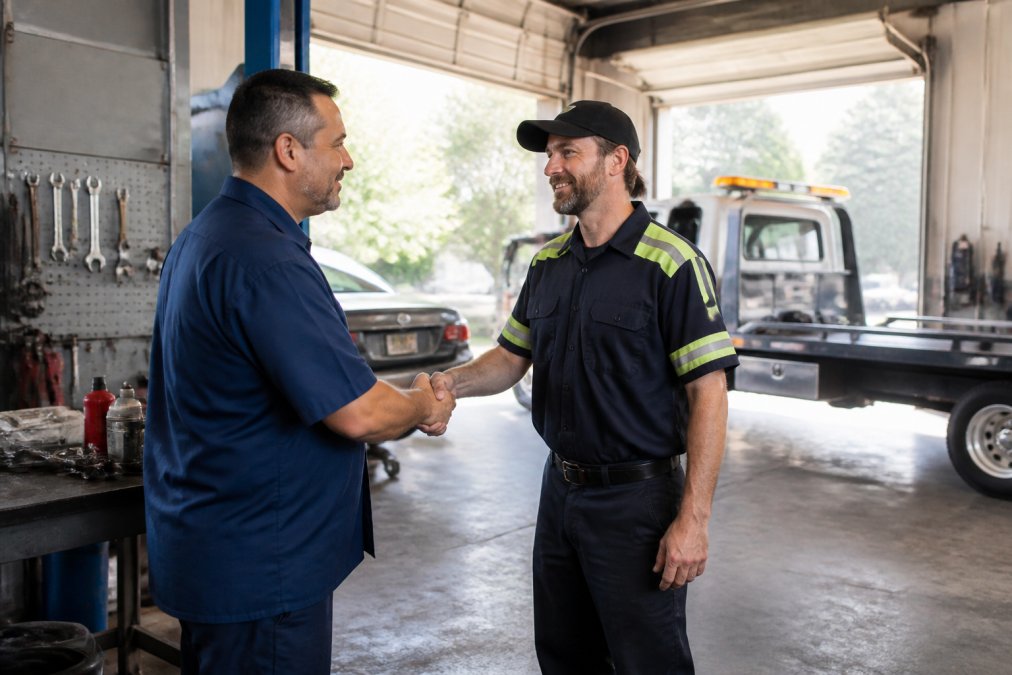
The most effective auto repair shop towing partnerships are built on explicit agreements, not informal handshakes. Start with a conversation about service radius, average response time by zone, and capacity during peak hours. Establish communication protocols early: who calls whom when a vehicle is en route, what information gets relayed, and how the shop confirms secure receipt after hours.
Vehicle-Specific Towing Requirements to Discuss With Your Provider
Not all vehicles tow the same way, and a towing partner who does not understand vehicle-specific requirements is a liability for your shop.
Key categories to address:
- All-wheel-drive and four-wheel-drive vehicles: These must be transported on a flatbed. Towing with wheels on the ground destroys the transfer case and differentials.
- Electric vehicles: EVs require specific handling protocols. Many cannot be towed with wheels on the ground due to regenerative braking systems. Flatbed transport is standard.
- Exotic and lowered vehicles: Ground clearance is the primary concern. Confirm your provider has low-profile loading ramps and experience with these vehicles.
- Motorcycles: Require specialized cradles and tie-down equipment.
- Boats and trailers: If your shop handles marine engines or trailer systems, confirm your tow partner has the towing capacity and equipment for these loads.
Jeremy, a customer who used Fast Towing San Diego, noted: “Fast Towing came to the rescue and even got me a great Body Shop to fix my car all new again.”
Never assume a towing company can handle specialty vehicles without asking directly. Sending an AWD vehicle via wheel lift tow is one of the most common causes of post-tow drivetrain damage, and the shop receiving that vehicle often inherits the customer’s frustration.
Step-by-Step Guide: How Towing Services for Local Repair Shops Actually Work
Understanding the logistics from request to delivery helps shop managers set accurate expectations for their customers.
Step 1: Customer contacts the tow service. The driver calls, uses an app, or requests service through a web form. A good dispatch service captures vehicle type, location, condition, and destination in a single intake call.
Step 2: Dispatch assigns the nearest available unit. Dispatch software routes the job to the closest appropriate truck. For specialty vehicles, dispatch confirms the right equipment is assigned before sending.
Step 3: The tow operator arrives and assesses the vehicle. On-site, the operator confirms the vehicle’s condition, documents any pre-existing damage, and selects the correct loading method.
Step 4: Vehicle is loaded and transported. Towing safety protocols require proper tie-down, clearance checks, and a route assessment for low-clearance issues on exotic or oversized vehicles.
Step 5: Vehicle is delivered to the repair shop. The operator confirms delivery with the shop, transfers any relevant documentation, and in after-hours scenarios, ensures the vehicle is secured in the designated area.
Step 6: Shop notifies the customer. The repair facility confirms receipt and provides an estimated timeline for assessment.
| Step | Action | Responsible Party | Timing |
|---|---|---|---|
| 1 | Service request | Customer / Dispatch | Immediate |
| 2 | Unit assignment | Dispatch | Within minutes |
| 3 | On-site assessment | Tow operator | Upon arrival |
| 4 | Load and transport | Tow operator | Per route distance |
| 5 | Shop delivery | Tow operator | Upon arrival |
| 6 | Customer notification | Repair shop | After delivery confirmed |
Insurance and Warranty Coverage: What Shop Managers Should Know
Before signing any partnership agreement, confirm the following with your tow provider:
- Cargo liability coverage: Does the tow company carry insurance for vehicle damage that occurs during transport? What is the coverage limit per vehicle?
- General liability: Are they covered if a tow truck damages your shop property during delivery?
- Worker’s compensation: Are their operators covered, so your shop is not exposed if an injury occurs on your lot during delivery?
Many drivers carry roadside assistance benefits through their auto insurance policy or through programs like AAA membership. According to the Insurance Information Institute’s guide to auto insurance coverage, roadside assistance and towing reimbursement are commonly available as policy add-ons. Shop managers who understand this can help customers navigate insurance reimbursement claims.
Manufacturer warranties and extended service contracts sometimes include towing provisions as well. If a customer’s vehicle is under warranty and the breakdown is warranty-related, the tow may need to go to a dealer rather than an independent shop.
Ask your tow partner for a current certificate of insurance before formalizing any agreement. Specifically request the cargo liability limit and confirm it is adequate for the highest-value vehicles your shop regularly services.
How to Choose a Towing Company for Business: Key Criteria
Choosing the right tow company for your shop is a decision with long-term consequences.
Response time consistency: Ask for average response times by time of day and day of week. A company that averages 20 minutes at 2 PM but 90 minutes at 2 AM is not a reliable 24/7 partner.
Fleet composition: Confirm they operate flatbeds, wheel lift units, and any specialty equipment your vehicle mix requires.
Dispatcher quality: Call them as a mystery shopper. How fast do they answer? How clearly do they communicate? The dispatcher is the first voice your customer hears in a crisis.
Licensing and certification: Tow operators in California are regulated under the California Vehicle Code and the Bureau of Automotive Repair. According to the California Bureau of Automotive Repair’s licensing and regulations overview, towing companies operating in California must meet specific licensing requirements. Confirm your partner is fully compliant.
References from other shops: Ask specifically for references from repair facilities, not just individual drivers.
Communication systems: Do they offer real-time tracking? Can they send ETAs to your shop automatically? Modern dispatch platforms make this standard and meaningfully improve your intake process.
Fast Towing San Diego brings over 100 years of combined experience and professionally trained drivers to every dispatch, serving individual drivers, fleet accounts, and repair shop partners across San Diego.
Towing Service Contracts for Businesses: What to Include
A verbal agreement is not a towing partnership. A written contract is.
The following elements should appear in any towing service contract for businesses:
- Service area and response time guarantees: Define the geographic radius and the maximum response time commitment, with consequences for repeated failures.
- Pricing structure: Towing costs vary based on distance, vehicle type, time of day, and equipment required. Contracts should specify flat-rate pricing where possible, or clearly define the rate structure so your shop can communicate accurate estimates to customers. Contact Fast Towing San Diego directly for current pricing and rate information.
- Vehicle handling standards: Specify which equipment must be used for which vehicle types. Include language about pre-transport documentation and damage liability.
- After-hours protocols: Define exactly how after-hours deliveries are handled, including lot security and key storage.
- Insurance requirements: Require a certificate of insurance with minimum coverage levels, and name your shop as an additional insured where appropriate.
- Termination terms: Include a reasonable notice period for either party to exit the agreement without penalty.
- Dispute resolution: Define how damage claims or service failures are handled, including timelines and escalation paths.
Sarah, a customer who used Fast Towing San Diego for a trailer move, described the experience this way: “We needed a trailer moved… Fast Towing who said LET’S GO! They did an awesome job.”
Include a performance review clause. Quarterly check-ins where both parties review response times, incident reports, and customer feedback keep the partnership accountable and give you grounds to renegotiate terms if service quality slips.
For shop managers handling fleet accounts or government contracts, the contract complexity increases. Fleet towing agreements often require multi-vehicle dispatch capability, priority response tiers, and detailed reporting for billing reconciliation. Confirm your tow partner has experience with fleet accounts before signing.
The towing logistics behind a well-run repair shop are not glamorous, but they are consequential. Shops that get this right build a customer pipeline that operates around the clock, handles any vehicle type, and turns breakdown moments into long-term customer relationships.
Frequently Asked Questions
How do auto repair shops partner with towing companies?
Most auto repair shops partner with a local towing company by establishing a preferred provider agreement. The shop refers customers who need a tow directly to that company, and in return the towing service prioritizes delivery to that shop. A reliable partner like Fast Towing San Diego offers 24/7 dispatch service, prompt response times, and the ability to handle a wide range of vehicles, making the coordination seamless for both the shop and the vehicle owner.
What are the benefits of towing services for a local mechanic shop?
Repair shop towing partnerships increase vehicle intake without requiring the shop to own or staff a tow truck. When a customer breaks down, a trusted towing partner delivers the disabled vehicle directly to the shop, reducing customer stress and preventing them from choosing a competitor. Additional benefits include faster turnaround, stronger customer loyalty, and the ability to serve customers who cannot drive their vehicle in. Shops also benefit from a towing partner that can handle specialty vehicles like motorcycles or exotic cars.
What should be included in a towing service contract for a business?
A solid towing service contract for businesses should specify service area coverage, guaranteed response times, flat-rate or negotiated pricing structures, vehicle handling and towing safety protocols, liability and insurance reimbursement terms, storage fees policies, and procedures for specialty or oversized vehicles. It should also outline communication expectations, dispatch service availability, and any discounts for volume or fleet accounts. Having these details in writing protects both the repair shop and the towing provider.
Do towing companies offer special rates for repair shops?
Many professional towing companies offer negotiated flat-rate pricing or volume discounts for repair shops that generate consistent referral business. Rather than paying standard per-call rates, a shop with an established towing partnership may access preferential pricing. Contact Fast Towing San Diego directly for current pricing and to discuss a towing service contract tailored to your shop’s volume and vehicle types, since rates depend on factors like service radius, vehicle type, and frequency of calls.
Can a repair shop request towing for vehicles that need specialized handling?
Yes. Repair shops regularly need towing for vehicles with specific requirements, including low-clearance exotic cars, motorcycles, AWD vehicles that cannot be towed with a standard wheel lift, and oversized trucks or trailers. A qualified towing provider with a diverse fleet, including flatbed tow trucks and appropriate towing equipment, can accommodate these needs. Always confirm vehicle-specific towing requirements with your provider before establishing a partnership to ensure they have the right equipment and trained technicians.
How does insurance reimbursement work when a vehicle is towed to a repair shop?
When a vehicle is towed following a covered incident, the vehicle owner’s auto insurance policy may reimburse towing costs up to a policy limit, particularly if they carry roadside assistance or comprehensive coverage. Repair shops should advise customers to contact their insurer promptly and obtain a claim number before the tow when possible. The towing company can typically provide an itemized receipt for submission. Coverage limits and reimbursement processes vary by insurer, so customers should review their policy or call their insurance provider directly.
Running a repair shop without a dependable tow partner means leaving customer acquisition to chance at the exact moment those customers need the most help. Fast Towing San Diego provides 24/7 dispatch, professionally trained drivers, and a towing fleet capable of handling everything from standard sedans to exotic vehicles, motorcycles, and trailers across San Diego and beyond. Get started with Fast Towing San Diego and turn every breakdown call into a reliable shop referral.