
Table of Contents
- Why a Night Driving Kit Needs Different Gear Than a Daytime Kit
- Car Emergency Kit Checklist: The Night Driving Essentials
- Car Breakdown Safety at Night: A Step-by-Step Plan
- Dead Car Battery Emergency Supplies to Keep in the Trunk
- Roadside Assistance for a Dead Battery: When to Call Instead of DIY
- How to Store, Check, and Replenish Your Kit
- Conclusion: Night Readiness Comes Down to Visibility and Power
- Frequently Asked Questions
Last Updated: October 12, 2026
Why a Night Driving Kit Needs Different Gear Than a Daytime Kit
That is why a daytime kit and a night kit are not the same thing. A daytime kit gets you moving again. A night kit keeps you visible and powered while you wait.
The essentials for night driving break into four jobs: see, be seen, stay warm, and stay connected. This guide covers each one, plus a step-by-step plan for the first ten minutes after a nighttime breakdown.
Car Emergency Kit Checklist: The Night Driving Essentials
The emergency car kit essentials for night driving come down to light, visibility, warmth, and communication, built around the items emergency-preparedness organizations already recommend. The American Red Cross car emergency kit guide lists a first aid kit, flashlight, extra batteries, jumper cables, food, and blankets as basics.
A good way to think about it: every item should answer one question. Can I see? Can others see me? Can I stay warm and fed? Can I call for help?
If you only upgrade two things for night driving, make them a reflective safety vest and a portable power bank. Visibility and power solve most nighttime problems.
Lighting and Visibility Gear
Lighting is the first priority after dark, but “pack a flashlight” is not enough.
Choose lights by these criteria, not by brand:
- Output: Look for at least 200-300 lumens for a headlamp or handheld light. That is bright enough to illuminate a tire, engine bay, or the ground around your feet without blinding oncoming drivers.
- Runtime: Check the rated runtime at a usable brightness, not just the maximum. A light that runs 30 minutes on high is a toy; one that runs 6-10 hours on a medium setting is a tool.
- Battery type: Standardize on one battery size (AA or AAA) so spares work in every device. Rechargeable lights are convenient but useless if the charge is gone, so pair them with a battery-powered backup.
- Weather resistance: Look for an IPX4 rating or better. Rain and snow do not pause for breakdowns.
A headlamp is not a substitute for a flashlight, carry both. A headlamp keeps both hands free for tire changes, jumper cables, or reading a map, and it points where you look.
Preserve your phone battery. Your phone is your lifeline, and cold plus a weak signal drains it fast.
For being seen, layer your visibility gear:
- Reflective safety vest for every occupant, not just the driver. Passengers who step out to stretch or help are just as invisible to traffic. Pack one per person.
- A reflective triangle or LED beacon placed behind the vehicle. LED beacons are safer than flares in dry conditions and can be reused.
- Road flares only if you are comfortable using them and conditions allow. Never use flares near spilled fuel, dry grass, or a leaking tank, and never in an area under a burn ban.
The Ready.gov car emergency kit checklist includes flares or a reflective triangle and a phone charger, which is exactly the right starting point for night gear.
First Aid, Warmth, and Communication Supplies
A basic first aid kit covers minor cuts and scrapes: bandages, gauze pads, adhesive tape, antibiotic ointment, antiseptic wipes, pain relievers, and non-latex gloves.
Warmth matters more at night because temperatures drop and you may be waiting longer. Pack a blanket or survival blanket per person, plus work gloves.
Food and water round out the kit: bottled water and nonperishable food that will not spoil in a hot trunk.
| Kit Category | Key Items | Night-Specific Upgrade |
|---|---|---|
| Lighting | Flashlight, extra batteries | Headlamp plus handheld light, standardized battery size, IPX4 or better |
| Visibility | Reflective triangle, flares | Reflective vest for each occupant, LED beacon |
| First aid | Bandages, gauze, ointment, gloves | Personal medications |
| Warmth | Blanket | Survival blanket per person |
| Communication | Phone charger | Portable power bank, emergency radio |
| Food and water | Bottled water, nonperishable food | Nothing extra needed |
Car Breakdown Safety at Night: A Step-by-Step Plan
Night breakdown safety follows a fixed order: get off the road, make yourself visible, then call for help. Do those three things in that order and you have handled the riskiest part of the night.
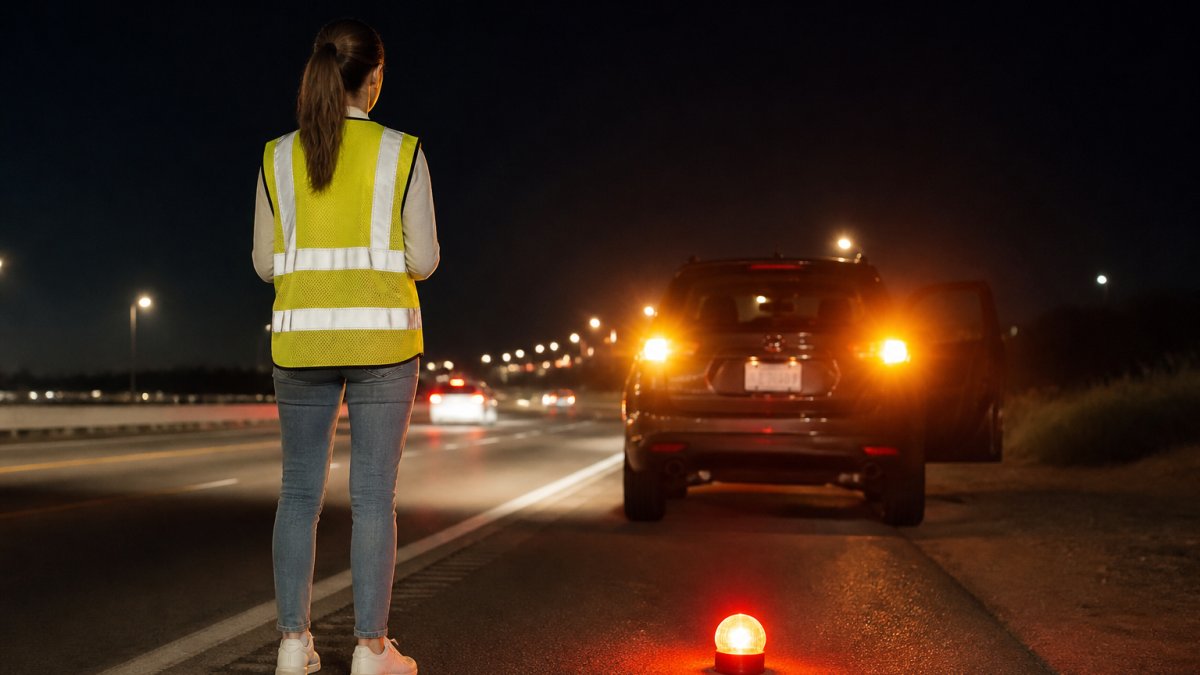
Here is the sequence we walk drivers through:
- Pull as far off the road as you safely can. Aim for the right shoulder, away from traffic lanes.
- Turn on your hazard lights immediately. Leave them on the whole time.
- Set your warning device. Place a reflective triangle or LED beacon behind the vehicle, farther back at higher speeds.
- Put on your reflective vest before you exit. Put it on inside the car if traffic is close.
- Stay in the vehicle if traffic is heavy or you feel unsafe. Exit only on the side away from traffic.
- Call for help and share your location. Use a map pin or mile marker so help finds you fast.
- Keep the engine off in an enclosed space. If you run the heater for warmth, crack a window and never in a closed garage.
Standing behind your car to wave down help is the single most dangerous move at night. Drivers cannot judge distance in the dark. Stay inside with your hazards on and let your warning device do the work.
Dead Car Battery Emergency Supplies to Keep in the Trunk
A dead battery is the most common nighttime breakdown, and the supplies you keep for it decide whether you drive home or wait for a tow.
A battery booster is worth the space at night. It lets you jump your own car without a second vehicle, which matters after dark when few drivers stop and the ones who do may not be safe to approach.
Jumper cables still earn a place as a backup. They never need charging, they work in extreme cold where a booster’s lithium cells can underperform, and they cost far less.
What to look for in a booster:
- Peak amps: Match the rating to your engine size. A small four-cylinder needs far less than a V8 or diesel.
- Safety features: Reverse-polarity protection and spark-proof clamps prevent the most common cause of booster damage, hooking up the clamps backward in the dark.
- Charge retention: A booster that self-discharges in a month is unreliable. Look for one that holds a charge for several months between top-ups.
- Cold-weather performance: Lithium boosters lose capacity in freezing temperatures. If you live where winters are harsh, keep the booster inside the cabin rather than the trunk, or choose a model rated for low temperatures.
Also keep a basic tool kit: a screwdriver, adjustable wrench, and a tow strap. The AAA road trip safety guidance recommends a reflective vest, work gloves, a tow strap, and patch-and-seal tape, a practical list for battery and tire trouble alike.
Before you open the hood at night, do this:
- Put on your reflective vest and turn on your hazard lights.
- Set your warning device behind the vehicle.
- Use your headlamp so both hands stay free.
- Check that the battery is not cracked, leaking, or heavily corroded. If it is, do not attempt a jump, call for help.
- Connect the clamps in the correct order, positive first, and keep the cables clear of moving parts.
Store your battery booster charged and check it every six months. A booster that has been sitting dead in a cold trunk is useless exactly when you need it. If you keep it in the trunk, top it up before the first cold snap of the season.
Never jump-start a battery that is frozen, cracked, or leaking. A frozen battery can rupture when it receives a charge. If you see bulging, cracks, or fluid, stop and call for roadside assistance.
Roadside Assistance for a Dead Battery: When to Call Instead of DIY
Call for roadside assistance instead of jumping the battery yourself when you are on a busy road, in bad weather, or unsure how to connect the cables safely. A jump start is a simple job in daylight; at night, on a shoulder, it becomes a risk.
Call for help when any of these apply:
- You are on a freeway or high-traffic road
- You cannot safely open the hood away from traffic
- The battery is damaged, leaking, or corroded
- You have no cables or booster
- You are alone, injured, or it is late and you feel unsafe
This is where a 24/7 service earns its keep. Fast Towing San Diego provides jump starts and tire changes around the clock, and our team can connect you with trusted repair shops afterward if the battery needs replacing rather than a jump.
How to Store, Check, and Replenish Your Kit
A kit only works if it is organized and current, so store it in a sturdy container in the trunk and check it every six months. Treat the check like an oil change: a fixed date you do not skip.
Use this simple routine:
- Confirm the flashlight and headlamp work and batteries are fresh
- Charge the portable power bank and battery booster
- Check first aid supplies for expired ointment or missing items
- Replace water and any food past its date
- Confirm the reflective vest and warning device are present and undamaged
Storing everything in one labeled container means you are not searching a dark trunk by feel. Group items by job: light, first aid, warmth, tools.
Conclusion: Night Readiness Comes Down to Visibility and Power
The difference between a stressful night breakdown and a dangerous one usually comes down to two things: whether other drivers can see you, and whether you can call for help.
If your battery dies after dark and you would rather not risk a roadside jump, Fast Towing San Diego is available 24/7/365 with professionally trained drivers and more than 100 years of combined experience.
Frequently Asked Questions
What should I keep in my car for a nighttime emergency?
A night driving kit should cover visibility, power, and warmth. Pack a flashlight plus a headlamp with spare batteries, reflective triangles or an LED beacon, a reflective safety vest for each occupant, jumper cables or a battery booster, a portable power bank and phone charger, blankets, water, nonperishable food, a first aid kit, and an ice scraper in colder months. Store everything in one trunk container so you can find it in the dark without digging through loose items.
How do you stay safe if your car breaks down at night?
Pull as far onto the right shoulder as possible, turn on your hazard lights, and set reflective triangles or an LED beacon behind the vehicle if traffic allows. Put on a reflective vest before stepping out. Stay inside the car with your seatbelt on unless you must exit, keep the doors locked, and call for roadside assistance. If you have to wait, share your location with someone you trust and keep your phone charged with a power bank.
What should I do if my car battery dies at night?
Turn on your hazard lights and move to a safe position away from traffic. If you have jumper cables or a battery booster and another driver is willing to help, connect them according to the manufacturer’s instructions. If no help is available, call roadside assistance for a jump start. A dead car battery at night is best handled by a professional rather than repeated jump attempts that can leave you stranded longer in the dark.
Should I keep a flashlight or a headlamp in my car emergency kit?
Keep both. A flashlight is useful for signaling and lighting the area around your vehicle, while a headlamp keeps your hands free when you’re checking a tire, connecting jumper cables, or reading a map. Pack extra batteries for each, and test them every six months. Many roadside kits include a flashlight, but a separate headlamp is worth adding because it makes nighttime repairs and inspections far easier.
How often should I check and replenish my night driving kit?
Check your kit every six months and before any long road trip. Replace expired first aid supplies, swap out old batteries, refill water, and confirm your power bank holds a charge. Seasonal swaps matter too: add an ice scraper, cat litter or sand for traction, and extra blankets in winter, then restock water and check for heat damage in summer. A quick biannual review keeps the kit usable when you actually need it.