
Table of Contents
- Why Lowered Sports Cars Need Specialized Towing
- Flatbed Towing vs. Wheel-Lift: Which Method Protects Your Car
- Assessing Ground Clearance and Approach Angle Before Towing
- How to Load a Lowered Car Onto a Tow Truck
- Safe Tie-Down Points for a Sports Car
- Low Clearance Car Towing: Preventing Undercarriage Damage
- Drivetrain-Specific Towing Precautions
- What to Tell Your Towing Company Before They Arrive
- Frequently Asked Questions
Last Updated: October 8, 2026
Why Lowered Sports Cars Need Specialized Towing
Understanding how to safely tow a lowered sports car is essential, as these vehicles present challenges standard towing methods cannot handle. At Fast Towing San Diego, the difference between a successful tow and a costly disaster comes down to using the right equipment and method from the start.
Standard tow trucks use a wheel-lift or hook system that works fine when ground clearance isn’t a concern. But with a lowered car, the loading angle itself becomes a liability, a typical tow truck’s approach angle is too steep for a low-profile vehicle.
Here’s what most people miss: the damage happens during loading, not transport. Once the car is secured on a flatbed, it’s safe. The critical window is those first few minutes when the vehicle transitions from the road onto the truck.
Common Damage Points on Lowered Vehicles
Lowered sports cars are vulnerable at specific points:
- Front bumper and splitter, These hang low and catch on ramps or the truck bed edge
- Undercarriage, Suspension components, exhaust systems, and heat shields scrape against the loading surface
- Wheels and tires, Sidewalls get pinched or torn by improper tie-down placement
- Sills and rocker panels, Side contact during loading causes cosmetic and structural damage
Flatbed Towing vs. Wheel-Lift: Which Method Protects Your Car
For a lowered car, the choice between flatbed and wheel-lift towing is the difference between safe transport and a damaged vehicle. Flatbed towing is the only reliable method for low-clearance vehicles.
Flatbed towing uses a large, flat truck bed that tilts down to ground level. The entire vehicle sits on the bed, fully supported, with all four wheels off the road, nothing drags or scrapes.
Wheel-lift towing (also called a wrecker or rotator) lifts the front or rear wheels while the other two roll on the road. It works for standard vehicles but is dangerous for lowered cars: the approach angle forces the bumper and splitter into contact with the truck frame or ramps, and even a few inches of contact can cause thousands of dollars in damage.
Never use a wheel-lift or hook system on a lowered car, even if the driver claims they’ve done it before. One bad experience doesn’t make it safe, it just means the damage hasn’t been noticed yet.
Flatbed towing also keeps the drivetrain safe. A front-wheel-drive car towed on its front wheels can damage the transmission, and a rear-wheel-drive car towed on its rear wheels risks gearbox damage. Flatbed eliminates this risk because all wheels stay off the ground.
Assessing Ground Clearance and Approach Angle Before Towing
Before calling a tow truck, measure your car’s ground clearance and approach angle. These numbers determine whether standard equipment will work or if you need specialized ramps and boards.
Ground clearance is the distance from the lowest point of your vehicle to the ground. A stock sedan sits around 5-6 inches; a lowered car can sit 2-4 inches.
Approach angle is the steepness at which a vehicle can climb onto a surface without the bumper or undercarriage hitting.
The math is simple: if your car’s ground clearance is less than 5 inches, you need ramps or boards to reduce the loading angle. Without them, contact is inevitable.
Photograph your car’s side profile before calling the tow company. Send the photo to the dispatcher. This single step prevents 90% of loading damage because the driver knows exactly what they’re dealing with.
Measure ground clearance with a ruler or tape measure placed flat on the ground next to the car, at the front bumper, center undercarriage, and rear bumper. Report the lowest number to the tow company.
How to Load a Lowered Car Onto a Tow Truck
Learning how to safely tow a lowered sports car means understanding that loading requires precision, the right equipment, and a driver who understands the process. This is where most damage occurs.
Preparing the Vehicle and Equipment
Before the truck arrives:
- Turn off the engine and engage the parking brake
- Disable the alarm system if your car has one, vibration during loading can trigger it
- Shift into neutral so the car can roll freely onto the truck bed
- Unlock the steering wheel by turning the key to the “on” position without starting the engine
- Clear the area of obstacles, parked cars, and debris
- Have the keys ready for the tow operator
Equipment the truck should have:
- Flatbed truck with a tilting bed (not a wheel-lift)
- Ramps or boards rated for your car’s weight (typically 3,000-5,000 lbs for a sports car)
- Soft tie-down straps (never chains or metal hardware)
- Wheel chocks to prevent rolling
- A winch with a cable or strap
If the truck arrives without ramps or boards and your car is lowered, do not proceed. Ask the driver to go get them, this is not optional.
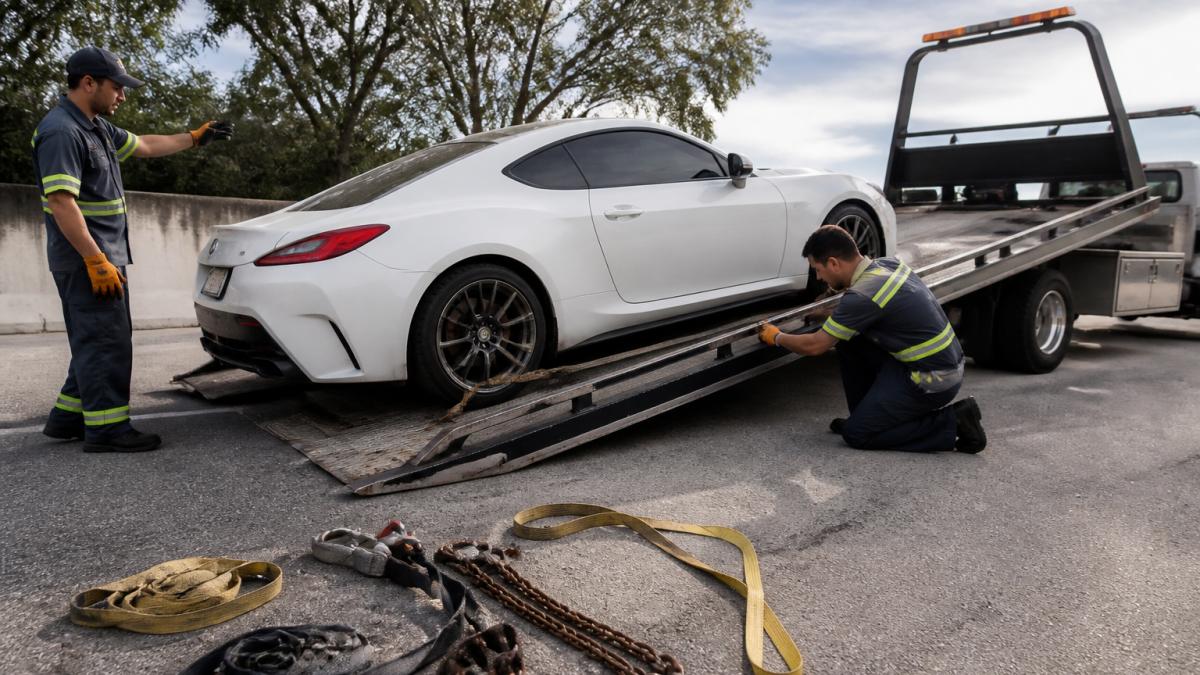
Executing the Loading Process
The loading sequence is critical, a single mistake can damage the bumper, splitter, or undercarriage.
Step 1: Position the truck and ramps (5 minutes)
Step 2: Guide the car onto the ramps (5-10 minutes)
The car should roll slowly onto the ramps under its own power or be winched gently, never excessive throttle.
Watch the front bumper and splitter as the car climbs.
Step 3: Continue onto the truck bed (5 minutes)
Once the front wheels are on the bed, the car should continue rolling slowly until the rear wheels clear the ramps.
Step 4: Secure the vehicle with tie-down straps (10 minutes)
Never use chains or metal-to-metal contact.
Tighten the straps gradually, the goal is to prevent movement, not crush the suspension.
Place wheel chocks in front of and behind the wheels if the truck has them. This adds a second layer of security.
Safe Tie-Down Points for a Sports Car
Choosing the correct attachment point is essential. The wrong point can damage suspension, bodywork, or wheels.
Safe tie-down points:
- Wheel center, Wrap the strap around the wheel, not the tire sidewall
- Suspension control arms, Attach to the lower control arm on each wheel
- Frame rails, If accessible, attach to the vehicle’s frame (not the bumper or body panel)
- Tow eyes, Some sports cars have factory tow eyes; use these if available
Never attach to:
- Bumpers (front or rear), They’re cosmetic and will bend or break
- Splitters or diffusers, These are aerodynamic parts and will tear off
- Brake lines or fuel lines, Damage here creates safety hazards
- Suspension springs or shocks, Straps on these components cause damage during transport
- Doors or windows, These will bend or crack under load
If you’re unsure about your car’s attachment points, consult the owner’s manual or ask the tow company before they arrive.
The safest tie-down points are always the wheels themselves (wrapped with padding) or the frame rails. When in doubt, use the wheels.
Low Clearance Car Towing: Preventing Undercarriage Damage
The undercarriage is the most vulnerable part of a lowered car during towing. Suspension components, exhaust systems, heat shields, and oil pans hang low and can strike the loading surface or truck bed.
Common undercarriage damage during towing:
- Dented oil pan (costs $300-$800 to replace)
- Bent exhaust pipes or muffler (costs $400-$1,200)
- Torn heat shield (costs $150-$400)
- Damaged suspension components (costs $500-$2,000+)
- Scraped or dented frame rails (costs $1,000-$3,000+)
Prevention steps:
- Use ramps or boards, Reduce the loading angle to 10 degrees or less
- Load slowly, Walking pace only; no acceleration
- Monitor clearance, Watch for contact as the car climbs onto the truck
- Use padding, Place rubber or foam padding on ramps where the car makes contact
- Secure the load, Once on the truck, the car is safe; undercarriage damage happens during loading
A flatbed keeps the undercarriage safe during transport because the car is fully supported. The critical window is those first few seconds when the car transitions from the road onto the truck bed.
Drivetrain-Specific Towing Precautions
Different drivetrains require different handling. A mistake here can disable your car or cause expensive transmission damage.
Front-wheel drive cars:
- Never tow on the front wheels (in a wheel-lift setup)
- Flatbed towing is required because the front wheels must stay off the ground
- If towed on the front wheels, the transmission can be damaged as the wheels roll
- Cost to repair: $2,000-$4,000+
Rear-wheel drive cars:
- Can be towed on the rear wheels if absolutely necessary, but flatbed is still safer
- Never tow on the front wheels
- If towed on the front wheels, the car will roll and the rear end will drag
- Flatbed is the best option to avoid any risk
All-wheel drive cars:
- Must be flatbed towed; never use a wheel-lift
- All-wheel drive systems lock all four wheels together
- If any wheels roll while others are stationary, the transmission and differential are damaged
- Cost to repair: $4,000-$8,000+
When you call for a tow, tell the driver your car’s drivetrain. This single piece of information prevents transmission damage. At Fast Towing San Diego, our drivers know the towing rules for every drivetrain, but it’s your responsibility to communicate clearly.
If you have an all-wheel drive lowered car, do not let anyone use a wheel-lift. Insist on flatbed towing. The cost of transmission repair is far higher than the cost of flatbed service.
What to Tell Your Towing Company Before They Arrive
Clear communication prevents damage. Tell the dispatcher:
Essential information:
- “My car is lowered”, This sets expectations immediately
- “Ground clearance is [X] inches”, Give the actual measurement you took
- “It’s a [front/rear/all-wheel] drive car”, Drivetrain matters
- “I need a flatbed truck, not a wheel-lift”, Be explicit
- “Bring ramps or boards”, Don’t leave this to chance
- “Please call me when you’re 10 minutes away”, You need time to prepare
Optional but helpful:
- “The car has a front splitter that hangs low”
- “The exhaust is lowered too”
- “I’ve had damage before with [other tow company]”
- “Please send your most experienced driver”
When you call Fast Towing San Diego, our dispatchers ask these questions automatically, we know exactly what equipment to bring. If you’re calling another service, be specific; vague requests lead to the wrong truck showing up.
After the tow company confirms they understand:
- Take a photo of the truck and driver’s name
- Stay present during loading
- Watch for contact or scraping
- If something looks wrong, speak up immediately
The tow operator works for you. If you see a problem, stop the process, better to delay 10 minutes and do it right than rush and damage your car.
Getting a lowered sports car towed safely requires the right truck, equipment, and driver, and a flatbed with ramps and soft tie-downs beats every other method. When you need towing in San Diego, Fast Towing San Diego brings all three.
Frequently Asked Questions
How do you tow a lowered car without scraping the undercarriage?
Use a flatbed tow truck instead of a wheel-lift to avoid contact with the ground. Position ramps or boards at a shallow angle to reduce the loading angle. Measure ground clearance and approach angle before the tow truck arrives. Ensure the towing company disconnects the wheels if necessary and uses soft straps on all tie-down points to prevent metal-on-metal contact that can damage your bumper, splitter, and undercarriage.
What are the safest tie-down points for a sports car?
Use factory-installed anchor points or reinforced frame mounting locations, never bumpers or bodywork. For lowered cars, attach soft straps to the suspension mounting points or frame rails. Avoid attaching to front splitters, rear diffusers, or any body panels. Verify the attachment points can support your vehicle’s weight, and always use padding or soft straps to prevent metal-on-metal contact that causes cosmetic and structural damage.
Can a rear-wheel-drive sports car be towed with its wheels on the ground?
No. Rear-wheel-drive cars must be towed on a flatbed or with the drive wheels lifted off the ground. Towing with RWD wheels rolling causes transmission fluid loss and severe drivetrain damage. Always request flatbed towing for RWD sports cars, or specify that the rear axle must be disconnected or the wheels lifted to prevent costly repairs.
Should you tell the towing company your car is lowered before they arrive?
Yes, absolutely. Communicate that your car is lowered, has a custom suspension, or is a sports car with low ground clearance. Describe any body modifications like front splitters or diffusers. Provide the ground clearance measurement and approach angle if you know them. This ensures the towing company brings the right equipment (flatbed, ramps, soft straps) and avoids sending a standard wheel-lift truck that could cause thousands of dollars in damage.