
Table of Contents
- Why a Failing Car Battery Gives Warning Signs First
- 1. Slow Engine Cranking and Sluggish Starting
- 2. Clicking Sounds When You Turn the Key or Press Start
- 3. Dim or Flickering Headlights and Electrical Issues
- 4. Corrosion, Swelling, and Smells That Signal a Failing Battery
- Bad Battery vs Bad Alternator: How to Tell the Difference
- How to Test a Car Battery With a Multimeter and Load Test
- How Long Does a Car Battery Last, and What Shortens Its Life?
- Frequently Asked Questions
Last Updated: October 17, 2026
Why a Failing Car Battery Gives Warning Signs First
A car battery rarely dies without notice. In most cases, the signs your car battery is about to fail show up days or even weeks before the engine refuses to start, which gives you time to act. We get calls every week from drivers who ignored a slow crank or a flickering dashboard light until the car would not move at all.
Here is the good news: a battery speaks up before it quits. It cranks slower. It makes noise. It lets lights dim. The trick is knowing what to listen for.
Below, we break down the seven warning signs, how to tell a bad battery from a bad alternator, and how to test your battery yourself. Read on, because the last section covers how long you actually have once the first sign appears.
1. Slow Engine Cranking and Sluggish Starting
A slow engine crank is the most common early warning. You turn the key or press the start button, and instead of a quick, strong turnover, the engine groans and labors before catching.
That sluggishness means the battery is not delivering enough cold cranking amps. Cold cranking amps (CCA) measure how much power a battery can push out in cold temperatures. As a battery ages, its internal resistance rises and its CCA drops.
Watch for these starting clues:
- The engine turns over slower than it did six months ago
- It takes two or three attempts to start, especially on cold mornings
- The starter sounds tired but the car eventually fires
A common mistake is blaming the starter. In practice, a weak battery mimics a failing starter almost perfectly. Test the battery first, because it is the cheaper and easier fix.
Ignoring a slow crank is how most drivers end up stranded. A battery that cranks slowly in October often fails completely by the first hard freeze. Get it tested before that happens.
2. Clicking Sounds When You Turn the Key or Press Start
A rapid clicking sound when you turn the key usually means the battery does not have enough charge to engage the starter. You hear a machine-gun-style click-click-click, and the engine never turns over.
Here is what each sound tells you:
- Single loud click, then nothing: often a bad starter solenoid or a loose connection
- Rapid clicking: low battery voltage, the classic dead battery signal
- Clicking plus dim lights: almost always the battery or its connections
The clicking happens because the starter solenoid tries to engage, draws more power than the battery can supply, and drops out. It repeats this cycle fast, which produces the clicking.
Before you assume the worst, check the battery terminals. A loose or corroded connection can cause the same clicking. If the terminals are clean and tight and you still hear clicking, the battery is the prime suspect.
3. Dim or Flickering Headlights and Electrical Issues
Dim headlights at idle are a strong sign of a weak battery or a charging system problem. If your lights brighten when you rev the engine and dim when it idles, the battery is not holding its charge well.
Electrical components acting oddly is another clue. You might notice:
- Interior lights that flicker or glow dimmer than usual
- A radio or infotainment screen that resets on its own
- Power windows that move slowly
- A clock that loses its time setting
These small electrical issues happen because the battery cannot hold a steady voltage. Modern cars run dozens of computers, and each one needs stable power. When voltage sags, those systems misbehave in strange, inconsistent ways.
A dashboard warning light, often shaped like a battery, is the car telling you directly. If that battery warning light comes on while driving, pull over safely and check your charging system soon. It can point to the battery, the alternator, or the belt that drives the alternator.
4. Corrosion, Swelling, and Smells That Signal a Failing Battery
Physical changes to the battery itself are some of the clearest signs your car battery is about to fail. Pop the hood and look closely at the battery case and terminals.
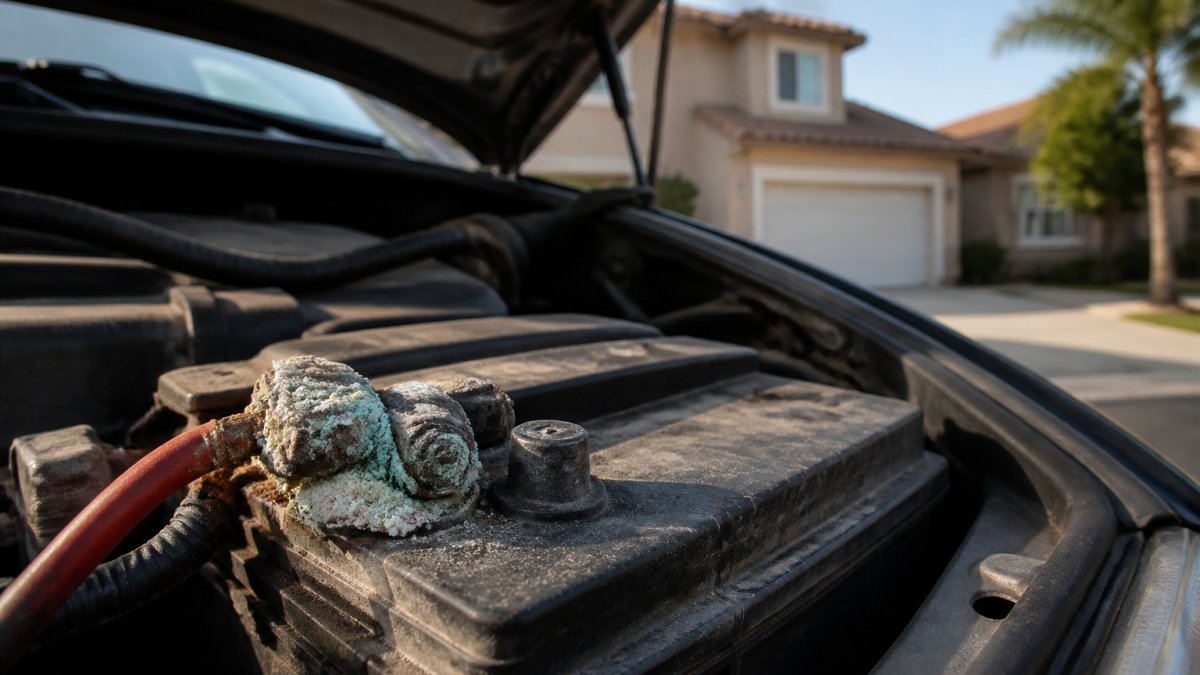
Terminal corrosion shows up as white, blue, or orange buildup around the battery posts and connectors. That crust is dried battery acid and sulfate. It blocks current flow and makes starting harder. Clean it with a baking soda and water paste, then rinse and dry.
A swollen battery case is more serious. If the sides of the battery bulge outward, the battery has failed internally and can leak or rupture. Do not jump-start or charge a swollen battery. Replace it.
A rotten-egg smell means trouble. That sulfuric smell comes from a battery that is venting hydrogen gas, often because it is overcharging or failing. Turn off the engine, keep sparks and flames away, and have it checked.
Run your hand along the battery case when the engine is off and cool. Any bulge you can feel on the sides means the battery is done. No test needed.
Bad Battery vs Bad Alternator: How to Tell the Difference
A weak battery, a failing alternator, and a bad starter can produce nearly identical symptoms: slow cranking, clicking, dim lights, and a no-start.
Step 1: Check resting voltage with the engine off. Set a multimeter to DC volts and touch the red probe to the positive post and the black probe to the negative post.
Step 2: Start the engine and recheck. With the engine running, the alternator should push the reading to roughly 13.5 to 14.5 volts. If it stays near 12 volts or drops, the alternator is not charging.
Step 3: Jump-start the car and observe what happens next. This is the single most useful test for separating battery from alternator. If the car starts on a jump and then runs normally for days, the battery was discharged or weak.
Step 4: Listen to the starter. A single loud click followed by nothing often points to a bad starter solenoid or a loose connection. Rapid machine-gun clicking points to low battery voltage.
Here is how the numbers sort it out:
| Reading | Engine Off | Engine Running | What It Means |
|---|---|---|---|
| Healthy | 12.6V | 13.5-14.5V | Battery and charging system are fine |
| Weak battery | Below 12.4V | Rises to normal range | Battery is not holding charge |
| Bad alternator | 12.6V | Stays near 12V or drops | Alternator is not charging |
| Bad starter | 12.6V | 13.5-14.5V | Battery and charging are fine; starter or connection is the fault |
| Both failing | Below 12.4V | Stays low or drops | Test both before replacing either |
A quick rule: if the car starts fine after a jump but dies again soon after, the alternator is likely the problem. For a full breakdown of charging system basics, see the U.S. Department of Energy vehicle charging guide.
Before you buy any part, clean and tighten both battery terminals and check the ground cable where it bolts to the engine or frame. A loose or corroded ground causes the same slow-crank and clicking symptoms as a dead battery, and it costs nothing to rule out.
How to Test a Car Battery With a Multimeter and Load Test
Testing a car battery takes about ten minutes and a cheap multimeter. Here is the step-by-step process we walk drivers through.
- Turn off the engine and all accessories. Let the battery rest for an hour if it was just driven.
- Set your multimeter to DC volts. Touch the red probe to the positive post and the black probe to the negative post.
- Read the voltage. 12.6V or higher means a full charge. 12.4V is about half charged. Below 12.2V means it needs charging or replacement.
- Start the engine and recheck. The reading should climb to 13.5-14.5V. If it stays near 12V, the alternator is not charging.
- Run a load test. A load test applies a heavy draw to see how the battery holds up under stress. Most auto parts stores run one for free.
A load test tells you the battery’s real condition, not just its current charge. A battery can read 12.6V at rest and still fail under load. If the voltage drops hard during the load test, replace the battery. For more on battery testing standards, the Battery Council International publishes guidance on testing and recycling.
A resting voltage of 12.6V means charged, not healthy. Only a load test proves the battery can deliver power when the starter demands it.
How Long Does a Car Battery Last, and What Shortens Its Life?
Most car batteries last three to five years, but how you drive changes that number a lot. A battery in a mild climate with regular highway driving often reaches five years. One in extreme heat with short trips may fail in two or three.
There is no exact answer, but the pattern is consistent. A battery that cranks slowly but still starts usually has days to a few weeks, not months. A battery that clicks or needs a jump has hours to days.
These habits shorten battery lifespan:
- Short trips. A five-minute drive never lets the alternator fully recharge the battery. Over time, it stays undercharged.
- Extreme heat. Heat speeds up the chemical reaction inside the battery and wears it out faster than cold does.
- Frequent deep drains. Leaving lights on or running accessories with the engine off drains the battery and shortens its life.
- Loose terminals. A poor connection causes resistance, heat, and slow charging.
Cold weather exposes a weak battery. A battery that limps through summer often dies on the first cold morning because cold thickens engine oil and demands more cranking power. Heat does the long-term damage; cold delivers the final blow.
If the battery has already failed and the car will not start, safety comes first.
If your battery is past the three-year mark and showing any warning sign, plan a replacement before it strands you. When a battery does die and you need a jump-start or a tow, our team at Fast Towing San Diego is available around the clock.
A swollen battery can rupture or leak acid. Do not jump-start, charge, or handle it. Have it replaced, and keep sparks and flames away until it is out of the vehicle.
Frequently Asked Questions
What are the signs your car battery is about to fail?
The most common signs include slow engine cranking, a clicking sound when you turn the key, dim or flickering headlights, a battery warning light on the dashboard, and inconsistent electrical behavior. Physical clues matter too: white, blue, or orange buildup on the terminals, a swollen battery case, or a rotten-egg smell all point to a car battery that needs replacement. If you notice two or more of these, get the battery tested before it leaves you stranded.
How can you tell whether the battery, alternator, or starter is bad?
Start with a voltage check. A resting battery should read around 12.6 volts; if it drops below 12.2, the battery is weak. With the engine running, the alternator should push voltage to roughly 13.5 to 14.5 volts. If voltage stays low while running, the charging system is the problem. A starter fault usually shows as a single loud click with strong lights, while a bad battery dims the lights and cranks slowly. Testing each part in that order separates bad battery vs bad alternator vs starter quickly.
How long does a car battery last, and when should I replace it?
Most car batteries last three to five years in normal conditions. Heat, frequent short trips, and start-stop systems shorten that window. In hot climates, expect closer to three years. If your battery is past the four-year mark and shows any warning sign, replace it rather than waiting for a failure. Check the date sticker on the case, and have the battery load-tested once a year after year three.
What should I do when my car battery dies on the road?
Pull as far off the roadway as you can, turn on your hazard lights, and stay in the vehicle if traffic is close. If you have cables and a willing helper, a jump-start can get you moving, but connect positive to positive first, then negative to a metal ground on the dead car. After a jump, drive at least 20 minutes to recharge. If the battery is swollen, leaking, or smells like sulfur, do not jump it. Call a roadside service for a safe jump-start or tow.