
Table of Contents
- San Diego Heavy Machinery Logistics: What Actually Decides Your Move
- Heavy Equipment Transport Trailers: Flatbed, Lowboy, and RGN Compared
- Machinery Transport Preparation Checklist: From Fuel to Tie-Downs
- Oversize Load Permits, Escorts, and Route Restrictions in California
- Heavy Equipment Shipping Cost: What Drives Your Quote
- Route Planning Around Port Terminals, Freeways, and Local Access Limits
- Insurance, Damage Documentation, and Contingency Planning
- Choosing a Heavy Machinery Logistics Partner
- Frequently Asked Questions
Last Updated: October 14, 2026
San Diego Heavy Machinery Logistics: What Actually Decides Your Move
Heavy machinery logistics is the planning and execution of moving oversized, overweight, or high-value equipment from one point to another using specialized trailers, permits, securement systems, and route analysis. This guide from Fast Towing San Diego covers the trailer types, preparation steps, permit rules, and cost drivers that actually shape a machinery move.
Most people assume the machine is the hard part. It isn’t. The hard part is everything around it.
A common mistake we see is booking a trailer before anyone has measured the machine.
The five decisions below, trailer, preparation, permits, cost, and route, are the ones that determine your final quote and your delivery window.
Heavy Equipment Transport Trailers: Flatbed, Lowboy, and RGN Compared
A flatbed trailer handles equipment that loads from ground level or a dock; a lowboy trailer carries taller machines under a lower deck height; and an RGN, or removable gooseneck, drops its neck to load equipment that cannot climb a ramp.
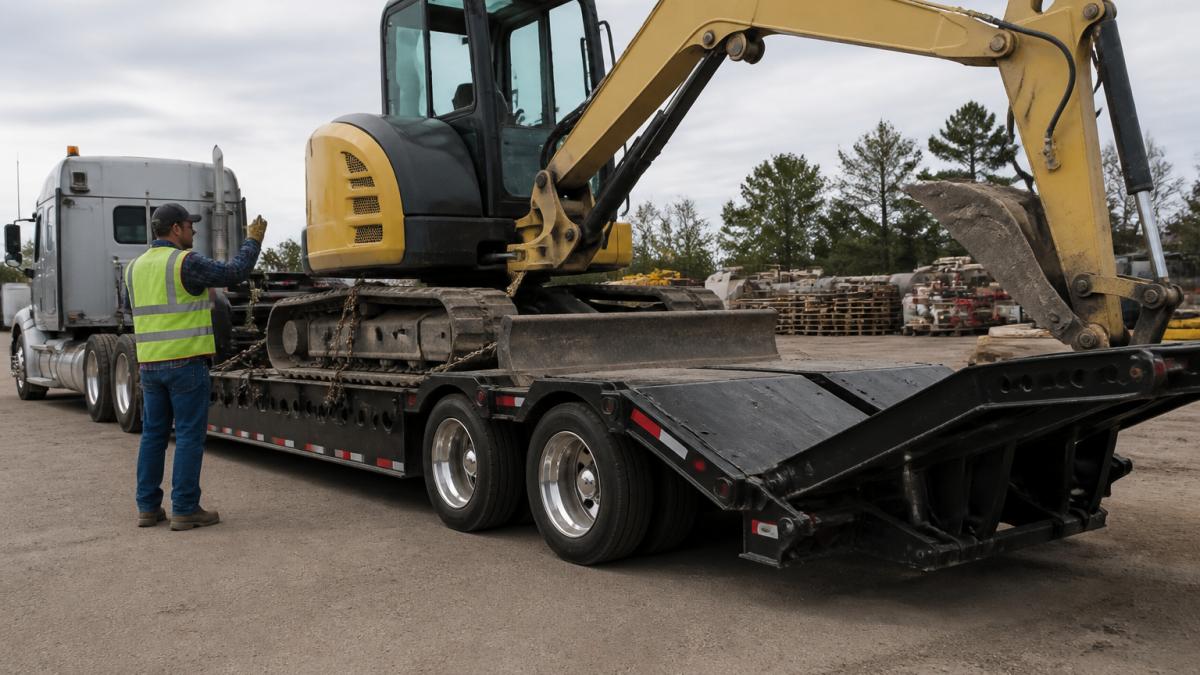
| Trailer Type | Deck Height | Best For | Loading Method |
|---|---|---|---|
| Flatbed | Standard height | Forklift-loadable equipment | Ramp or dock |
| Lowboy | Lower deck | Tall machines near height limits | Ramp or dock |
| RGN | Lowest, detachable | Very tall or non-driving equipment | Drive-on after neck removal |
Matching Deck Height and Capacity to Your Machine
Start with loaded height. A lowboy lets a taller machine clear overpasses that a standard flatbed cannot. Then check capacity against operating weight, not dry weight, because fuel, attachments, and counterweights add real pounds. Finally, confirm the deck length leaves room for proper tie-down angles at both ends.
Measure your machine’s height with the boom or mast in its travel position, not its stowed position. A few inches of difference is often what pushes a load from “no permit needed” into “oversize load.”
Machinery Transport Preparation Checklist: From Fuel to Tie-Downs
Proper preparation protects the machine, the trailer, and everyone on the road. Work through this before the truck arrives, not while it’s idling in your yard.
- Record machine dimensions and operating weight
- Reduce fuel to a safe travel level
- Lower and lock all booms, arms, and attachments
Securement Math: Chains, Hooks, Binders, and Working Load Limits
Securement is where amateurs get caught. Every chain, hook, and binder has a working load limit, and the combined limit of your tie-downs must exceed the weight of the cargo by a safety margin. Use four-point securement as a baseline, angle chains so they resist forward, backward, and sideways movement, and inspect every link for wear before it goes on.
Never mix securement hardware with different working load limits on the same load. The weakest link sets the limit for the whole tie-down, and a failure at highway speed turns cargo into a projectile.
Oversize Load Permits, Escorts, and Route Restrictions in California
An oversize or overweight load generally requires a permit before it moves on public roads, and California sets its own thresholds for width, height, length, and weight. Because permit thresholds and escort rules are set by the state and can change, always confirm current requirements with the California Department of Transportation before you schedule a move.
Most guides stop there. What they don’t give you is the actual sequence. Here is the permitting workflow that keeps a move on schedule.
Step 1: Classify the Load
Measure the machine in its travel configuration, boom lowered, attachments secured, fuel at travel level. Compare those numbers against California’s oversize thresholds for width, height, length, and weight. If any dimension exceeds the threshold, you need a permit. If the load is both oversize and overweight, expect separate permit categories and potentially separate applications.
Step 2: Identify the Permit Type and Issuing Authority
Single-trip permits cover one movement on a defined route. Annual or blanket permits may cover repeated moves of the same equipment on approved routes. For loads that cross state lines, each state issues its own permit, and the route must satisfy every state’s conditions. Within California, some routes also require local city or county encroachment permits when the load enters municipal streets or crosses structures the state does not control.
Step 3: Apply and Confirm Restrictions
The application typically requires the load’s dimensions, weight, origin, destination, proposed route, and travel dates. Once the permit is issued, read the conditions carefully, they often specify allowable travel hours, prohibited road segments, minimum escort requirements, and speed or lane restrictions. A permit is not a blanket authorization; it is a conditional approval tied to a specific route and time window.
Step 4: Arrange Escorts and Pilot Vehicles
Escort requirements scale with the load. Wider or longer loads may need one pilot vehicle; extreme dimensions may require front and rear escorts, and some routes require law enforcement escorts for bridge crossings or high-traffic segments. Pilot vehicle operators must meet state certification and equipment requirements, including proper signage, flags, and communication gear.
Step 5: Verify the Route Before the Truck Rolls
Permit conditions can change with construction, weather, or special events. Reconfirm the route the day before the move. Check bridge weight limits, overpass clearances, and any temporary restrictions. If a segment is closed, the permit may need to be amended before the load can legally proceed.
Build permit lead time into your schedule. Single-trip permits are often issued within a few business days, but complex routes, multiple jurisdictions, or escort requirements can add time. Applying late is one of the most common reasons a machinery move slips.
The Federal Motor Carrier Safety Administration also sets cargo securement standards that apply to commercial vehicles, so your tie-down method needs to meet both state permit conditions and federal securement rules. For anything crossing state lines, expect a separate permit for each state.
Heavy Equipment Shipping Cost: What Drives Your Quote
Heavy equipment shipping cost comes down to distance, weight, dimensions, permits, escorts, and access difficulty, not a single flat rate. A short in-city move of a compact machine prices very differently from a multi-day haul of an oversize load that needs pilot vehicles and a circuitous route around weight-restricted bridges.
Most carriers quote per mile, but the per-mile rate is only the starting point. Here is how each factor actually moves the total.
Distance and Billable Miles
Carriers price by the mile, but the billable miles are not always the shortest route. If a weight-restricted bridge or low overpass forces a detour, those extra miles are billable. A move that looks like 40 miles on a map can price as 55 or 60 billable miles once the legal route is mapped.
Weight and Dimensions
Weight affects both the trailer required and the permit category. A machine that stays under the oversize threshold moves on a standard permit or none at all. Cross into oversize or overweight territory and you add permit fees, possible escort costs, and restrictions on travel hours that can stretch the move across more days.
Permits and Escorts
Permit fees vary by state, load dimensions, and route. Escort or pilot vehicle costs are typically charged per vehicle, per mile, or per day, and a load requiring front and rear escorts can double that line item. These are pass-through costs, but they are real and they scale with the load.
Loading and Unloading
If the machine cannot drive onto the trailer, you may need a crane, a forklift, or a ramp system. Crane service is priced separately and often by the hour with a minimum. Access at the origin or destination, tight gates, low wires, soft ground, can add rigging time or require a different trailer.
Scheduling and Timing
After-hours, weekend, or expedited moves cost more because they disrupt the carrier’s normal routing. Conversely, flexible scheduling can sometimes reduce cost by letting the carrier combine your load with a nearby move. If your timeline is tight, expect a premium.
How to Compare Quotes
When you compare quotes, compare the scope, not just the number. Ask whether the quote includes permits, escorts, loading equipment, and fuel surcharges, or whether those are added later.
Because every load is different, we quote each move individually rather than publishing a rate card. The fastest way to get an accurate number is to share your machine’s dimensions, weight, and both locations so we can price the actual route.
Route Planning Around Port Terminals, Freeways, and Local Access Limits
Route planning for heavy machinery means checking bridge weight limits, overpass clearances, construction zones, and local access restrictions before the truck rolls, not after.
Build the route around the load, not the map’s fastest path. A slightly longer route that avoids a low overpass or a weight-restricted bridge beats a shorter one that stops traffic.
The route that looks fastest on a map is rarely the route a heavy load can legally take. Clearance and weight limits decide the path.
Insurance, Damage Documentation, and Contingency Planning
Insurance and documentation protect both sides when something goes wrong. Before loading, photograph the machine and note any existing damage in writing.
Contingency planning matters just as much. Weather, traffic, and mechanical issues can delay a move, so build slack into your schedule and keep a contact on both ends reachable during transit.
For specialized or high-value equipment, including boats, exotic vehicles, and machines that can’t be driven onto a standard trailer, the U.S. Department of Transportation publishes guidance on carrier responsibilities that’s worth reviewing.
Choosing a Heavy Machinery Logistics Partner
Choose a logistics partner based on equipment, experience, and communication, not the lowest quote alone. Ask what trailers they run, how they handle permits and escorts, and whether they carry insurance that covers your load’s value.
At Fast Towing San Diego, our team brings over 100 years of combined experience and professionally trained drivers to every job, from accident towing to equipment transport. If you manage a fleet or need multiple vehicles moved, we handle those accounts too.
Frequently Asked Questions
How do you transport heavy machinery safely?
Safe transport starts with accurate dimensions and weight, then matching the machine to the right trailer. Equipment is driven or winched onto the deck, positioned for balanced axle weight, and secured with chains, hooks, and binders rated to at least half the cargo weight. Soft straps protect painted surfaces. Routes are checked for bridge limits and turning clearance before departure, and a final walkaround confirms every tie-down is tight before the truck leaves the pickup location.
What information do I need to get a heavy equipment shipping quote?
Have the machine’s make, model, length, width, height, and operating weight ready, plus whether any attachments add to those figures. Give the exact pickup location and delivery location, including whether either site has a loading dock, ramp, or forklift. Note any access restrictions like low wires, narrow gates, or soft ground. Also mention your target dates, since scheduling flexibility affects heavy equipment shipping cost and trailer availability.
When does heavy equipment transport require oversize load permits or escorts?
In California, loads exceeding standard legal width, height, or weight thresholds need an oversize load permit before the truck moves. Oversize load permits are issued for a specific route and time window, and some configurations require pilot vehicles or escorts, especially on freeways or during night moves. Because thresholds and escort rules vary by route and axle configuration, confirm requirements with the permit office or your carrier before scheduling.
How should heavy machinery be prepared for transport?
A machinery transport preparation checklist covers: lower attachments and booms, retract cylinders, and lock any articulation pins. Fuel levels are usually kept low to cut weight. Remove loose items, secure or remove the key, and disconnect the battery if the carrier asks. Clean grease and mud off the undercarriage so tie-down points are visible. Photograph the machine from all sides before pickup to document its condition.
What type of trailer is used to haul heavy equipment?
Flatbed trailers handle most mid-size construction equipment that can be loaded from ground level or a ramp. Lowboy trailers use a lower deck for taller machines that would otherwise exceed height limits. RGN (removable gooseneck) trailers detach at the front so equipment can be driven on without a ramp, which suits very heavy or low-clearance machines. The choice depends on your machine’s height, weight, and loading method.
What affects the cost of transporting heavy machinery?
Transport distance and cost per mile set the baseline, but weight, dimensions, and permit needs add to it. Oversize loads may require pilot vehicles, escorts, and route surveys, all of which raise the total. Access difficulty at the pickup location or delivery location, such as tight streets or the need for a crane, adds labor. Scheduling matters too: weekend, night, or rush moves cost more than flexible weekday windows.
How long does heavy equipment shipping usually take?
Local moves within the metro area often complete the same day once the trailer and permits are arranged. Regional hauls typically take one to three days depending on distance and driver hours-of-service rules. Cross-country transport can run one to two weeks, longer if permits, escorts, or weather delays apply. Ask your carrier for a realistic window rather than a single date, and build a buffer into your project schedule.
Moving heavy machinery is a planning problem before it’s a driving problem, and the details you skip at the start are the ones that cost you time and money later. Fast Towing San Diego handles the trailer selection, securement, and route planning so your equipment arrives intact and on schedule, backed by over 100 years of combined experience, professionally trained drivers, and 24/7 availability. Get started with Fast Towing San Diego and move your equipment with confidence.