
Table of Contents
- Why Your Repair Shop Needs a Dedicated Towing Company Partner
- 24/7 Emergency Towing Services and Roadside Assistance for Your Customers
- Understanding Towing Service Contracts for Repair Shops
- How to Manage Vehicle Intake from Towing Services
- Commercial Towing Partnership Benefits and What to Expect
- Cost Transparency and Estimating for Towing Services
- Checklist for Repair Shops Before and After Vehicle Towing
- Frequently Asked Questions
Last Updated: September 20, 2026
Why Your Repair Shop Needs a Dedicated Towing Company Partner
A towing company for auto repair shops isn’t a luxury, it’s a business necessity. When customers arrive at your shop after a breakdown or accident, they’ve already had a stressful experience. The last thing they need is to spend another hour figuring out how to get their vehicle to you.
24/7 Emergency Towing Services and Roadside Assistance for Your Customers
Emergency situations don’t follow business hours. A customer’s transmission fails at midnight or gets stranded on the freeway at 3 AM. A towing company for auto repair shops with round-the-clock availability solves this.
Ask potential towing partners about their average response time. Response speed directly impacts customer perception of your shop.
Understanding Towing Service Contracts for Repair Shops
Key contract elements include:
- Service scope: What types of vehicles will be towed (cars, trucks, motorcycles, exotic vehicles)
- Geographic coverage: The service radius and any additional fees for extended distances
- Pricing model: Flat rates, hourly charges, mileage-based fees, or hybrid structures
- Response time guarantees: Expected arrival windows and compensation if not met
- Insurance and liability: Who covers damage during transport and what the limits are
- Term and termination: Contract length, renewal terms, and exit conditions
Never sign a contract with vague liability language. If a vehicle is damaged during towing, you need to know exactly what’s covered and what isn’t. Ambiguous terms lead to disputes when something goes wrong.
Negotiate terms that match your shop’s volume and service area. A high-volume shop might secure better rates than a small operation. A shop in a dense urban area needs different coverage than one serving rural regions.
How to Manage Vehicle Intake from Towing Services
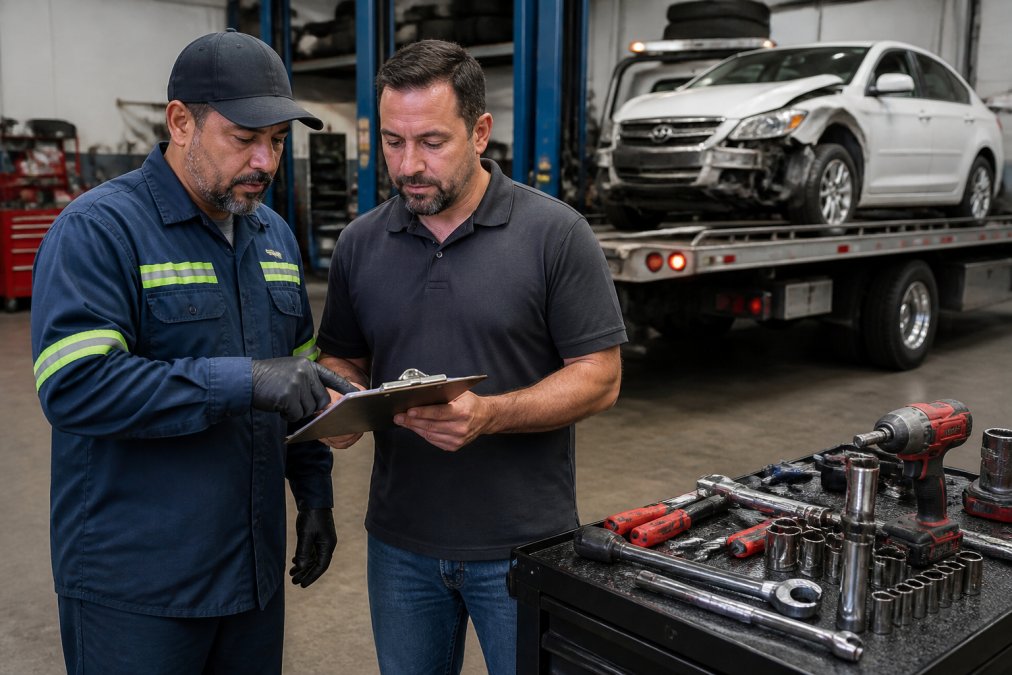
Vehicle intake prevents confusion, reduces liability, and keeps customers informed. It’s also when you coordinate insurance claims and warranty coverage, two areas that create customer confusion if mishandled.
The Physical Intake Checklist
When a towed vehicle arrives, follow these steps:
- Verify the vehicle and customer information. Match the vehicle to the service order and confirm customer contact details. Ensure the vehicle identification number (VIN) on the tow ticket matches the customer’s paperwork.
- Conduct a pre-service inspection. Document the vehicle’s exterior condition with photos from all angles (front, rear, sides, roof). Note any scratches, dents, or existing damage. This protects both you and the towing company if the customer later claims transport damage.
- Review the towing report. The towing company should provide notes on where the vehicle was picked up, the reason for the tow, and any observations about mechanical condition (e.g., “engine was smoking,” “customer reported brake failure”). These notes inform your diagnostic approach.
- Create a digital intake record. Log the arrival time, current mileage, fuel level, and any items left in the vehicle (personal belongings, documents, tools). This record becomes part of the service history.
- Communicate with the customer. Send a confirmation message (email or text) that the vehicle has arrived safely. Include the estimated timeline for diagnosis and next steps.
- Assign to a service bay. Schedule diagnostic work and notify the customer of the appointment time for estimate review.
Insurance Claims Coordination During Intake
When a vehicle arrives, ask:
- Is this claim-eligible? Did the customer have roadside assistance, accident insurance, or breakdown coverage? Many don’t know.
- Has the claim been filed? If not, they must file immediately to avoid denial.
- What is the claim number? Document it to link the tow cost to reimbursement.
- Who is the adjuster? For accident claims, coordinate inspection timing to avoid delays.
Insurance Claim Documentation
- Insurance company name and claim number
- Adjuster name and contact information
- Coverage type (roadside assistance, collision, comprehensive, breakdown)
- Towing coverage limit (if applicable)
- Customer’s deductible
Warranty Coverage and Intake
Ask the customer:
- Is the vehicle under warranty? Manufacturer warranty (typically 3 years/36,000 miles) or extended warranty (aftermarket or dealer-purchased)?
- What is the warranty provider? Manufacturer (Ford, Honda, etc.) or third-party (extended warranty company)?
- What does the warranty cover? Some warranties cover towing to a dealer; others don’t. Some cover towing to any repair shop; others require dealer service.
Document warranty information in your intake record:
- Warranty provider and policy number
- Coverage type and limits
- Towing coverage (yes/no)
- Any restrictions on where repairs can be performed
Post-Towing Communication Protocol
Establish a clear communication timeline:
- Within 1 hour: Confirm receipt and inspection start.
- Within 4 hours: Preliminary assessment.
- Within 24 hours: Detailed estimate with itemized repairs, parts, labor, and timeline.
- Before repairs: Written authorization and adjuster approval (if insurance involved).
- Daily updates (repairs exceeding 2 days): Brief status updates.
Checklist for Intake Staff
Use this checklist to ensure consistent, professional intake:
- Photograph vehicle exterior from all angles
- Record VIN, mileage, and fuel level
- Review towing report for notes and observations
- Verify customer contact information
- Ask about insurance coverage and claim status
- Document claim number and adjuster contact (if applicable)
- Ask about warranty coverage and verify restrictions
- Check for personal items inside the vehicle
- Create digital intake record with arrival time and condition
- Send customer arrival confirmation message
- Assign vehicle to service bay and technician
- Schedule diagnostic work and estimate timeline
Never begin repairs on a warranty-covered vehicle without confirming coverage with the warranty provider. A repair performed outside warranty terms can void coverage and create a liability dispute with the customer.
Intake is your first opportunity to build trust with a stressed customer. Clear communication about insurance, warranty, and next steps transforms a frustrating breakdown into a professional, transparent experience.
Commercial Towing Partnership Benefits and What to Expect
A commercial towing partnership benefits repair shops by creating operational efficiency, customer loyalty, and revenue opportunities. Direct benefits include reduced customer frustration, faster vehicle arrival, liability protection, better diagnostics, and referral opportunities. Your shop becomes known for solving problems completely, customers get towed to a shop that can fix it, driving repeat business. Some towing companies offer additional services like mobile diagnostics or fleet management support.
The strongest partnerships are built on reliability and communication. Choose a towing company that answers the phone, provides updates, and follows through on commitments every single time.
Cost Transparency and Estimating for Towing Services
Cost uncertainty kills partnerships. When you don’t know towing costs, you can’t give accurate estimates. When customers get surprise charges, they blame the shop. Understanding cost structure lets you forecast accurately.
The Two-Part Towing Cost Structure
Surcharges and Hidden Costs
Ask about common surcharges:
- After-hours: Premium for nights, weekends, holidays.
- Vehicle type: Heavy trucks, RVs, or exotic vehicles cost more.
- Recovery/winch-out: For stuck or inaccessible vehicles.
- Long-distance: Surcharges beyond a certain distance from dispatch center.
- Flatbed vs. wheel-lift: Flatbed costs more but is safer for luxury vehicles.
Building Accurate Customer Estimates
Negotiating Volume Discounts
Red Flags in Pricing Agreements
Request a detailed price sheet for common scenarios (distances, vehicle types, times of day). Compare actual numbers across towing partners before signing.
Tracking Costs and Reconciling Invoices
Checklist for Repair Shops Before and After Vehicle Towing
A structured checklist prevents oversights and keeps operations smooth. Use this before dispatch and after arrival.
Before Requesting a Tow:
- Confirm customer contact information and preferred destination
- Document the vehicle’s current location and accessibility
- Note any special handling requirements (exotic car, motorcycle, trailer)
- Verify the customer has authorized the tow
- Prepare service paperwork with customer expectations
- Confirm your shop has capacity to receive the vehicle
Upon Vehicle Arrival:
- Photograph the vehicle’s exterior condition from all angles
- Record the vehicle’s mileage and fuel level
- Check for items left inside (customer belongings, documents)
- Review the towing report for any notes or observations
- Verify no new damage occurred during transport
- Create a digital service record with arrival time and condition
- Contact the customer to confirm safe arrival
- Assign the vehicle to a service bay and technician
Before Vehicle Departure:
- Ensure all diagnostic work is complete and documented
- Provide the customer with a detailed repair estimate
- Confirm authorization before beginning repairs
- Update the service record with work completed
- Verify the vehicle is clean and ready for pickup
- Arrange customer pickup or delivery logistics
Frequently Asked Questions
How do I find a reliable towing company for my auto repair shop?
Look for a towing company with 24/7 availability, professionally trained drivers, and experience handling the types of vehicles your customers own. Verify they offer roadside assistance capabilities beyond basic towing, such as jumpstart and tire change services. Ask about their response time guarantees and whether they coordinate with repair facilities. Check references from other shops they work with and confirm they maintain proper insurance coverage and licensing for commercial partnerships.
What are the main benefits of partnering with a local towing service?
A local towing company partnership improves customer experience through faster response times, reduces vehicle downtime, and eliminates the need for customers to arrange their own transport. You gain priority dispatch status, streamlined communication protocols, and the ability to direct accident victims to your repair shop immediately. Local partners understand your shop’s workflow, can coordinate vehicle intake procedures, and often provide volume discounts for commercial accounts. This strengthens customer loyalty since you handle the entire recovery process.
What should I include in a towing service contract with a repair shop partnership?
Your towing service contract should specify response time guarantees, coverage area, types of vehicles serviced, hook-up fees, mileage rates, and available roadside services. Include terms for priority dispatch during peak hours, communication protocols for vehicle intake, and procedures for warranty claims coordination. Define whether the towing company handles towing to your facility exclusively or manages multiple destinations. Clarify liability coverage, payment terms, and any volume discounts for fleet or frequent customer referrals to ensure transparent and reliable service.
How can I manage vehicle intake when towed vehicles arrive at my shop?
Establish clear intake procedures with your towing partner, including advance notification of arrival times and vehicle condition. Assign staff to perform on-site assessments documenting damage, mileage, and mechanical failure points before vehicles enter the shop. Create a vehicle tracking system that coordinates with the towing company’s dispatch center for real-time updates. Maintain organized paperwork for insurance coverage and warranty claims coordination. Train your team to photograph vehicles upon arrival and communicate diagnostic findings back to customers promptly, ensuring smooth handoff from towing logistics to repair operations.
When a customer’s vehicle breaks down, they don’t just need a repair, they need someone to solve the problem completely. Fast Towing San Diego handles the transport side with 24/7 availability, professionally trained drivers, and connections to trusted repair shops. Your shop focuses on diagnostics and repairs while we manage the logistics. That partnership approach is what separates shops that keep customers happy from shops that just fix cars.